

AUM
AUM · Coding · Leaning
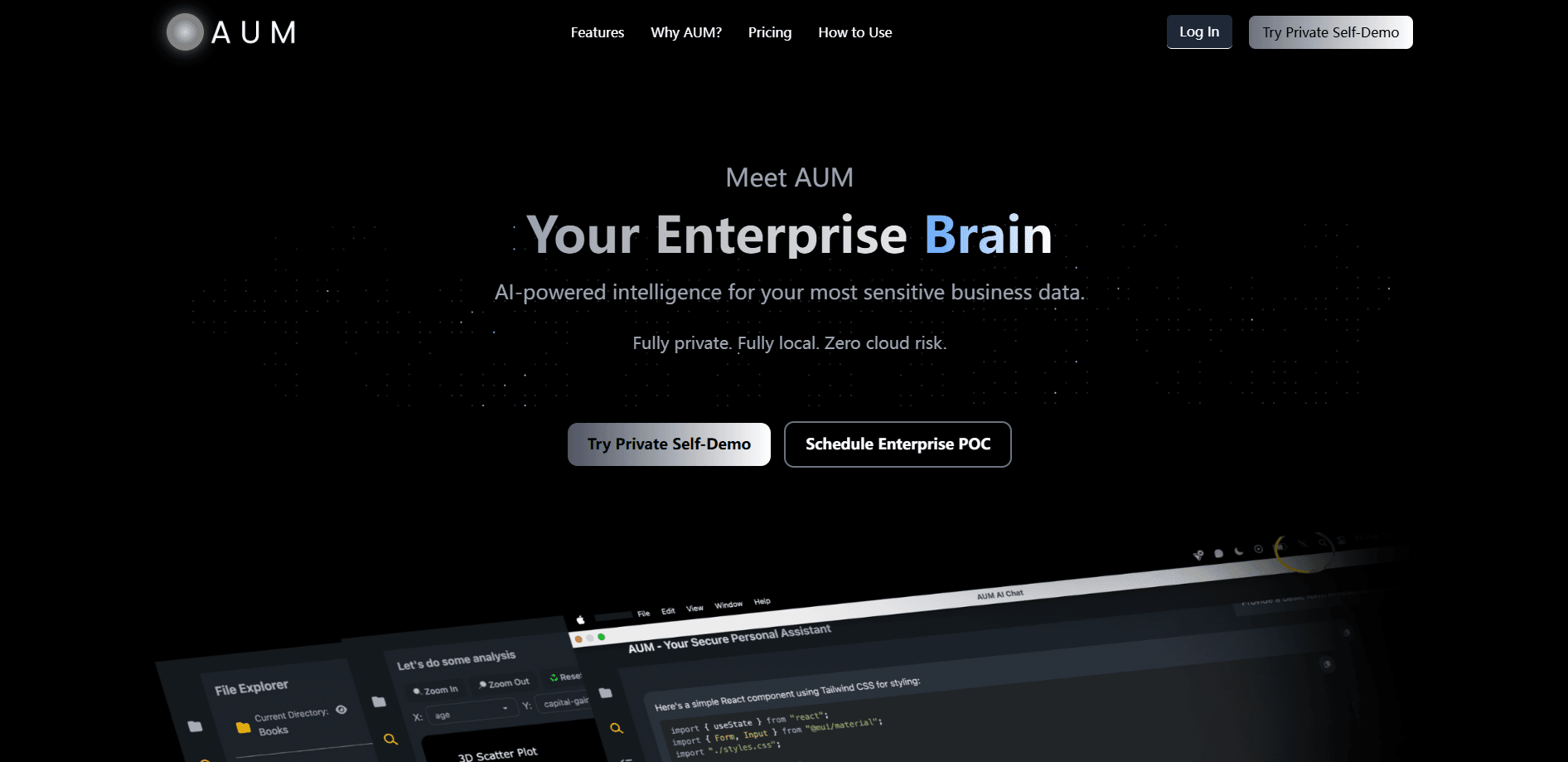
AUM is a private AI platform that runs on your own hardware. It searches files, queries databases and automates work with no cloud calls, so sensitive data never leaves your building.
About AUM
What Is AUM
AUM, from the team behind aumbot, is an AI platform for organizations that can't send their data to a cloud provider. It runs the whole stack inside your own infrastructure, on a server in your office or a private cloud you control. You point it at the files, contracts and databases you already have, then ask questions in plain language and get answers back.
The product exists because cloud AI tools hand your documents to a third party. For a law firm, a hospital or a bank, that trade is often a non-starter. Compliance rules like HIPAA and GDPR turn a simple chatbot into a legal review, and API bills scale with every query. AUM takes the opposite path: deploy locally, keep the data on site, and run open models such as Mistral, DeepSeek or Llama 3 on your own machines.
Two limits are worth knowing before you buy. Running large models locally needs real hardware, so a machine with a decent GPU and enough memory is the entry cost, not a monthly fee. And because the tool is built for private infrastructure, there's no public demo sandbox where you can try it with your own files.
Getting Started
- Check the hardware you have, since AUM runs on your own servers, a private cloud or an air-gapped machine
- Install AUM on that infrastructure and connect the folders, files and databases you want it to read
- Build a custom AI brain for a team or process, like HR or standard operating procedures
- Ask questions or set up workflows, then review answers and data analysis in the interface
Product Information
A quick look at AUM's pricing, supported platforms, and performance.
Best for
The users, tasks, and scenarios where this tool fits best.
Users
- Law firms
- Healthcare teams
- Financial institutions
- Government and defense teams
- Consulting firms
Tasks
- Private file search
- Database queries
- Document and proposal drafting
- Multi-file analysis
- Workflow automation
Scenarios
- Regulated industries
- Remote and offline sites
- Client confidentiality
- High-volume document review
- Data sovereignty requirements
Key features
Fully Local Deployment
AUM runs the entire AI stack on hardware you own. There are no cloud dependencies and no external API calls, so every query stays inside your infrastructure. You can deploy on on-premise servers, inside a private cloud or VPC, on an air-gapped machine with no internet at all, or spread across several local devices. The point is that you keep the infrastructure control, not a vendor.
Secure Private File Search
AUM searches across your documents, folders and private files in seconds, and it holds up when the pile runs into millions of records. It works over the files you already have, whether that's PDFs, contracts, reports or internal notes. That means you stop digging through folders by hand and start asking the AI where a clause or figure lives. The search runs locally, so nothing is uploaded to index it.
Custom AI Brains for Teams
You can build a dedicated enterprise AI brain for different teams or processes. A company might train one brain on HR policy, another on standard operating procedures, and a third for a specific department. Each one answers from the knowledge you give it rather than from the open web, which keeps answers on topic and grounded in your own material. That separation also lets you decide who can query which brain.
Talk to Your Databases
AUM connects to your business databases and lets you query them in everyday language. Instead of writing SQL or asking an analyst, you ask the question the way you'd ask a colleague and get the result back. It's aimed at people who want to run data analysis and answer hard business questions without being a data specialist. Answers come from your live data, not an outside copy.
Workflow Automation Across Apps
AUM can act on your behalf, not just answer questions. Ask it to create documents, draft proposals, send emails or write into Notion, and it does those steps as part of a task. This is what turns the tool from a search box into something that saves real time, since the AI finishes the work instead of handing you instructions. The automation runs against your internal systems.
Open-Source Model Support
AUM works with open models such as Mistral, DeepSeek, Llama 3, Mixtral, plus lighter ones like Falcon, Phi-3 and BERT. You pick the model that fits your hardware and use case, and the platform lets you access newer models on your own machines without paying extra for them. The only real requirement is a machine with enough free computing power to run them.
Compliance-Ready Architecture
The platform is built around the rules that block cloud AI in regulated work. AUM describes its architecture as aligned with HIPAA, GDPR and SOC 2, with role-based access control so you set granular permissions for who sees what. Because data stays on site, client confidentiality and internal IP stay under your control. This is the feature that usually decides whether a firm can adopt AI at all.
Pros and cons
Pros
- Keeps sensitive data on your own hardware, with no cloud calls or external APIs
- Runs fully offline, including air-gapped and remote setups where cloud tools can't reach
- Works with open models like Mistral, DeepSeek, Llama 3 and Mixtral, so you're not locked to one vendor
- Searches across millions of files and lets you query databases in plain language
- Free version available without cutting off AI access, and no per-query API bill
- Role-based access control and compliance-aligned design fit regulated industries
Cons
- Running large models locally needs serious hardware, so the real entry cost is a capable machine
- No cloud version and no public sandbox, which makes it hard to test before you commit
- Setup is aimed at organizations with IT staff, not individual users who want a quick sign-up
- Some advertised features, like the email and calendar assistants, are listed as coming soon rather than available now
Frequently asked questions
AUM is a private AI platform and offline AI assistant that runs entirely on your own hardware. It searches your files, queries your databases and automates tasks without sending anything to a cloud provider, so sensitive business, legal or patient data stays on your premises.
Related content
Explore related tools, skills, and articles for AUM.
AUM Alternatives

Rival Workshop
Rival · Coding · ProductivityRival Workshop is a local app that puts every skill and rule file in your repo on a shelf, so you can see what Claude Code, Codex or Cursor loads before each task.

Octri.dev
Octri, LLC · CodingOctri.dev turns one OpenAPI spec into a documentation site, client SDKs in ten languages, an MCP server for AI agents and production monitoring for those SDKs.

CoreSpeed
CoreSpeed · Coding · ProductivityCoreSpeed is an MCP server that gives AI agents connected apps, shared memory and thousands of built-in tools behind one sign-in, with credits and spend caps on every call.