

AxWise - AI User Discovery Engine
AxWise GmbH · Productivity
AxWise is a cognitive decision layer for agentic work. It takes a vague goal, resolves who the work is really for and what outcome matters, sorts what's known from what's still a guess, and returns an execution brief plus a ranked agent or team to carry the task out. It's AI decision intelligence aimed at one narrow job. Teams use it to pick the right AI worker before anything runs, and the open-source core can be self-hosted inside an existing product or agent stack.
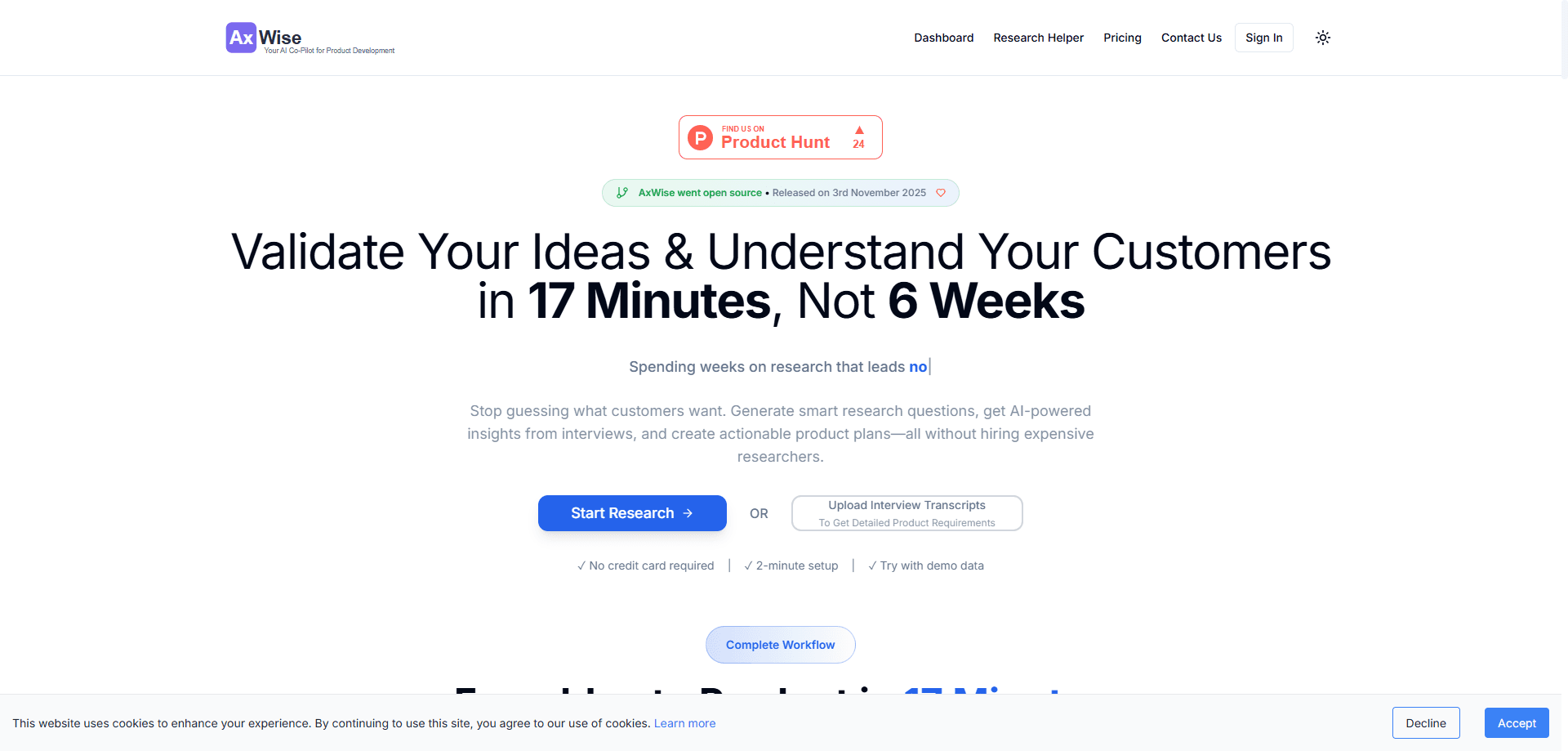
About AxWise - AI User Discovery Engine
What Is AxWise
AxWise is a decision intelligence platform built for teams that hand work to AI agents. Its job is the part most tools skip: figuring out the actual problem before an agent starts acting. You give it a goal in plain language, and it returns an evidence-bounded execution brief that names the customer, the outcome, the open questions, and the capabilities the task requires.
The product treats evidence differently from inference. Quote-backed fields keep the speaker, source document, and exact wording, so you can tell a verified customer statement apart from a model's guess. Synthetic research gets flagged as a hypothesis rather than passed off as fact. That distinction matters. A wrong premise sends an entire workflow in the wrong direction.
AxWise advises, it doesn't authorize. Every recommendation needs approval from the host system it's embedded in. What happens if nobody approves? Nothing runs. In its current reference setup, a companion platform called Orqaly checks identity, budgets, and connector permissions before any external action fires. The core is open source and self-hostable, which is the main limitation to plan around: this is evidence-aware infrastructure for teams with some engineering capacity, not a finished consumer app.
Getting Started
- Create an account or clone the open-source core from the AxWise GitHub repository if you plan to self-host.
- Describe your goal in plain language, including context about who the work is for and the outcome you want.
- Let AxWise resolve the problem owner, decision-maker, evidence, and required capabilities into an execution brief.
- Review the ranked agents or teams it returns, checking every quote-backed claim against its source.
- Approve a recommendation inside your host system, which authorizes the downstream agent to act.
Product Information
A quick look at AxWise - AI User Discovery Engine's pricing, supported platforms, and performance.
Best for
The users, tasks, and scenarios where this tool fits best.
Users
- Product and operations teams
- Platform engineers and AI builders
- Research and discovery leads
Tasks
- Turning a symptom into a defined problem
- Choosing between agents or teams
- Tracking evidence provenance
Scenarios
- Early-stage discovery on a process problem
- Bounded agent handoffs
- Building an evidence-aware workflow into a product
Key features
Goal-to-Brief Resolution
AxWise takes a loosely stated goal and works out the pieces a team usually skips. It identifies who the work is for, which outcome matters, what's known, what's uncertain, and which capabilities the task needs. The output is an execution brief a person can act on, not a chat transcript to interpret.
Evidence-Bounded Personas
Customer and persona fields keep their source. Each one can hold the speaker, the source document, the exact quote, and character offsets for field-level review. AxWise keeps quoted evidence separate from model inference, so you can see which parts of a profile came from real input and which were filled in by the model.
Hypothesis Labeling for Synthetic Research
When research data is synthetic or inferred, AxWise marks it as a hypothesis instead of verified truth. This keeps a model's educated guess from quietly turning into a fact that later decisions rest on. For teams running discovery at speed, that labeling is the difference between a useful draft and a misleading one.
Agent and Team Ranking
Given the resolved brief, AxWise ranks existing agents or teams by how well each fits the specific goal. A discovery specialist might rank above a process specialist while evidence is still thin, then fall behind once verified facts firm up the problem. The fit signals behind each ranking are shown, not hidden. Which agent fits changes as the facts change.
Self-Hostable Cognitive API
The open-source core can run inside your own product or agent stack through a self-hostable API. You embed the decision logic where your workflow already lives rather than routing everything through a separate tool. Self-hosting also keeps sensitive customer context on your own infrastructure. No external dashboard required.
Authorization Boundary
AxWise returns recommendations that a host system has to approve before anything external runs. In the reference integration, validation covers tenant ownership, identity, agent availability, approval, budget, and connector permissions. The layer advises; your system decides what's allowed to execute.
Inspectable Decision Trace
Every recommendation comes with a decision trace showing how AxWise got from the goal to the handoff. You can follow each step, including the point where it decided whether more research was worth doing. That audit trail is what makes the recommendations reviewable instead of automatic.
Pros and cons
Pros
- Separates verified evidence from model inference, which cuts down on decisions built on invented facts.
- Ranks agents by goal-specific fit and shows the signals behind each ranking.
- Open-source core can be self-hosted, keeping sensitive customer context on your own infrastructure.
- The authorization boundary keeps a host system in control of what actually executes.
- Decision traces make each recommendation auditable rather than a black box.
Cons
- No free plan and pricing is only available through sales, so you can't test costs up front.
- No native mobile app. Everything runs through the web console or your own API integration.
- The current hosted reference workflow is tuned for Orqaly, so other setups need more wiring.
- It's infrastructure, not a plug-and-play tool. You need developer time to get real value from it.
Frequently asked questions
It converts a vague goal into an evidence-bounded execution brief and then recommends the agent or team best suited to the work. Along the way it separates confirmed facts from hypotheses and returns an auditable trace of how it reached its recommendation.
Related content
Explore related tools, skills, and articles for AxWise - AI User Discovery Engine.
AxWise - AI User Discovery Engine Alternatives

Swms
Swms AI · Writing · Productivity · BusinessSwms is an AI safety compliance tool that turns a plain description of a job into ready-to-use safety documents. Describe your project, trade, and known hazards, and it writes a safe work method statement, job hazard analysis, safe work procedure, RAMS, or safety data sheet in seconds. It also ships with Oscar, a chat assistant that answers workplace safety questions in any language. Teams in construction, mining, transport, and warehousing use it to cut the paperwork that usually eats into a workday.

Wordly AI Translation
Wordly · Voice & Language · ProductivityWordly AI Translation is a real-time AI translation and captioning platform built for meetings, conferences, and events. It delivers live translation, captions, transcripts, and summaries in more than 60 languages, and attendees join by scanning a QR code or opening a link instead of using dedicated headsets. The platform works with Zoom, Microsoft Teams, Google Meet, and Webex, and it's designed for organizations that want multilingual access without hiring human interpreters for every session. Simple as that.

Rows
Rows (Superhuman) · Productivity · BusinessRows is an AI spreadsheet and data analysis tool that imports live data from more than 50 sources, then lets you work with it using plain language instead of SQL queries or nested formulas. You can pull numbers out of PDFs, connect ad platforms, databases, and bank accounts, and ask the AI to build reports, merge datasets, or set up models that recalculate themselves. It runs in the browser, works like a spreadsheet, and now sits under the Superhuman umbrella.