

BestDefense.io
BestDefense.io · Coding
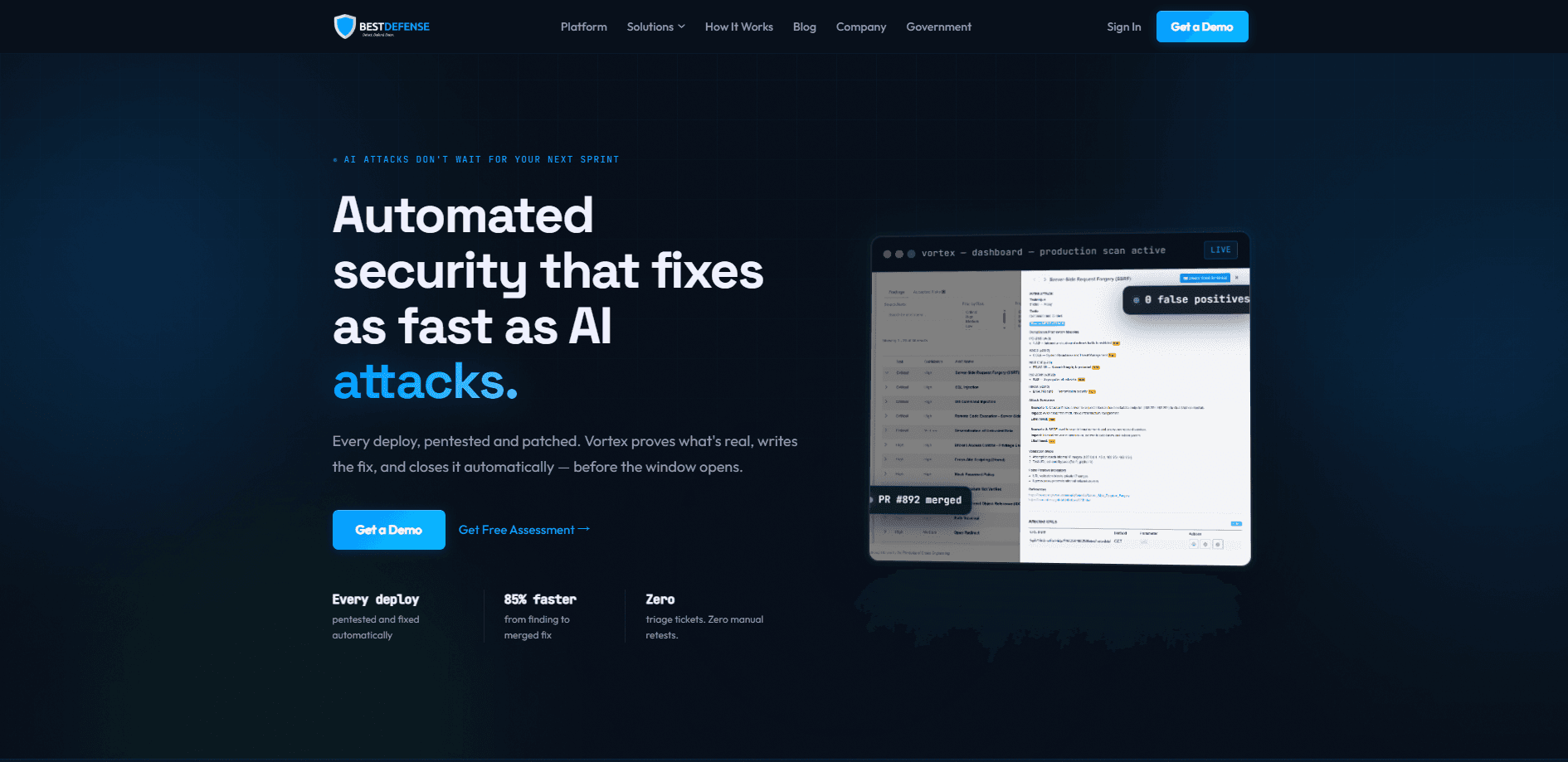
BestDefense.io is a continuous security validation platform built around its Vortex engine. It maps your attack surface on every deploy, runs exploit-confirmed AI pentests, writes code-fix pull requests for what it finds, re-tests the original exploit chain, and generates audit-ready compliance evidence. Think of it as automated pentesting that runs on your own machine before code ever reaches the main branch. It's aimed at engineering and security teams that ship often and can't keep a manual pentest schedule in step with their release cycle.
About BestDefense.io
What Is BestDefense.io
BestDefense.io targets a gap most teams know well: code ships far faster than security testing. Its own site claims you ship 66 times more often than you test. Vortex tries to close that gap by running the full loop, map, pentest, fix, verify, proof, automatically rather than on a quarterly schedule.
The core idea is that a finding isn't a finding until it executes. Instead of flagging patterns that might be vulnerable, the platform tries to actually run real exploit chains, SQL injection, auth bypass, SSRF, privilege escalation, and business-logic flaws. Anything that doesn't execute never reaches your team. Why does that matter? It cuts noise, which is the main reason security alerts get ignored.
The limit is that this is a pre-commit, developer-machine tool. It runs on your machine and needs Docker. It's not a cloud dashboard you point at a running URL, so smaller teams without a CI setup or container workflow will need some setup work first.
Getting Started
- Connect your repository. BestDefense.io works with GitHub, GitLab, and Bitbucket, and links into Jira, Jenkins, SonarQube, Snyk, Slack, AWS, Azure, and GCP.
- Install Docker on the machine where Vortex will run, since pentesting executes locally before commit.
- Let Vortex map the codebase. It builds a graph of endpoints, APIs, auth flows, and dependencies at ship time.
- Review confirmed exploits and the pull requests it generates. The CI gate blocks vulnerable builds until each one is resolved.
- Set your compliance targets so closed loops produce timestamped evidence mapped to frameworks like SOC 2, ISO 27001, PCI DSS, NIST, and CMMC.
Product Information
A quick look at BestDefense.io's pricing, supported platforms, and performance.
Best for
The users, tasks, and scenarios where this tool fits best.
Users
- Dev teams that deploy several times a week
- Security engineers buried in scanner noise
- Compliance owners at startups
Tasks
- Mapping attack surface
- Fixing confirmed vulnerabilities
- Verifying that a fix held
Scenarios
- Shipping a new API endpoint
- Preparing for a SOC 2 audit
- Pre-commit checks on a developer laptop
Key features
Continuous Attack Surface Mapping
Vortex maps every endpoint, API, auth flow, and dependency the moment code ships. Coverage gets rebuilt on each deploy, so it never goes stale between releases. For teams that add endpoints faster than they can track them, this removes the manual inventory step that usually falls behind.
Exploit-Confirmed AI Pentesting
The platform runs live exploit chains instead of matching patterns. It targets SQL injection, auth bypass, SSRF, privilege escalation, and business-logic flaws. If an attack doesn't execute, it never reaches your team, which is the main reason this approach produces less noise than a traditional scanner.
Auto-Generated Code Fixes
For every confirmed exploit, Vortex writes a stack-aware patch scoped to your code and opens it as a pull request rather than a PDF report. The CI gate blocks any vulnerable build until the patch is merged. That turns a finding into a mergeable change instead of another ticket in a backlog.
Adversarial Re-Testing
After a fix lands, the platform reruns the original exploit against the patched build. If the vulnerability regressed, your team hears about it before production does. This closes the loop that most scanners leave open, where a fix is assumed to work because the alert stopped firing.
Audit-Ready Compliance Evidence
Every closed loop generates a timestamped evidence record. These are mapped to SOC 2, ISO 27001, PCI DSS, NIST, and CMMC. Instead of assembling proof by hand each quarter, the records accumulate as you work, which shortens audit prep considerably.
Graph-Native Analysis
Vortex maps your code as a graph, uses graph-guided analysis to find tainted paths, and proves every path is closed after a fix. In its own example, a taint reaching both a SQL sink and a command-exec sink in a nightly job gets fixed at both points, with each path verified closed.
Pros and cons
Pros
- Only confirmed exploits reach your team, which keeps the review queue short and readable.
- Fixes arrive as pull requests against your own code, so remediating doesn't start from a blank page.
- Re-testing after a patch means a closed finding is verified, not just marked done.
- Compliance evidence builds up automatically, cutting quarterly audit prep.
- Integrates with the tools teams already use, including GitHub, GitLab, Jira, Snyk, and Slack.
Cons
- Requires Docker and runs on your machine, so teams without a container workflow face setup before any value.
- Pricing isn't published. You have to contact sales, which makes budgeting harder up front.
- The focus is code and application security. It isn't a fit if you need network or endpoint monitoring.
Frequently asked questions
It's a continuous security validation platform. It maps your attack surface, runs AI-driven pentests that confirm exploits by executing them, generates code fixes as pull requests, re-tests the original exploit, and produces compliance evidence, all on every deploy.
Related content
Explore related tools, skills, and articles for BestDefense.io.
BestDefense.io Alternatives
Forefront
Forefront · CodingForefront is a web platform for building with open-source AI. It lets you fine-tune leading open-source language models on your own data, evaluate how they perform, and run them through an API or export them to host yourself. Developers who want the convenience of a closed-source platform but insist on owning their models and data are the target audience here.

Startkit
StartKit.AI · CodingStartkit is a boilerplate for building AI SaaS and AI wrapper products. Think of it as an AI startup boilerplate with the boring parts already wired up: authentication, Stripe and Lemon Squeezy payments, usage limits, transactional email, and an AI API starter that talks to OpenAI, Anthropic, Groq, or Llama. You clone the repo, set your price, and start on the part of your product that people actually pay for. It's Next.js under React and Tailwind, so most of the boilerplate code already feels familiar.
Testim
Tricentis · CodingTestim is an AI-powered test automation platform for building and running end-to-end tests across web, mobile, and Salesforce applications. It leans on machine learning to keep tests stable when an interface changes, so teams spend less time fixing broken selectors. Not bad for an automated testing tool you can start using today. You create tests by recording actions in a browser, then optionally add JavaScript when you need more control. It's a solid pick for busy QA teams.