

Bidmatic.io
Bidmatic Inc. · Marketing
Bidmatic.io is an ad monetization platform for publishers. It pairs a Prebid header bidding wrapper with an SSP, AI bid optimization, and video ads across web, app, and CTV.
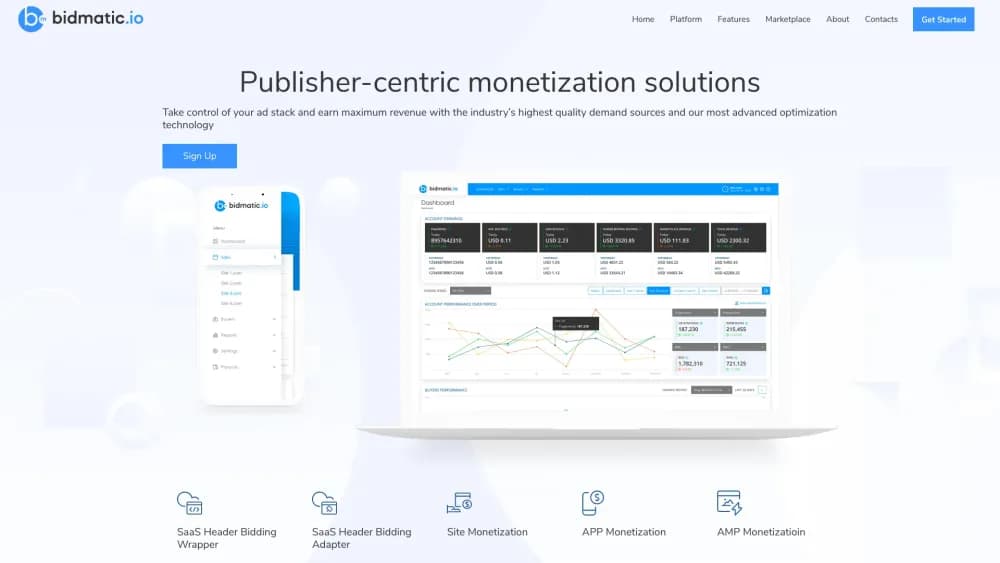
About Bidmatic.io
What Is Bidmatic.io
Bidmatic.io is the ad monetization platform run by Bidmatic Inc., a Delaware company with roots in display and video advertising going back to 2011. Publishers connect their sites to a Prebid-based header bidding wrapper, and Bidmatic sells that inventory through its own publisher SSP: direct brand deals, private marketplaces, and open market backfill. Display, video, in-app, and CTV inventory all sit in one account.
The problem it targets is simple. A site that runs AdSense alone takes whatever a single demand source offers, and it never sees the bids it lost. Bidmatic puts multiple demand partners into the same auction, then adds formats that earn more than a standard banner, like sticky units, interstitials, and outstream video. As an AdSense alternative, it works alongside Google rather than replacing it, which matters if you already have a GAM setup you trust.
Two limits shape who this fits. Onboarding runs through an account team, so there's no self-serve switch to flip and small sites may wait. Pricing is a revenue share worked out per publisher, not a published rate card, and traffic in North America, Eastern Europe, and CIS fills best. If most of your audience sits outside those regions, ask for a test before you move your whole inventory.
Getting Started
- Sign up at bidmatic.io or send the team a note about your site. Expect a short call about traffic, GEOs, and current ad stack before anything goes live.
- Add your site in the dashboard. You can test on part of your traffic first, which keeps your existing setup running while the auction data comes in.
- Pick an integration path. The managed setup gives you one code for all ad blocks, or you can take separate codes per placement for tighter control.
- Connect Google Ad Manager if you have it. If you don't, Bidmatic can provide GAM access through Google's MCM program or run a GAMless setup.
- Choose formats and floor prices, then watch the reporting. Payment terms and the revenue share come from your agreement, not from a public pricing page.
Product Information
A quick look at Bidmatic.io's pricing, supported platforms, and performance.
Best for
The users, tasks, and scenarios where this tool fits best.
Users
- Independent publishers with steady organic traffic
- Media groups running several sites
- Sites that only run AdSense
Tasks
- Raising CPM on banner inventory
- Adding video revenue without a video team
- Testing header bidding before committing
- Consolidating ad ops across web, app, and CTV
Scenarios
- A site stuck on a flat RPM for months
- A regional publisher in Central Europe
- A news site publishing dozens of articles a day
Key features
Prebid Header Bidding Wrapper
The wrapper is the core of the platform, and it's maintained rather than left on an old Prebid build. Bidmatic moved its core to Prebid 10+ in early 2026 and now lets publishers pin a custom Prebid version per site, which helps when one property needs a staged rollout. Ad unit level GEO and device filters let you show different demand partners to different traffic without rebuilding the config. A refactor cut the configuration payload by about half and trimmed average impression render time by roughly 90ms, according to Bidmatic's own release notes.
Direct Demand and Curated Marketplaces
Bidmatic's SSP mixes three demand sources. Direct brand and agency deals bring higher CPMs and fewer intermediaries. Private marketplaces package inventory for specific GEOs, verticals, or premium slots, which is where regional publishers get the most out of it. Open market backfill picks up the remnant impressions that premium campaigns leave behind. Publishers can also block whole advertiser categories, which is the difference between a clean ad experience and a page full of junk.
AI Bid and Viewability Signals
The platform handles ad revenue optimization in real time instead of waiting for a weekly manual review. Its Prebid adapter also ships a viewability prediction module that scores an impression before the bid request goes out, so buyers can bid on the placements likely to be seen. That module needs Prebid 10.24 or newer, and publishers have to update to use it. For a publisher, the practical effect is that good placements get priced higher and weak ones stop dragging the average down.
High-Impact Display Formats
The display lineup goes well past standard IAB sizes. Sticky billboards, adhesion units, sidewalls, background takeovers, half-screen placements, and dynamic in-content auto-insert are all available, plus a Superflex unit that lets several smaller bids compete against a large one. Interstitials became a standalone programmatic channel in 2026, so buyers can target full-screen inventory directly instead of finding it inside a mixed banner pool. Each format is a separate switch, which is useful because stacking all of them at once is a fast way to wreck page speed.
Video and CTV Monetization
Video runs on VAST and covers in-stream pre, mid, and post-roll, outstream, accompanying content, and rewarded units. The same demand stack serves web players, mobile apps, smart TVs, and streaming, with server-side ad insertion for linear CTV. In-app inventory supports banner, interstitial, native, and rewarded video through SDK or server-to-server bidding. For a publisher with a video player and a website, that means one partner for both rather than two sets of tags and two invoices.
AI Video Content with HeroVideo
HeroVideo, Bidmatic's separate AI video product, turns published articles into narrated videos with an avatar and visuals, then overlays the player on the article's hero image. Videos come out formatted for YouTube, TikTok, and Instagram, so the same piece of content can earn on site and feed a social channel. Ads are on by default, which is the point: the video creates inventory that didn't exist before. It's the clearest example of the AI video ads angle, and it's optional if you only want the monetization side.
Reporting and Managed Ad Ops
Reports run in real time and break revenue down by site, placement, and demand partner, which is enough to see which format actually pays. Publishers who don't want to run ad ops themselves can hand over the whole stack: Bidmatic handles setup, optimization, and day-to-day management. The team also runs a brand safety scoring process with category exclusions, so you're not manually auditing every creative that lands on your page.
Pros and cons
Pros
- One integration covers display, video, in-app, and CTV, so you're not stitching three vendors together.
- The Prebid wrapper gets real updates: Prebid 10+, custom core versions, per ad unit GEO and device filters, and a viewability module.
- There are no integration fees and no long-term contract, which makes a side-by-side traffic test low risk.
- Direct and PMP demand is strong in Central Europe, a region where global exchanges often underpay.
- HeroVideo turns an existing article archive into video inventory without a production team.
Cons
- Pricing is a negotiated revenue share, so you can't model take-home pay from the website before a sales call.
- Setup is managed. There's no self-serve path from signup to live ads, and small sites may sit in a queue.
- Demand is thickest in North America, Eastern Europe, and CIS. Traffic from other regions may see thinner competition.
- Formats are switched on individually, and a site that enables too many at once will feel the page weight in Core Web Vitals.
Frequently asked questions
Bidmatic.io monetizes publisher inventory. It runs a header bidding auction across multiple demand partners, sells display, video, in-app, and CTV placements through its SSP, and reports what each placement earns. Publishers use it to replace a single-source setup like AdSense or to add a second demand channel next to an existing wrapper.
Related content
Explore related tools, skills, and articles for Bidmatic.io.
Bidmatic.io Alternatives

Tractionwave
TractionWave · Image · MarketingTractionWave is an AI attention heatmap tool for static ads. Upload a PNG or JPG and it returns predicted attention, ranked hotspots, and fixes before you spend budget.

OpenSEO - AI Visibility
EveryApp · Coding · Marketing · BusinessOpenSEO is an open source SEO platform for keyword research, backlinks, rank tracking, site audits, and AI visibility, with usage-based pricing and MCP access for AI agents.

Plugins Radar
Plugins Radar · Marketing · BusinessPlugins Radar tracks where your ChatGPT plugin ranks in directory and in-chat search, which competitors outrank it and what changed, with hourly checks on 9,885 listings.