

Bitrise
Bitrise Ltd. · Coding
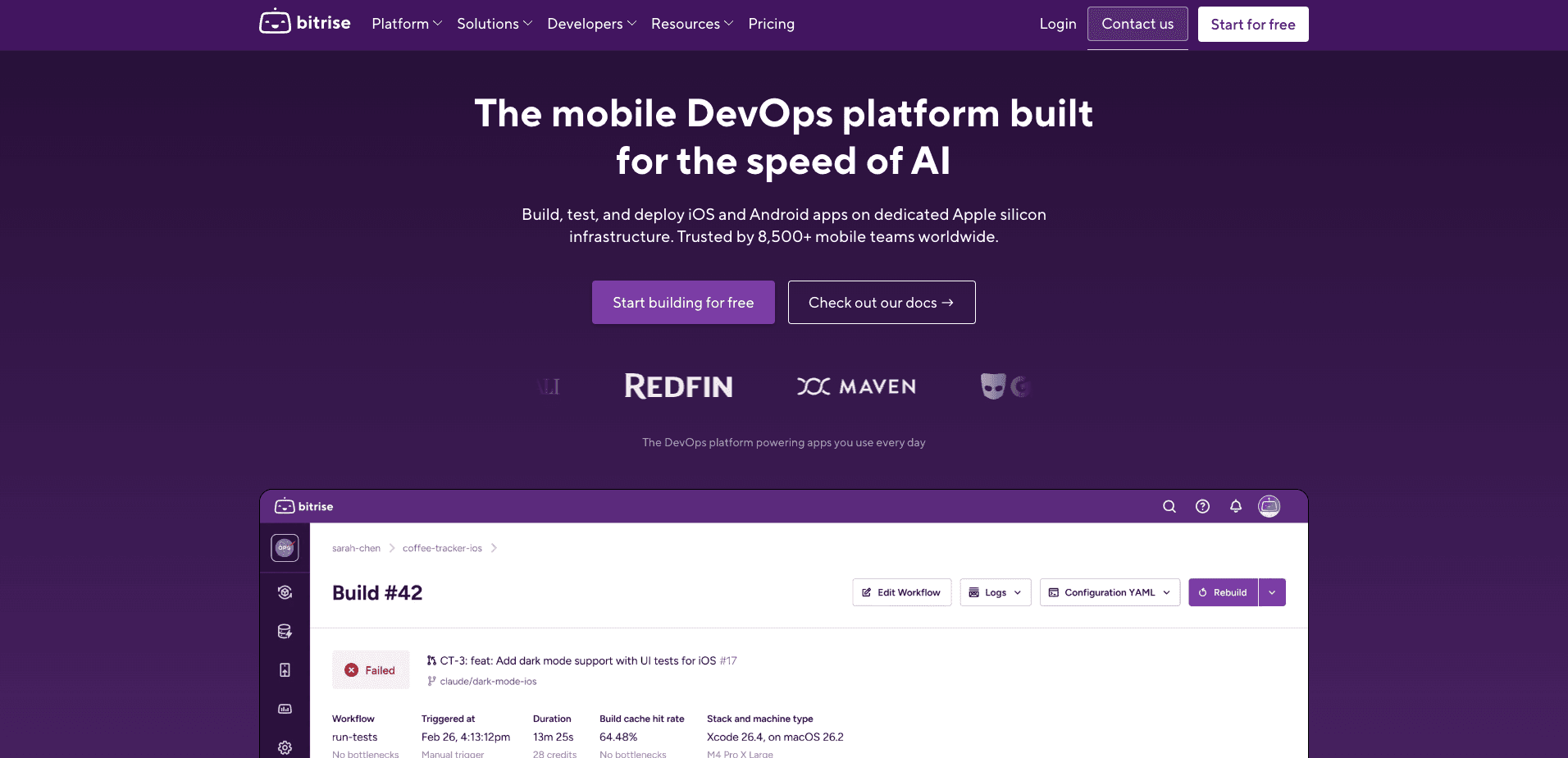
Bitrise is a mobile DevOps platform for building, testing, and shipping iOS and Android apps without babysitting your own build machines. It runs continuous integration for mobile apps and continuous delivery (CI/CD) on managed macOS and Linux infrastructure, so a push to your repo triggers a build, your tests run, and a signed release goes out to testers or the store. It's built for mobile teams that want Apple silicon and fresh Xcode without maintaining the servers themselves. Fair warning: the free tier is small, and paid tiers climb fast.
About Bitrise
What Is Bitrise
Bitrise is a cloud service that handles the build, test, and release pipeline for mobile apps. You connect a Git repository, pick a stack, and the platform compiles your code on dedicated machines, runs your test suite, and distributes the result to wherever your team needs it. The pitch is simple. Your team writes app code, and Bitrise runs the machinery that turns that code into something installable.
The main problem it solves is hardware and maintenance, and for most mobile teams the trade-off is straightforward. Building iOS apps legally requires macOS, which means either buying Mac minis or renting them from someone who already has the racks and the ops staff to keep them running. Bitrise gives you managed Apple silicon on demand. It also keeps its stacks current. According to the company, a new Xcode version lands on the stack within 24 hours of Apple's release. That matters, because an outdated Xcode can block you from shipping at all.
The big limitation is cost at scale, because the plans are priced for teams that already have steady build volume rather than occasional users. The free Hobby tier covers one developer with a small monthly build allowance. Serious throughput pushes you into the Starter and Pro plans quickly. It's also a mobile-first platform. If your main pipeline is a large web or backend monolith, a general-purpose CI provider may fit your budget better.
Getting Started
- Sign up at bitrise.io with your GitHub, GitLab, or Bitbucket account.
- Connect the repository you want to build and let the setup wizard scan it.
- Confirm the detected stack and let Bitrise generate a starter workflow for your platform.
- Trigger your first build by pushing a commit or hitting the run button in the dashboard.
- Add signing credentials and a distribution step when you're ready to send builds to testers.
Product Information
A quick look at Bitrise's pricing, supported platforms, and performance.
Best for
The users, tasks, and scenarios where this tool fits best.
Users
- Indie iOS developers
- Small mobile teams
- Growing engineering orgs
Tasks
- iOS build automation
- Android build automation
- Flaky test cleanup
- App distribution
Scenarios
- Shipping a cross-platform app
- Pre-release smoke testing
- Keeping up with Apple's release cycle
Key features
Managed Apple Silicon Build Infrastructure
Bitrise runs your iOS builds on dedicated macOS machines, including M2 Pro Large instances on higher plans. You don't provision, patch, or scale the hardware yourself. For teams without a physical Mac farm, this removes the biggest practical blocker to automated iOS delivery. No Mac army required.
400+ Prebuilt Steps
The platform ships with over 400 integration steps covering iOS, Android, React Native, and Flutter. A step is a reusable pipeline action, like running a test framework or uploading a finished build to the app store. Instead of maintaining custom scripts that rot over time, you assemble a workflow from building blocks that someone else keeps working.
Flaky Test Quarantining
Random test failures are one of the most common reasons teams stop trusting their pipeline. Bitrise detects flaky tests and moves them out of the blocking path automatically. It then reruns only what failed rather than the whole suite. Your team fixes the quarantined test before it rejoins the run. Shipping on a coin flip is no way to work.
Managed Code Signing
iOS and Android signing certificates are a classic source of leaked secrets. Bitrise stores credentials separately from your source code and injects them at build time. That keeps private keys out of your repository. Builds still produce signed, installable artifacts. No certificate in Git. Good.
Concurrent Builds and Elastic Scaling
Higher plans let several builds run at once, up to 10 on Pro with flexible scaling for Linux when your throughput climbs beyond the standard allowance. For a team merging code all day, parallel builds mean a queue of pull requests doesn't turn into an hour-long wait. Pay-As-You-Go and extra build capacity options handle occasional spikes. What does that save you? Hours, every week.
Release Management Hub
Bitrise Release Management gives you one place to track where each build sits as it moves from internal testing through store submission. It's free on the Basic plan, so distribution visibility doesn't require an enterprise contract.
Bitrise Insights
Insights surfaces trends in your CI/CD health, like which builds and tests cause the most trouble over time, so you can spot the slow step or unstable suite that keeps eating your team's afternoons. It starts at $12.50/mo and helps teams find the pipeline bottlenecks that quietly cost hours every week.
Security and Compliance
Bitrise holds SOC 2 Type 2 and PCI-DSS certifications, and it states it's GDPR compliant, with AES-256 encryption at rest protecting the build artifacts and credentials the platform stores on your behalf. For teams selling into regulated markets, these certifications can be the difference between a workable vendor and a blocked one.
Pros and cons
Pros
- Managed macOS and Apple silicon removes the need to run your own Mac build fleet.
- Fresh Xcode within 24 hours of Apple's release keeps iOS delivery unblocked.
- 400+ prebuilt steps cut the maintenance burden of custom CI scripts.
- Free Hobby plan lets you try real mobile CI/CD before paying anything.
- SOC 2 Type 2 and PCI-DSS certifications suit security-conscious teams.
Cons
- Pricing scales fast. The free tier covers one developer with a limited build allowance, so any real team pays from $89/mo.
- It's mobile-first, so non-mobile pipelines get less value than from a general-purpose CI provider.
- Some advanced speed features like Build Cache start around $600/mo. Steep for small teams.
Frequently asked questions
Bitrise automates the build, test, and release process for iOS and Android apps. You connect a repository, and it compiles your code, runs tests, and distributes signed builds to testers or stores on managed infrastructure.
Related content
Explore related tools, skills, and articles for Bitrise.
Bitrise Alternatives
Forefront
Forefront · CodingForefront is a web platform for building with open-source AI. It lets you fine-tune leading open-source language models on your own data, evaluate how they perform, and run them through an API or export them to host yourself. Developers who want the convenience of a closed-source platform but insist on owning their models and data are the target audience here.

Startkit
StartKit.AI · CodingStartkit is a boilerplate for building AI SaaS and AI wrapper products. Think of it as an AI startup boilerplate with the boring parts already wired up: authentication, Stripe and Lemon Squeezy payments, usage limits, transactional email, and an AI API starter that talks to OpenAI, Anthropic, Groq, or Llama. You clone the repo, set your price, and start on the part of your product that people actually pay for. It's Next.js under React and Tailwind, so most of the boilerplate code already feels familiar.
Testim
Tricentis · CodingTestim is an AI-powered test automation platform for building and running end-to-end tests across web, mobile, and Salesforce applications. It leans on machine learning to keep tests stable when an interface changes, so teams spend less time fixing broken selectors. Not bad for an automated testing tool you can start using today. You create tests by recording actions in a browser, then optionally add JavaScript when you need more control. It's a solid pick for busy QA teams.