

BotSailor
Xerone IT · Coding · Marketing · Chatbot
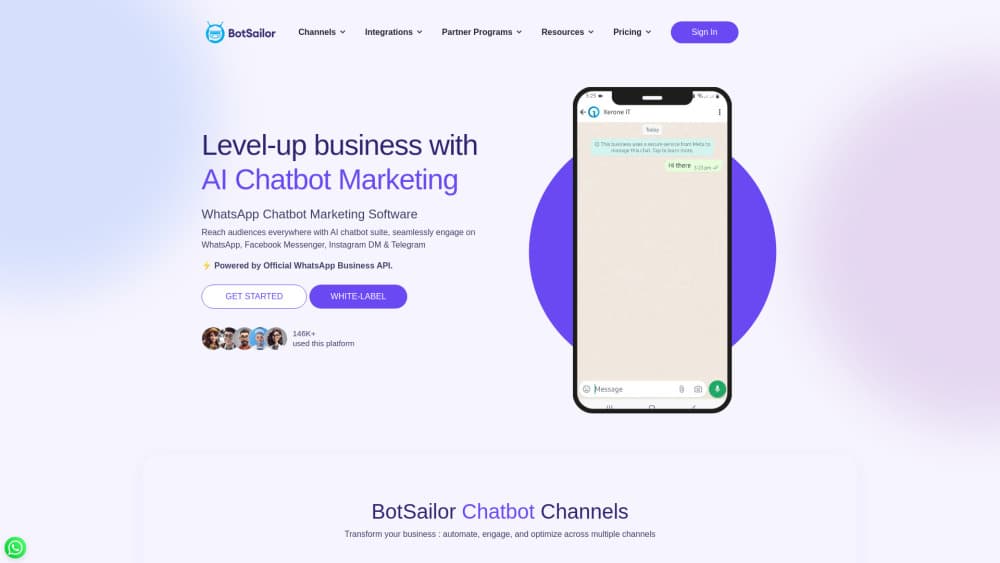
BotSailor is an AI customer engagement platform. It builds specialized AI agents and chatbot automation for WhatsApp, Instagram, Messenger, Telegram, and websites, so businesses can sell, support, and automate conversations from one place.
About BotSailor
What Is BotSailor
BotSailor is a SaaS platform for conversational automation and marketing. Its core idea is a team of specialized AI agents: you create one agent for sales, another for support, another for lead qualification, and BotSailor routes each incoming chat to the right one. Each agent uses your business knowledge, keeps context, and can take real actions such as collecting data, updating fields, calling an API, or handing the chat to a human.
The company comes from the team behind Xerone IT, based in Rajshahi, Bangladesh. That team worked on chatbot software since 2016 through ChatPion, and in 2021 it founded BotSailor through Muraduzzaman Konok, Al-Amin Jwel, and Mostofa Zaman with a global focus. BotSailor runs on the official WhatsApp Business API and also covers Facebook Messenger, Instagram, Telegram, and a website chat widget. Part of its business is white label: agencies can run their own branded automation SaaS on top of BotSailor's infrastructure.
The limits are worth knowing. WhatsApp itself charges for message delivery on top of the BotSailor plan, so your real cost is higher than the subscription alone. The free plan caps you at 200 subscribers and 200K AI tokens a month, which fits testing rather than a live business. And a multi-agent setup with ecommerce and deep integrations takes real configuration, so it rewards teams willing to build rather than plug in and go.
Getting Started
- Create a BotSailor account and connect WhatsApp, Instagram, Messenger, Telegram, or website chat in a couple of steps.
- Build one or more AI agents and give each the business knowledge it needs, from documents, URLs, or FAQs.
- Use the visual flow builder to lay out journeys with conditions, data, APIs, and AI, without writing code.
- Connect your store or tools, such as Shopify, WooCommerce, Google Sheets, or your own API, so chats can trigger actions.
- Test on the free plan, then upgrade as subscriber and AI token needs grow.
Product Information
A quick look at BotSailor's pricing, supported platforms, and performance.
Best for
The users, tasks, and scenarios where this tool fits best.
Users
- Small and mid-size businesses that sell on WhatsApp
- Support teams buried in repeated questions
- Ecommerce stores on Shopify or WooCommerce
- Agencies and entrepreneurs who want their own product
Tasks
- Running WhatsApp campaigns at scale
- Qualifying and routing leads
- Recovering abandoned carts
- Automating one channel across many touchpoints
Scenarios
- A retail brand that answers the same order questions all day
- A real estate office taking property inquiries after hours
- An agency launching its own SaaS
Key features
AI agents by business role
BotSailor's headline feature is a multi-agent system. You build dedicated agents for sales, support, lead qualification, or ecommerce, and each one draws on its own knowledge. When a message arrives, the platform routes it to the agent that fits, and that agent keeps the context of the conversation. Agents can also collect customer data, update custom fields, trigger flows, call external APIs, and pass the chat to a human when a person is the better answer. For a support team, that means the routine questions resolve themselves while the hard ones reach a person with the history already attached.
Visual flow builder
The flow builder is where the automation logic lives. You lay out customer journeys with conditions, data lookups, API calls, and AI steps, all on a visual canvas with no code. Teams use it for interactive journeys that ask one question at a time, validate each reply, and save it to the right field. It also handles behavior triggers, such as responding when someone clicks, replies, or reaches a set follower condition on Instagram. The point is that a marketer can build and change a journey without waiting on engineering.
Omnichannel shared inbox
Conversations from WhatsApp, Instagram, Messenger, Telegram, and web chat land in one inbox. A team member opens a thread and sees the unified profile, full history, tags, assignments, notes, and interaction data, so they reply with context instead of guessing. Automated actions and human replies sit side by side, and the inbox supports notes, labels, and smart actions to keep a busy queue organized. For a small team, this is often the feature that replaces several disconnected tools.
WhatsApp broadcasting and campaigns
Broadcasting is BotSailor's most used feature. You build a campaign with approved templates, custom fields, and audience segments, then send to opted-in subscribers with throttling that respects WhatsApp limits. Delivery reports show what landed. Around it sit sequence campaigns for follow-ups, social posting for Facebook and Instagram, and multi-channel messaging that pulls WhatsApp, SMS, and email into one flow. The result is outreach that feels personal and stays within the channels buyers already use.
Ecommerce and conversational commerce
BotSailor connects to Shopify, WooCommerce, and Salla to automate the shopping journey. It syncs products and order events, powers AI product discovery and recommendations, recovers abandoned carts, and handles order and payment updates. WhatsApp catalog commerce lets a shopper browse products, variants, and pricing inside the chat, and an appointment system books services with reminders and rescheduling. For a store, this turns a messaging channel into a sales channel rather than just a support line.
Integrations, API, and white label
BotSailor acts as an orchestration layer over tools you already run. It lists integrations for payments, CRMs, marketing platforms, SMS and email providers, and forms, plus an HTTP API and webhook workflow for anything else. Developers get a REST API under versioned endpoints with API-key authentication, which covers sending messages, managing subscribers, triggering flows, and embedding BotSailor AI. Agencies can go further with the white label chatbot and reseller options, running a branded platform and billing their own customers.
Pros and cons
Pros
- Covers WhatsApp, Instagram, Messenger, Telegram, and web chat in one platform, so a team manages every channel from a single inbox.
- The AI agents use your own business knowledge and can take real actions, not just send scripted replies.
- A free plan lets you test the platform and a first automation before paying anything.
- White label and reseller options let agencies turn BotSailor into their own branded product.
- Runs on the official WhatsApp Business API, which suits businesses that need a compliant route to WhatsApp messaging.
Cons
- WhatsApp charges for message delivery on top of the BotSailor plan, so the subscription is not your full cost.
- The free plan's 200 subscriber and 200K AI token limits are too low for a live business, so growth means paying quickly.
- Building a multi-agent setup with ecommerce and deep integrations takes real configuration time.
- A feature set this broad takes a while to learn, and small teams may only use a fraction of it at first.
Frequently asked questions
BotSailor builds AI agents and chatbot automation for customer conversations. Businesses use it to sell, support, and market across WhatsApp, Instagram, Messenger, Telegram, and websites, plus to run broadcasts, recover carts, and manage chats from one inbox.
Related content
Explore related tools, skills, and articles for BotSailor.
BotSailor Alternatives
Forefront
Forefront · CodingForefront is a web platform for building with open-source AI. It lets you fine-tune leading open-source language models on your own data, evaluate how they perform, and run them through an API or export them to host yourself. Developers who want the convenience of a closed-source platform but insist on owning their models and data are the target audience here.

Startkit
StartKit.AI · CodingStartkit is a boilerplate for building AI SaaS and AI wrapper products. Think of it as an AI startup boilerplate with the boring parts already wired up: authentication, Stripe and Lemon Squeezy payments, usage limits, transactional email, and an AI API starter that talks to OpenAI, Anthropic, Groq, or Llama. You clone the repo, set your price, and start on the part of your product that people actually pay for. It's Next.js under React and Tailwind, so most of the boilerplate code already feels familiar.
Testim
Tricentis · CodingTestim is an AI-powered test automation platform for building and running end-to-end tests across web, mobile, and Salesforce applications. It leans on machine learning to keep tests stable when an interface changes, so teams spend less time fixing broken selectors. Not bad for an automated testing tool you can start using today. You create tests by recording actions in a browser, then optionally add JavaScript when you need more control. It's a solid pick for busy QA teams.