

Breadcrumb
Breadcrumb · Coding
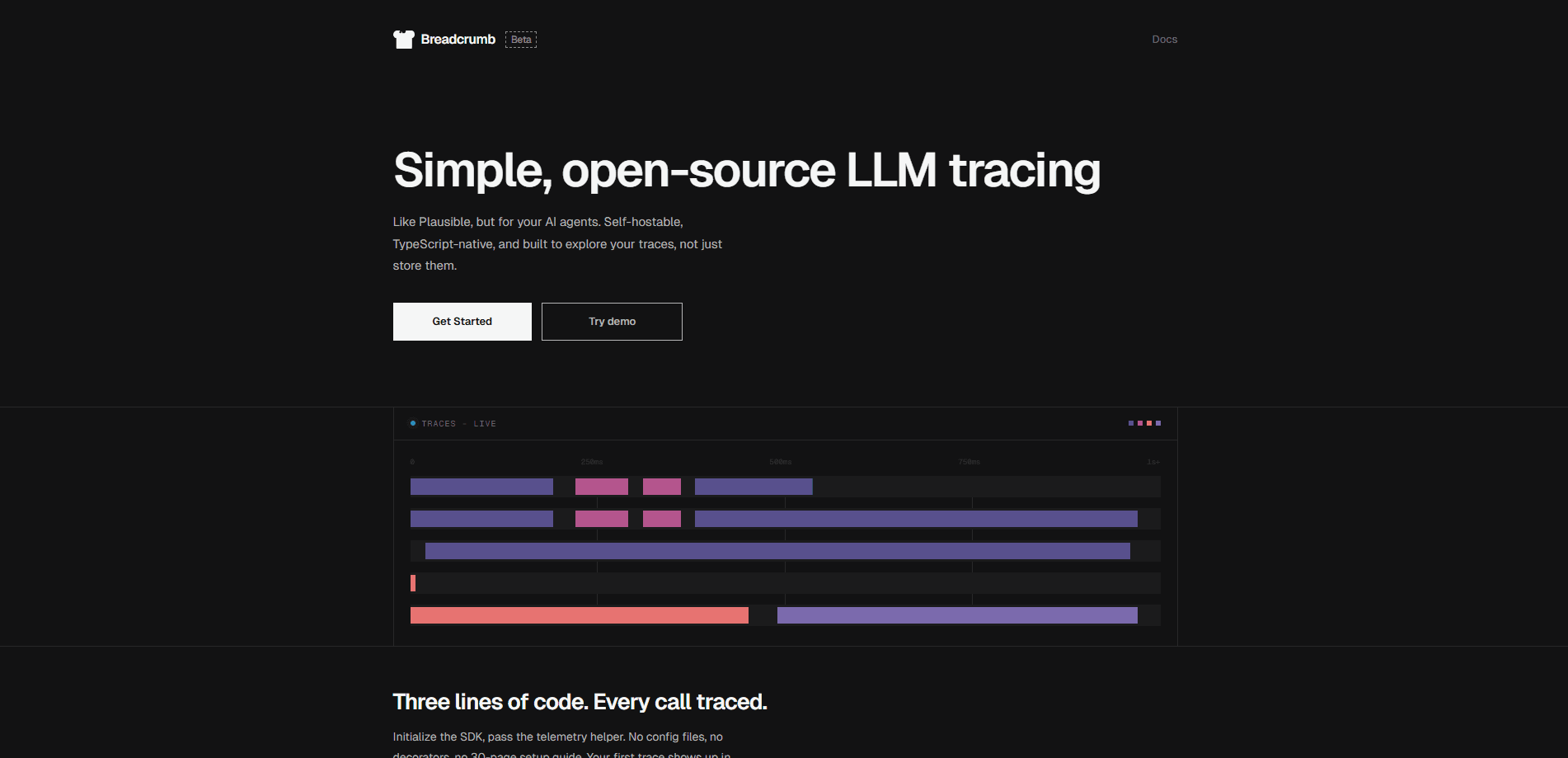
Breadcrumb is an LLM tracing library for TypeScript apps that installs like a code dependency instead of a hosted service. Every trace lands in the database you already run, and the dashboard ships as a component you mount inside your own app. This is self-hosted tracing, in the plainest sense. It's built for developers who want AI agent debugging with ordinary queries and their own auth, not another vendor account.
About Breadcrumb
What Is Breadcrumb
Breadcrumb is a tracing tool for teams building AI features in TypeScript. The core idea is ownership: instead of shipping your prompts and payloads to a third-party dashboard, Breadcrumb writes spans into the database your app already uses. You point one instance at your database, mount the dashboard behind your own login, and from then on your tracing data sits right next to your users table.
That layout is the point. Because spans live in your schema, you can join them with anything else you store. Want cost per customer on a billing page, or failure counts per tenant? Those are plain queries with the ORM you already know. A hosted tool can't do that. It only ever sees its own data. Breadcrumb gives you the queries, and the trade-off is that you run the storage.
The main limit is scope. Breadcrumb targets TypeScript apps built on the Vercel AI SDK. If your stack runs in Python, it won't fit. Same if you want zero setup. You also carry the database work yourself. For teams already running Postgres, that's cheap. For everyone else, it's a real cost.
Getting Started
- Install the core package and a database adapter from npm, then create a Breadcrumb instance pointed at your database and a base path.
- Mount the dashboard component in your app, protected by your own authentication.
- Instrument model calls by passing bc.telemetry() to the AI SDK where it accepts experimental_telemetry.
- Wrap the surrounding work, like retrieval, tool calls, and DB writes, in bc.trace() so it all lands on one timeline.
- Read traces in the dashboard, or hand your coding agent an MCP key and let it query them directly.
Product Information
A quick look at Breadcrumb's pricing, supported platforms, and performance.
Best for
The users, tasks, and scenarios where this tool fits best.
Users
- TypeScript developers building AI features
- Backend and platform engineers
- Small AI product teams without a dedicated observability budget
Tasks
- Debugging a slow or failing agent request
- Tracking spend per customer
- Letting a coding agent inspect production behavior
Scenarios
- Investigating why certain accounts churn
- Keeping prompt data private
- Auditing failures across tenants
Key features
Library, Not a Service
Breadcrumb installs as a code dependency, which means there's no external account or network hop for your trace data. You create one instance, point it at your database, and it runs inside your process. Nothing leaves your infrastructure unless you decide otherwise. No surprises there. For teams with strict data rules, that's often the deciding factor.
Traces in Your Own Database
Spans are normalized into a single table, breadcrumb_spans, living in the database your app already writes to. It's not an export, a webhook, or a read-only API over someone else's schema. Your analytics become ordinary queries with whatever ORM you use, so you can join traces with users, orders, or anything else you keep. Prisma users, for example, can pull the table in and treat it like any other model.
Automatic Model Instrumentation
Model calls instrument themselves. You pass bc.telemetry() where the Vercel AI SDK expects experimental_telemetry, and Breadcrumb reads the model, provider, token counts, cost, and payloads from attributes the SDK already emits. There's no manual span-building around each call. That keeps the setup small and makes it easier to add tracing to an existing project without rewrites.
Timeline Tracing with bc.trace()
The work around model calls doesn't instrument itself, so you wrap it in bc.trace(). Retrieval, tool calls, and the final database write all land on the same timeline as the model spans. When a request feels slow, you can see whether the delay sits in retrieval, a tool, or the model itself, rather than guessing.
MCP Access for Coding Agents
Breadcrumb exposes traces over MCP, so an agent can query them the way a developer would. You can hand a coding agent a key and let it dig through production traces, or read the dashboard yourself. The hidePayloads option keeps raw prompts out of what the agent sees, which matters when traces contain sensitive user input.
Custom Dashboard You Control
The dashboard is a component, not a fixed SaaS screen. A hosted tool has to stay generic because it serves everyone's app; yours only has to serve yours. You mount it behind your own auth, and you can ship extra panels as pages inside it. That flexibility is hard to get when the dashboard UI lives on someone else's domain and has to serve every customer's app.
Retention Without Event Metering
Retention is a window you set per environment, swept as traces arrive. Nothing is metered per event, so you never have to sample or drop payloads just to keep a bill down. You decide how long data stays, and you keep full traces while it's there.
Pros and cons
Pros
- Traces live in your own database, so you can join them with user, billing, and tenancy data.
- No per-event pricing means you can keep full payloads instead of sampling to control cost.
- Instrumentation is light: model calls pick up telemetry automatically through the AI SDK.
- The dashboard is a component behind your own auth, so prompt data stays private.
- MCP support lets a coding agent query traces directly, speeding up investigations.
Cons
- It only targets TypeScript apps on the Vercel AI SDK, so Python or other stacks aren't covered.
- You handle the database and storage yourself, which adds work if you don't already run Postgres.
- There's no managed cloud option, so teams wanting zero setup will need another tool.
Frequently asked questions
Breadcrumb traces LLM calls in TypeScript apps so you can see what an AI agent did and where time went. It records model calls, retrieval, tool use, and database writes all on one shared timeline, and it keeps every one of those spans in a database you control rather than a third party's.
Related content
Explore related tools, skills, and articles for Breadcrumb.
Breadcrumb Alternatives
Forefront
Forefront · CodingForefront is a web platform for building with open-source AI. It lets you fine-tune leading open-source language models on your own data, evaluate how they perform, and run them through an API or export them to host yourself. Developers who want the convenience of a closed-source platform but insist on owning their models and data are the target audience here.

Startkit
StartKit.AI · CodingStartkit is a boilerplate for building AI SaaS and AI wrapper products. Think of it as an AI startup boilerplate with the boring parts already wired up: authentication, Stripe and Lemon Squeezy payments, usage limits, transactional email, and an AI API starter that talks to OpenAI, Anthropic, Groq, or Llama. You clone the repo, set your price, and start on the part of your product that people actually pay for. It's Next.js under React and Tailwind, so most of the boilerplate code already feels familiar.
Testim
Tricentis · CodingTestim is an AI-powered test automation platform for building and running end-to-end tests across web, mobile, and Salesforce applications. It leans on machine learning to keep tests stable when an interface changes, so teams spend less time fixing broken selectors. Not bad for an automated testing tool you can start using today. You create tests by recording actions in a browser, then optionally add JavaScript when you need more control. It's a solid pick for busy QA teams.