

Brev
Brev · Productivity · Business
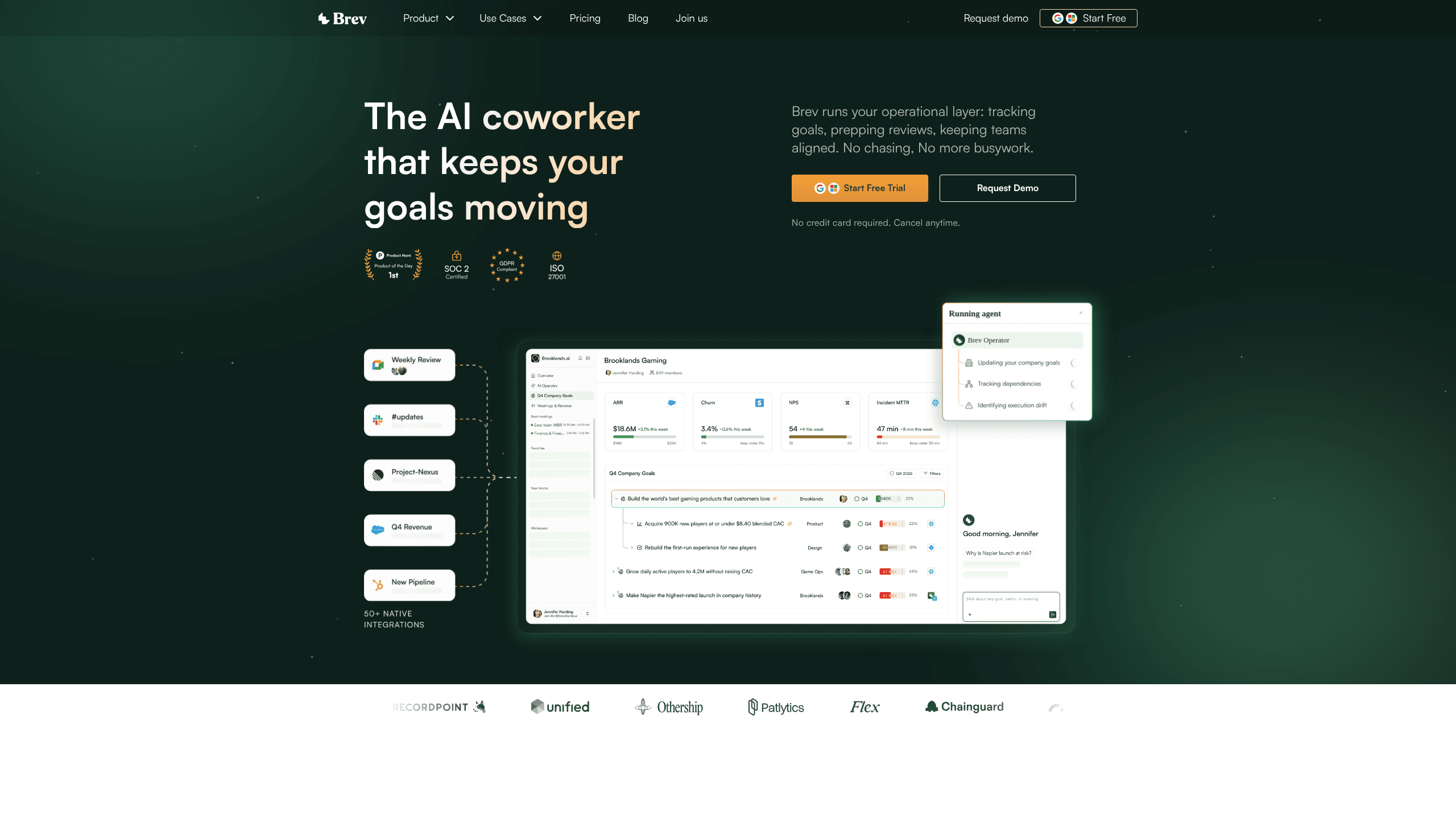
Brev is an AI coworker built for operations teams that need execution to stay visible. It connects goals, meetings, metrics, and decisions across the tools a company already uses, then turns that context into daily briefs, prepped reviews, and early risk signals. Teams run it headless inside Slack, Microsoft Teams, or an LLM, so nobody has to open another dashboard. Think of it as an AI coworker with a memory for your operations. Brev is aimed at leaders and ops managers who spend too many hours chasing status updates, and it bills by usage rather than per seat.
About Brev
What Is Brev
Brev is an AI operations platform and goal tracking software, not a reporting dashboard you check once a quarter. It reads the work happening across your company, ties that activity back to goals and OKRs, and keeps the picture current without anyone manually updating a tracker. The idea is that execution data should flow automatically from meetings and messages instead of being typed in after the fact, which is where most tracker data goes wrong in the first place. If you've ever run an OKR program that quietly died, this is the fix it's aiming for.
The main problem it solves is visibility. Leaders often can't answer "are we on track?" without pinging five people. Brev handles OKR management the same way, tying each objective to the daily work behind it. It watches bookings, spending, and team cadences, then surfaces a short brief when something drifts.
The output is deliberately small. A short brief. One number that moved. Nothing to decode.
The biggest limitation is scope. Brev is a business tool for organizations, not a personal productivity app. The Growth plan is priced for teams of around ten users and climbs quickly as headcount grows, and the serious security features such as SSO, SCIM, and RBAC sit behind the Enterprise tier. Solo users or small side projects won't get much out of it.
Getting Started
- Start a free trial at app.brev.io, or request a demo if you want a guided walkthrough before committing.
- Connect the tools your team already runs on, so Brev can pull goals, meetings, and metrics into one place.
- Add your goals and OKRs, either from scratch or imported, and link each one to the team that owns it.
- Invite your team and pick how they'll reach Brev, whether that's Slack, Microsoft Teams, or an LLM.
- Review the first daily brief and tune which signals matter. Then let Brev run meeting prep and updates on its own.
Product Information
A quick look at Brev's pricing, supported platforms, and performance.
Best for
The users, tasks, and scenarios where this tool fits best.
Users
- Operations managers at growing startups
- Executives and founders
- Team leads who run recurring reviews
Tasks
- Tracking goals and OKRs continuously
- Prepping meeting reviews and artifacts
- Chasing status updates
Scenarios
- Weekly operating cadences
- Early risk detection
- Distributed teams spread across tools
Key features
Company Brain
Brev keeps one shared store of decisions, commitments, and context that stays current as work happens. Instead of hunting through old docs and threads, teammates get the same answer to "why did we decide this?" Simple. The point is shared context, not another archive nobody reads.
Goals and OKRs Tracking
Brev tracks goals from the work teams are already doing, so OKRs don't go stale. It connects initiatives and KPIs, maps tactics and actions to each objective, and adds next quarter's goals when the time comes. You skip the manual refresh. That's the step that usually kills OKR programs.
Meetings That Write Their Own Updates
Review meetings come prepped without anyone assembling materials, and Brev drafts the agenda and brief before you walk in so the first five minutes aren't spent figuring out what to talk about. It captures notes and action items as the meeting runs. What gets said updates your goals automatically, so a meeting becomes a progress record instead of a separate to-do list.
Signals and Guidance
The platform watches for risks and surfaces them early, so leaders can course-correct faster. Daily digests and live team dashboards show where focus is needed. This is the part that replaces hours of piecing answers together from different tools. Miss a trend? Brev usually catches it before your next review.
Headless AI Coworker
Brev runs inside Slack, Microsoft Teams, and LLM clients, so teams manage execution without leaving where they work. That Slack AI integration means you can ask for a status update in the same window you'd normally type a message. It's headless by design, which means the interface is whatever chat tool you already have open. For people who hate switching tabs, that's the whole appeal. It matters more than it sounds.
Integrations and Developer Access
Brev lists 30+ native integrations plus full MCP and CLI support, so ops teams can wire it into existing workflows without rebuilding how they already track and report on work. MCP and CLI access matters for companies that want to script or extend it without waiting on a vendor roadmap item. API availability means custom dashboards and automations are on the table.
Pros and cons
Pros
- Runs inside Slack, Teams, and LLMs, so there's no new app to learn and adoption is easier.
- Tracks goals and OKRs from existing work, which removes the manual upkeep that usually makes OKR tools fail.
- Preps meeting reviews and artifacts automatically, saving the upfront gathering effort before every cadence.
- Surfaces risks early with daily briefs and signals, giving leaders time to react instead of discovering problems late.
- Prices by usage rather than seats, which can help teams that don't want to pay per head as they scale.
Cons
- The Growth plan starts around $250 per org per month for roughly ten users, so it's a real budget line for small teams.
- Security features like SSO, SCIM, RBAC, and MFA are Enterprise only, which rules it out for some security-conscious buyers on the lower tier.
- It's built for organizations, not individuals, so solo users and freelancers won't find much value.
- Some pricing answers need the sales team, so the exact credit cost of specific workflows isn't obvious upfront.
Frequently asked questions
Brev is an AI coworker that runs your operational layer: it tracks goals, preps review meetings, and keeps teams aligned. It works by connecting goals, meetings, metrics, and decisions across the tools a company uses. From there it turns that context into briefs and risk signals.
Related content
Explore related tools, skills, and articles for Brev.
Brev Alternatives

Swms
Swms AI · Writing · Productivity · BusinessSwms is an AI safety compliance tool that turns a plain description of a job into ready-to-use safety documents. Describe your project, trade, and known hazards, and it writes a safe work method statement, job hazard analysis, safe work procedure, RAMS, or safety data sheet in seconds. It also ships with Oscar, a chat assistant that answers workplace safety questions in any language. Teams in construction, mining, transport, and warehousing use it to cut the paperwork that usually eats into a workday.

Wordly AI Translation
Wordly · Voice & Language · ProductivityWordly AI Translation is a real-time AI translation and captioning platform built for meetings, conferences, and events. It delivers live translation, captions, transcripts, and summaries in more than 60 languages, and attendees join by scanning a QR code or opening a link instead of using dedicated headsets. The platform works with Zoom, Microsoft Teams, Google Meet, and Webex, and it's designed for organizations that want multilingual access without hiring human interpreters for every session. Simple as that.

Rows
Rows (Superhuman) · Productivity · BusinessRows is an AI spreadsheet and data analysis tool that imports live data from more than 50 sources, then lets you work with it using plain language instead of SQL queries or nested formulas. You can pull numbers out of PDFs, connect ad platforms, databases, and bank accounts, and ask the AI to build reports, merge datasets, or set up models that recalculate themselves. It runs in the browser, works like a spreadsheet, and now sits under the Superhuman umbrella.