

Bright Data
Bright Data · Coding
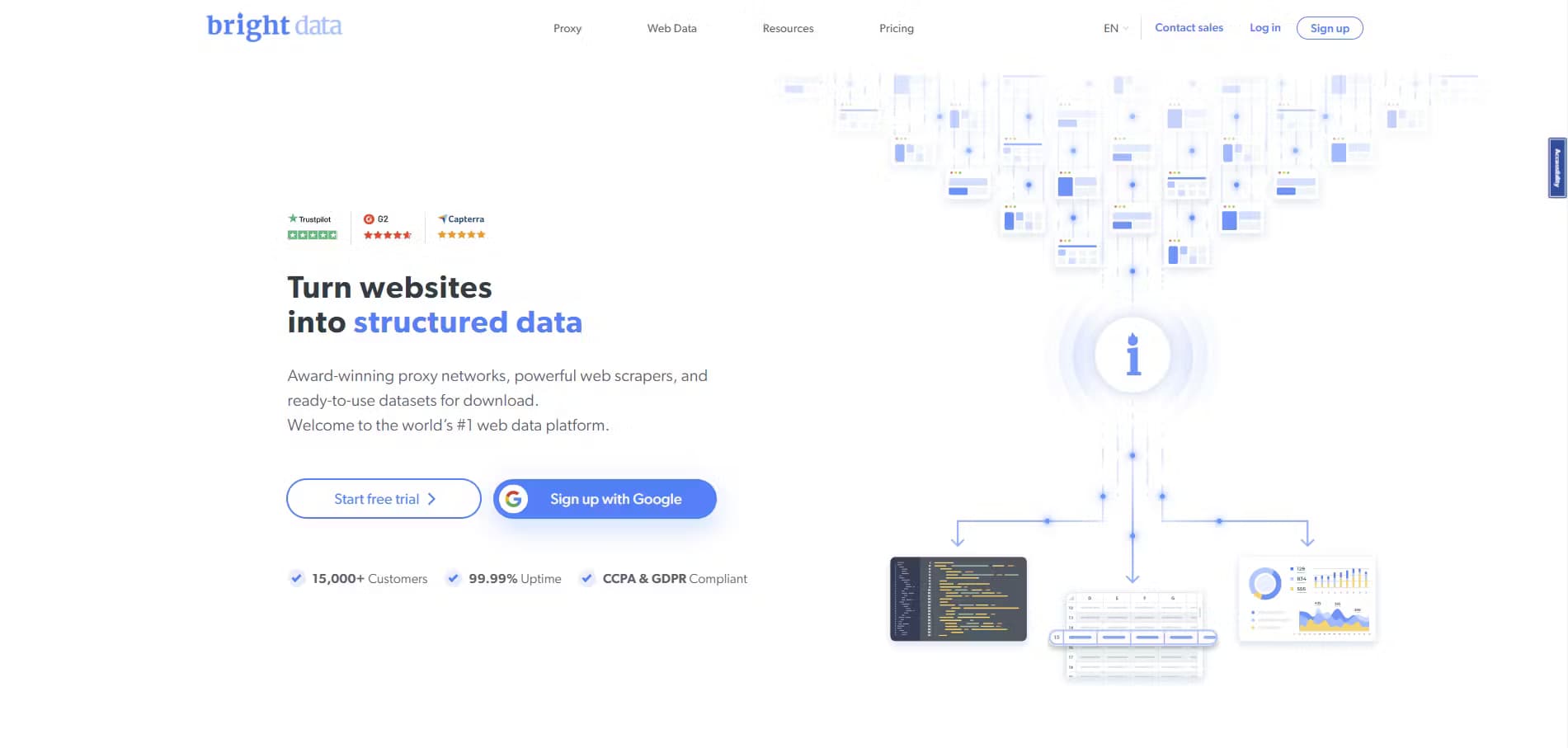
Bright Data is a web data platform. It gives teams proxies and scrapers plus ready datasets to collect public web data at scale.
About Bright Data
What Is Bright Data
Bright Data is a web data platform built for companies that need to pull public information off the internet without getting blocked. It bundles a proxy network, web scraping tools, and pre-built datasets into one account. The company says it serves 50,000+ organizations. That range runs from solo developers all the way up to large enterprises.
The core problem it solves is access. Websites block bots with IP bans, CAPTCHAs, and fingerprinting. Building around those defenses is slow, grinding work. Bright Data handles that layer for you. Your team then spends its time on the data instead of the plumbing.
It's not a budget tool. Pay-as-you-go proxy pricing starts around $4 per GB, and heavier plans run into hundreds or thousands of dollars a month. If you only need a few hundred records once, cheaper options exist. Bright Data makes sense when volume, reliability, and geographic coverage matter more than the lowest price. Simple as that.
Getting Started
- Create an account on the Bright Data site and verify your email; no credit card is required to start.
- Pick the product you need, such as a proxy network, the Web Scraper API, or a ready-made dataset.
- Grab your credentials from the dashboard and connect through the API, an SDK, or a no-code scraper.
- Run a small test job to confirm your requests return the data you expect.
- Scale up and set spend limits so your usage stays inside budget.
Product Information
A quick look at Bright Data's pricing, supported platforms, and performance.
Best for
The users, tasks, and scenarios where this tool fits best.
Users
- Data engineers
- E-commerce analysts
- AI and ML teams
- Growth and marketing teams
Tasks
- Collecting product prices and availability from retail sites at scale.
- Scraping search engine results for SEO and brand monitoring.
- Building training datasets from public web pages for language models.
- Gathering social media and review data for sentiment analysis.
- Automating recurring data feeds with webhooks instead of manual exports.
Scenarios
- Running a daily price-monitoring pipeline across multiple storefronts.
- Researching a new market without building a scraping stack from scratch.
- Feeding fresh public data into an internal dashboard or BI tool.
- Testing a scraper idea on the free tier before committing budget.
Key features
Proxy Networks
Bright Data runs one of the largest proxy networks, with 400M+ residential IPs across 195 countries. You can target by country, state, city, or zip code at no extra cost. Residential, ISP, datacenter, and mobile proxies are all available. Pick the proxy type that matches the site you're hitting.
Web Scraper API
Pre-built scrapers cover major domains like LinkedIn, Amazon, and Instagram. You pay only for records that come back successfully. A free tier gives you 5,000 records a month to test with. Parsing to JSON or CSV is included, so you skip writing your own extraction code.
Web Unlocker
This is the piece that gets around blocks. It rotates IPs, solves CAPTCHAs, and manages headers, user agents, and cookies automatically. For teams that keep hitting walls on protected sites, it removes the most tedious part of scraping. It's not magic. Still, it handles the common defenses.
Scraping Browser
You get remote browsers you can drive with Puppeteer or Playwright, with unlocking built in. If your workflow already uses those tools, you can point them at Bright Data and skip the infrastructure setup. That's handy for pages that lean hard on JavaScript.
Ready-Made Datasets
Instead of scraping from scratch, you can buy datasets covering 800+ domains, refreshed regularly and delivered through an API or webhook. There are 5B+ records available. This suits teams that want the data now and don't care how it was collected.
SERP API
You can pull live search results from multiple engines in JSON or HTML. That's useful for rank tracking, ad research, and understanding what people see in search. No browser automation needed on your end. Zero setup on the browser side.
AI Scraper Studio
This lets you turn a website into a data pipeline with AI-assisted scraper building. You don't have to hand-code selectors for every site. It's aimed at teams that scrape many different sites and want to cut the setup time for each one. Big time saver.
Pros and cons
Pros
- Proxy network with 400M+ IPs and fine geo-targeting down to zip code.
- Pay only for successfully delivered records on the Web Scraper API, so failed requests don't cost you.
- Free tier with 5,000 monthly records and no credit card, good for testing before you commit.
- Ready-made datasets and an AI scraper builder cut the engineering work for common targets.
- Broad tool lineup covers proxies, scraping, unlocking, and delivery in one place.
Cons
- Pricing adds up quickly; proxy bandwidth at $4 to $8 per GB is steep for high-volume jobs.
- The depth of options can overwhelm beginners who just want a simple scraper.
- Cost predictability is tricky, since bandwidth and record usage vary with the target sites.
- Some legal and compliance responsibility still sits with you, not the platform.
Frequently asked questions
Bright Data is used to collect public web data at scale, mainly for price monitoring, search data, market research, and building datasets for AI models. It provides the proxies, scrapers, and delivery tools so you don't have to build that infrastructure yourself.
Related content
Explore related tools, skills, and articles for Bright Data.
Bright Data Alternatives
Forefront
Forefront · CodingForefront is a web platform for building with open-source AI. It lets you fine-tune leading open-source language models on your own data, evaluate how they perform, and run them through an API or export them to host yourself. Developers who want the convenience of a closed-source platform but insist on owning their models and data are the target audience here.

Startkit
StartKit.AI · CodingStartkit is a boilerplate for building AI SaaS and AI wrapper products. Think of it as an AI startup boilerplate with the boring parts already wired up: authentication, Stripe and Lemon Squeezy payments, usage limits, transactional email, and an AI API starter that talks to OpenAI, Anthropic, Groq, or Llama. You clone the repo, set your price, and start on the part of your product that people actually pay for. It's Next.js under React and Tailwind, so most of the boilerplate code already feels familiar.
Testim
Tricentis · CodingTestim is an AI-powered test automation platform for building and running end-to-end tests across web, mobile, and Salesforce applications. It leans on machine learning to keep tests stable when an interface changes, so teams spend less time fixing broken selectors. Not bad for an automated testing tool you can start using today. You create tests by recording actions in a browser, then optionally add JavaScript when you need more control. It's a solid pick for busy QA teams.