

Built for Devs
Built for Devs · Coding · Marketing
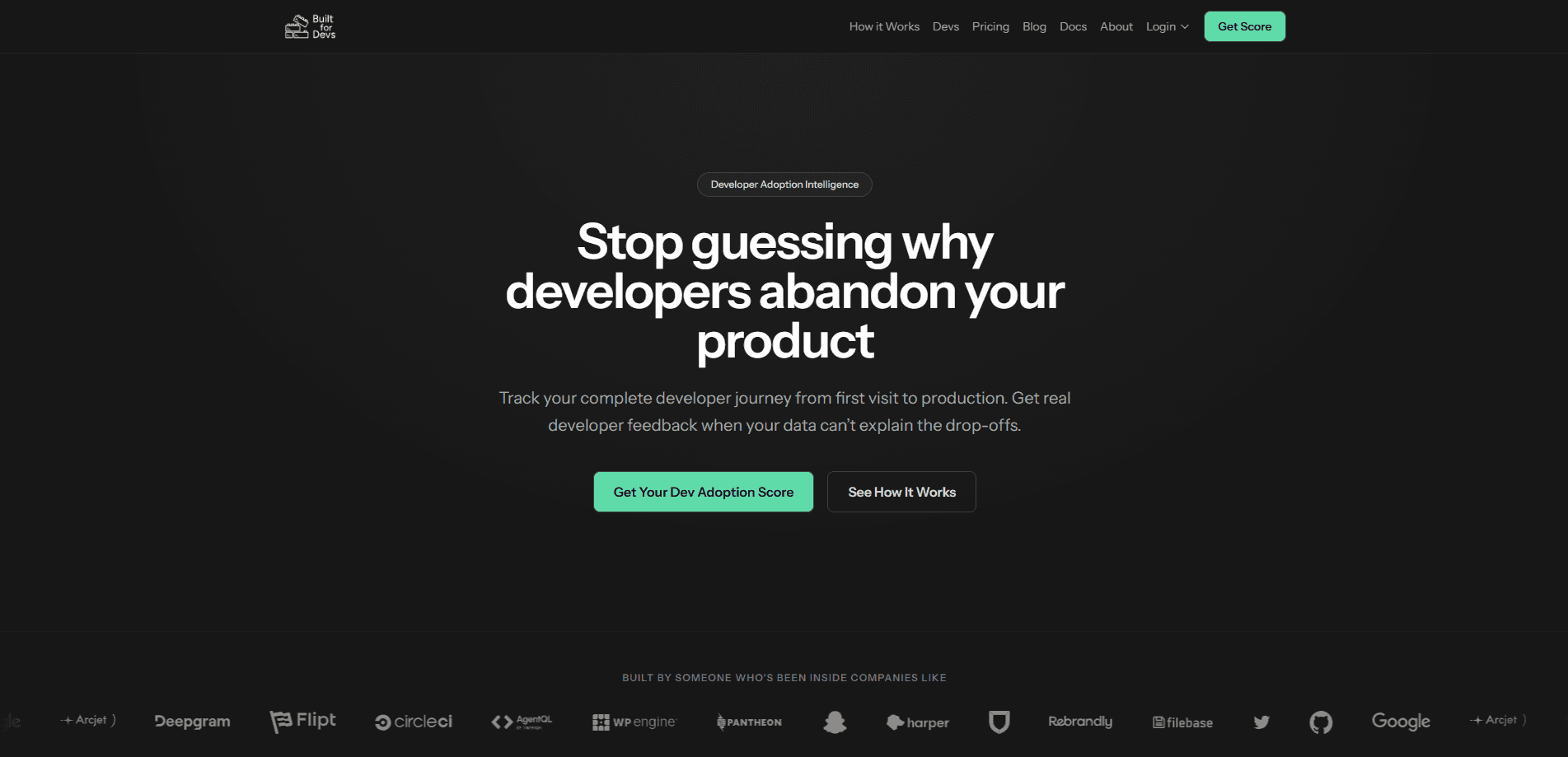
Built for Devs is a developer adoption intelligence platform. It helps companies understand how developers actually use their SDKs, APIs, and documentation, then pairs that usage data with feedback collected straight from the developers themselves. The goal is simple: turn scattered signals into a clearer picture of your developer experience, so product and DevRel teams can spot friction before it costs them users.
About Built for Devs
What Is Built for Devs
Built for Devs is a service for teams that ship developer-facing products. If you maintain an SDK, an API, a CLI, or a docs site, you already know the hard part isn't launch, and it never really was. It's figuring out why some developers stick and others quietly leave. This platform focuses on that gap.
It works by combining two things most tools treat separately. On one side there's adoption analytics: onboarding and usage signals that show where developers spend time and where they drop off. On the other side there's feedback: what developers say when you ask them directly. Put together, those two sources answer a question analytics alone can't. They don't stop at what developers do. They get at why.
The limits are worth naming up front. Adoption data only helps if your usage is instrumented, so you need developer buy-in and clean tracking. Feedback is self-reported, which means it skews toward the developers who bother to respond. And the value builds slowly. A single week of signals won't tell you much; patterns emerge over a quarter.
Getting Started
- Connect the sources you already use, such as your SDK or API usage events, docs, and any existing survey or support channels.
- Define which adoption signals matter to you, like first successful call, time to first app, or active integration.
- Invite developers to share feedback through a survey, in-product prompt, or direct interview.
- Review adoption and feedback side by side to find the friction points that show up in both.
- Act on one or two fixes, then track whether the adoption signals move.
Product Information
A quick look at Built for Devs's pricing, supported platforms, and performance.
Best for
The users, tasks, and scenarios where this tool fits best.
Users
- DevRel and developer marketing teams
- Product and platform teams at API-first companies
- Developer experience leads
Tasks
- Tracking onboarding drop-off
- Correlating usage with feedback
- Justifying DX investments
Scenarios
- Preparing a quarterly developer experience review
- Diagnosing a drop in API or SDK usage
- Testing a new onboarding flow
Key features
Adoption analytics
This is the core of the platform. It pulls in usage events from your SDK, API, or docs so you can see how developers move through your onboarding and into a working integration. The useful part is funnel thinking. Where do people start? Where do they stall? Where do they quit?
Developer feedback collection
The platform gathers feedback from developers rather than guessing at it. Surveys, in-product prompts, and interviews all feed the same pool of insights. It makes the case much clearer when a number spikes and nobody on the team can explain why it moved that week.
Feedback and usage correlation
Most tools stop at one data type. Built for Devs is built to sit between the two, so a drop in integration completion can be read next to what developers said that same week. That pairing is the reason to consider it over a plain analytics tool.
Developer experience tracking
Adoption intelligence here means watching the whole developer path, not a single metric. Onboarding, docs, support, and retention all count as parts of the developer experience. The platform is designed to show those parts together over time. Why does that matter? Because a docs rewrite can fix onboarding and still leave support tickets climbing.
Progress reporting
Because DX work is slow, the platform leans on longitudinal views. You track whether your changes moved the numbers across weeks and quarters, not just whether one release changed a chart. That fits how developer adoption actually behaves.
Pros and cons
Pros
- Combines usage analytics with direct developer feedback, which answers "why" and not only "what."
- Aimed at the developer-facing product case specifically, so the metrics fit SDK, API, and docs work.
- Works with data you likely already collect, up to what your usage tracking covers.
- Longitudinal tracking suits the slow timeline of developer adoption, which rarely rewards a single snapshot.
Cons
- You need usage instrumentation first, so teams with messy or half-finished tracking get noticeably less out of the platform than teams whose events are already clean.
- Feedback skews toward developers who respond, which can hide quiet churn.
- Pricing isn't published, so getting a number means contacting the team.
Frequently asked questions
It's a developer adoption intelligence platform. It tracks how developers use your SDK, API, or docs, collects feedback from those developers, and helps you read the two together so you can fix the friction that loses users.
Related content
Explore related tools, skills, and articles for Built for Devs.
Built for Devs Alternatives
Forefront
Forefront · CodingForefront is a web platform for building with open-source AI. It lets you fine-tune leading open-source language models on your own data, evaluate how they perform, and run them through an API or export them to host yourself. Developers who want the convenience of a closed-source platform but insist on owning their models and data are the target audience here.

Startkit
StartKit.AI · CodingStartkit is a boilerplate for building AI SaaS and AI wrapper products. Think of it as an AI startup boilerplate with the boring parts already wired up: authentication, Stripe and Lemon Squeezy payments, usage limits, transactional email, and an AI API starter that talks to OpenAI, Anthropic, Groq, or Llama. You clone the repo, set your price, and start on the part of your product that people actually pay for. It's Next.js under React and Tailwind, so most of the boilerplate code already feels familiar.
Testim
Tricentis · CodingTestim is an AI-powered test automation platform for building and running end-to-end tests across web, mobile, and Salesforce applications. It leans on machine learning to keep tests stable when an interface changes, so teams spend less time fixing broken selectors. Not bad for an automated testing tool you can start using today. You create tests by recording actions in a browser, then optionally add JavaScript when you need more control. It's a solid pick for busy QA teams.