

buzzabout - AI Audience Research Tool
buzzabout LLC · Marketing · Business
buzzabout is an AI audience research tool that reads public posts on seven social platforms, tags the hooks, pains and emotions behind them, and turns the findings into content briefs.
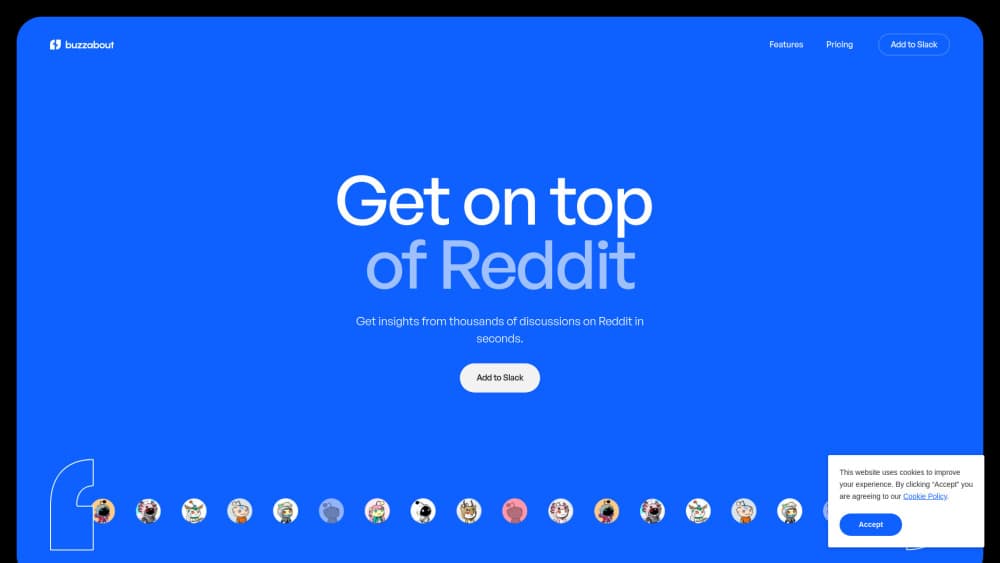
About buzzabout - AI Audience Research Tool
What Is buzzabout
buzzabout is a social listening platform built for social media research: the work of finding out what an audience actually says before you make content. Point one of its AI research agents at a brand, a competitor, a creator or a whole category, and it reads public posts and comments on Reddit, TikTok, YouTube, Instagram, Facebook, X and LinkedIn. Every result links back to the posts it came from, so a claim about buyer objections is checkable rather than a hunch.
The work splits into two halves. Listening agents run on a daily or weekly schedule and send digests to Slack or a webhook when a pain point spreads or a sentiment shift appears. Research agents answer a question you type in plain words and return a report, an audience profile or a content brief, which you share with one link.
Two limits shape who gets value here. Pricing starts at $98 per month with no free tier, and the cheapest plan caps each research run at 250 mentions. The data also comes from public sources only, so private forums and customer call transcripts need an Enterprise contract.
Getting Started
- Open a trial from the pricing page. New monthly accounts start with a $1 one-day trial that includes 1,000 credits.
- Create a project and name the brand, competitor or topic you want to track. Each project keeps its own saved context.
- Ask a research question or pick a listening agent template for trends, competitors, brand mentions, creators or pain points.
- Read the findings, then click through to the underlying posts to confirm the pattern holds.
- Turn the result into a content brief, export it as CSV or PDF, or send it to Claude or ChatGPT through the MCP connectors.
Product Information
A quick look at buzzabout - AI Audience Research Tool's pricing, supported platforms, and performance.
Best for
The users, tasks, and scenarios where this tool fits best.
Users
- Brand marketers
- Agency strategists
- UGC and creator teams
Tasks
- Writing a campaign brief
- Tracking a competitor
- Watching for a sentiment turn
- Profiling an audience
Scenarios
- Launching into an unfamiliar category
- Running weekly content planning
- Onboarding a new client
Key features
Ten-Dimension Post Tagging
Every post and comment gets tagged across topic, emotion, hook, narrative, tone, intent, CTA, sentiment, entities and language. You don't define the taxonomy in advance, which is the point: the patterns come out of the data instead of a form you filled in. buzzabout puts accuracy at 86% to 95% depending on pattern type and sample size, with concrete items like objections scoring highest.
Always-On Listening Agents
Agents run on your schedule and watch pain points, trends, competitors, your brand or the creators in your space. When something breaks out, a digest lands in Slack or hits a webhook. The practical effect is that a shift surfaces in a channel your team already reads, not in a login nobody opens twice.
Plain-Language Research With Citations
Type a question the way you would ask a colleague. The research agent chooses the method, runs it against real mentions and cites each post it used. You get a report, a persona or a brief rather than a wall of unlinked summaries. That citation trail is the difference between audience insights you can defend and a confident guess.
Audience and Persona Profiles
The audience research feature profiles the people behind a trend: their pains, unmet needs and the questions they keep asking, then adapts messaging per segment. It costs three credits per audience profile and isn't part of the Starter plan. Worth knowing before you assume the entry tier covers it.
Content Briefs and Shared Collections
A finding turns into a brief with the hook, format, platform, references and target audience attached. Collections hold the best-performing posts as a shared swipe file, so a creative team works from the same evidence. Both are shareable by link, which removes the export and re-upload dance.
MCP Connectors and REST API
Claude, ChatGPT and Cursor can pull the same research through the MCP server, and Business plans add a REST API for custom workflows. A typical call returns pains, hooks, quotes and frameworks for a project. Starter and Pro include MCP but not API access, a split that matters if you plan to wire buzzabout into your own stack.
Pros and cons
Pros
- Every finding links to the source posts, so you can check a pattern instead of trusting a score.
- The ten tagging dimensions cover hooks and narratives, not just sentiment and keywords like most social listening tools.
- Listening agents deliver to Slack and webhooks, which fits teams that don't want another dashboard tab.
- MCP support means Claude or ChatGPT can query the same research, with no export step.
- SOC 2 Type II and GDPR compliance with a choice of EU or US data region answers the first security question most buyers ask.
Cons
- No free plan. Testing costs $1 for a day, then $98 per month at the entry tier.
- Starter caps a research run at 250 mentions, so small samples give shakier percentages.
- Audience research, CSV export and API access sit behind Pro or Business, which pushes real evaluation work up to $178 per month.
- Credits drain across mentions, processed posts and profiles, so heavy use needs a top-up budget on top of the subscription.
Frequently asked questions
It reads public social posts and comments, tags them across ten dimensions, and reports which pains, hooks and narratives repeat in your niche. Output comes as a report, an audience profile or a content brief.
Related content
Explore related tools, skills, and articles for buzzabout - AI Audience Research Tool.
buzzabout - AI Audience Research Tool Alternatives

Tractionwave
TractionWave · Image · MarketingTractionWave is an AI attention heatmap tool for static ads. Upload a PNG or JPG and it returns predicted attention, ranked hotspots, and fixes before you spend budget.

OpenSEO - AI Visibility
EveryApp · Coding · Marketing · BusinessOpenSEO is an open source SEO platform for keyword research, backlinks, rank tracking, site audits, and AI visibility, with usage-based pricing and MCP access for AI agents.

Plugins Radar
Plugins Radar · Marketing · BusinessPlugins Radar tracks where your ChatGPT plugin ranks in directory and in-chat search, which competitors outrank it and what changed, with hourly checks on 9,885 listings.