

Callio
Callio · Coding
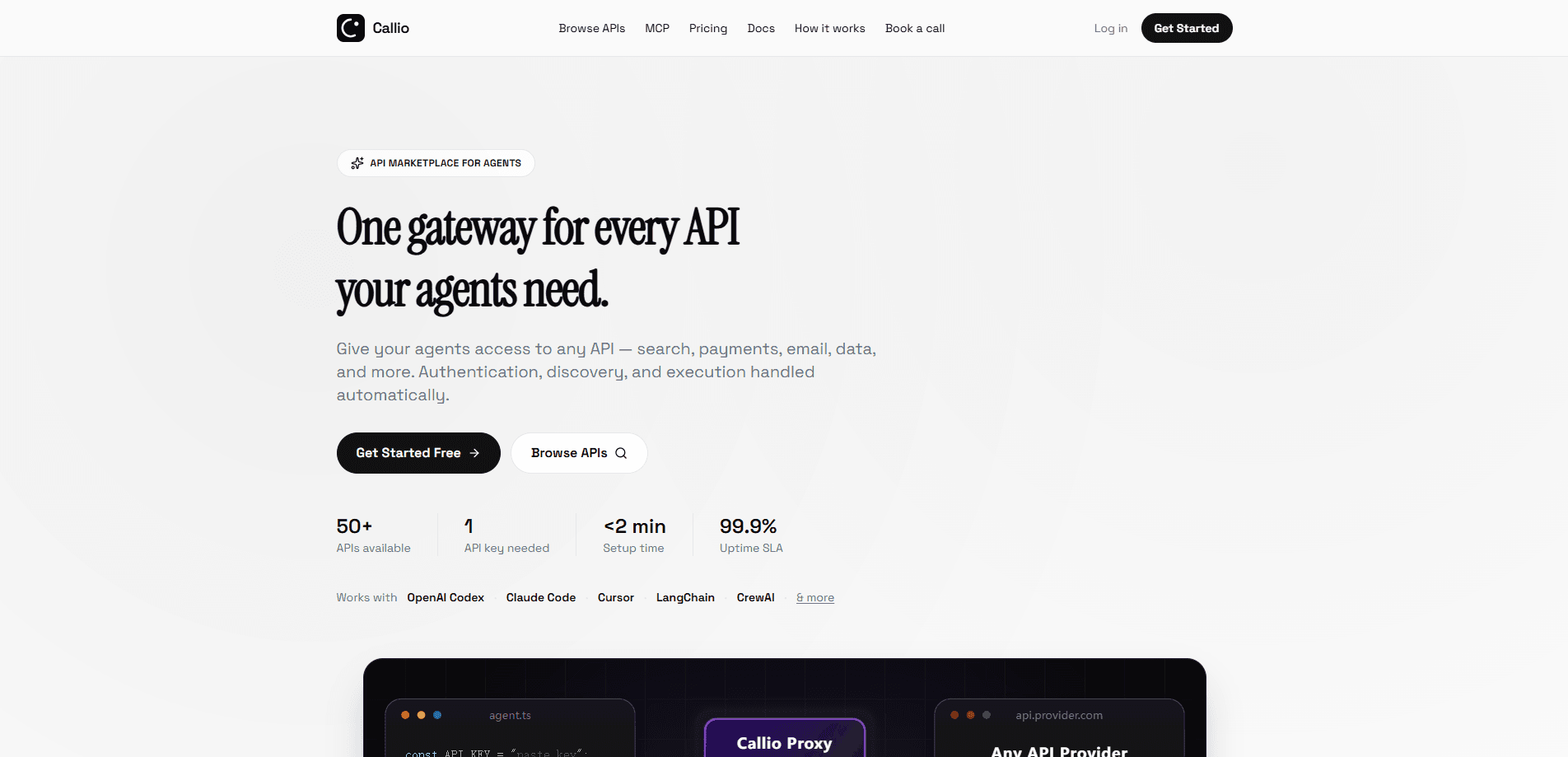
Callio is an API gateway and marketplace that gives AI agents and LLM apps one key to reach 175+ tools. Instead of wiring up a different auth flow, retry policy, and log format for every service, you point your agent at Callio and it handles key mapping, header injection, and request forwarding. It ships with native MCP support for Claude Desktop, Cursor, and Gemini, plus a unified dashboard that tracks latency, success rates, and request volume across every upstream API you touch.
About Callio
What Is Callio
Callio is a unified API gateway built for products, AI agents, custom backends, and low-code workflows that need dependable access to outside services. The pitch is simple: one routing pattern for every marketplace API, so you authenticate once with a Callio key and let the gateway forward the call to the provider you selected. It sits between your client and the destination API, injecting the right credentials as the request passes through.
The problem it solves is credential sprawl. Anyone who's wired an agent up to five or six services knows the drill. Each one wants its own key, its own headers, its own quirks, and none of them log nicely together. Callio keeps provider keys in an encrypted vault and reuses them across every call, which means you stop hardcoding secrets into each project.
The tradeoff is that you still bring your own provider keys for most upstream APIs. Callio doesn't resell access to OpenAI or Stripe. It just holds and injects your credentials. That keeps costs predictable, but it also means there's nothing to try until you've signed up for the underlying services.
Getting Started
- Sign up for a free account (no card required) and land in the developer dashboard.
- Grab your sandbox key from Dashboard → Keys. Sandbox traffic never counts against your monthly quota.
- Add your upstream provider keys (your OpenAI key, your SendGrid key, and so on) to the encrypted vault.
- Point your agent or backend at
https://callio.dev/api/proxy/<provider>and authenticate with your Callio Bearer token. - Install the MCP server into Claude Desktop, Cursor, or your runtime of choice, then watch request logs and latency in the telemetry view.
Product Information
A quick look at Callio's pricing, supported platforms, and performance.
Best for
The users, tasks, and scenarios where this tool fits best.
Users
- Developers building AI agents
- Small teams shipping a first AI product
- Platform engineers running multi-agent systems
Tasks
- Routing LLM calls to different providers
- Connecting agents to external tools via MCP
- Monitoring API traffic in one place
Scenarios
- Prototyping an agent before you have production keys
- Running a low-code workflow through Zapier or Make.com
- Scaling traffic past a hard request cap
Key features
Unified Proxy Interface
Every marketplace API follows one routing pattern: authenticate with your Callio key, and the gateway forwards the request to the provider you picked. It means one integration shape instead of a dozen. Developers who've maintained ten different client libraries will appreciate the difference immediately.
Encrypted BYOK Vault
Callio stores your upstream provider keys and OAuth tokens encrypted at rest with AES-256-GCM. The gateway injects the right authentication headers during forwarding, so secrets never sit in your source code. That's the whole point of BYOK API keys: you own the credentials, Callio just holds them safely. Request bodies travel over TLS 1.3 and aren't written to disk.
Native MCP Support
Callio ships an MCP server you can install straight into Claude Desktop, Cursor, Gemini, or your own runtime. Provider metadata and request schemas are organized so agent runtimes can discover, inspect, and call tools consistently. That's a big deal for MCP teams. It skips a lot of custom wrapping.
Interactive API Playground
The browser playground lets you explore endpoints, set parameters, and inspect live responses before writing a line of production code. You can test routes with sandbox or production keys and copy ready-to-paste snippets in cURL, JavaScript, or Python.
Unified Telemetry Dashboard
Request volumes, execution success rates, and average latencies across all your upstream integrations show up in one view. Logs cover the last 100 requests, and only non-sensitive metadata like status codes and latency is retained. No payload bodies. Per the site, the sample dashboard reported 9 requests, 0 failures, and 79ms average latency.
Team Workspaces
Team Workspaces let multiple developers share credentials and monitor central usage telemetry. Members can view API keys and usage logs, but they can't reach personal billing information or delete the workspace. Useful when you're scaling agent builders across an org without handing out admin rights.
Workflow Automations
Callio connects to Zapier and Make.com through polling triggers, so low-code builders can route external API calls through the gateway too. It's a small feature on paper, but it keeps credentials in one place even when the workflow never touches your own code.
Pros and cons
Pros
- One key and one routing pattern for 175+ APIs removes a lot of repetitive auth work.
- AES-256-GCM encryption and zero data retention address the security review questions that usually stall a rollout.
- Native MCP support means it plugs into Claude Desktop, Cursor, and Gemini without custom integration code.
- Transparent monthly pricing with sandbox traffic excluded from your quota.
- Team Workspaces share credentials without exposing billing or admin controls.
Cons
- You still need your own provider keys for most APIs, so Callio doesn't simplify getting started with the underlying services.
- Free plan caps at 500 requests a month, which is tight for anything beyond prototyping.
- Hitting your monthly limit returns a 429 until the next billing period or an upgrade, which can interrupt a live product if you don't watch usage.
Frequently asked questions
Callio is an API gateway for AI agents and LLM apps. It routes calls to 175+ external services through a single proxy interface, handling authentication, key injection, and logging so you don't build that plumbing yourself.
Related content
Explore related tools, skills, and articles for Callio.
Callio Alternatives
Forefront
Forefront · CodingForefront is a web platform for building with open-source AI. It lets you fine-tune leading open-source language models on your own data, evaluate how they perform, and run them through an API or export them to host yourself. Developers who want the convenience of a closed-source platform but insist on owning their models and data are the target audience here.

Startkit
StartKit.AI · CodingStartkit is a boilerplate for building AI SaaS and AI wrapper products. Think of it as an AI startup boilerplate with the boring parts already wired up: authentication, Stripe and Lemon Squeezy payments, usage limits, transactional email, and an AI API starter that talks to OpenAI, Anthropic, Groq, or Llama. You clone the repo, set your price, and start on the part of your product that people actually pay for. It's Next.js under React and Tailwind, so most of the boilerplate code already feels familiar.
Testim
Tricentis · CodingTestim is an AI-powered test automation platform for building and running end-to-end tests across web, mobile, and Salesforce applications. It leans on machine learning to keep tests stable when an interface changes, so teams spend less time fixing broken selectors. Not bad for an automated testing tool you can start using today. You create tests by recording actions in a browser, then optionally add JavaScript when you need more control. It's a solid pick for busy QA teams.