

Caveman
Julius Brussee · Coding
Caveman is a free Claude Code skill and local proxy that shrinks what a coding agent writes and reads, so it burns fewer tokens and costs less to run. The skill forces compressed "caveman" replies that keep every technical fact. The proxy is a token compression agent for the other direction. It shrinks the logs, diffs, and test output the agent scrolls through. It works with 30+ agents, needs no account, and starts with one command.
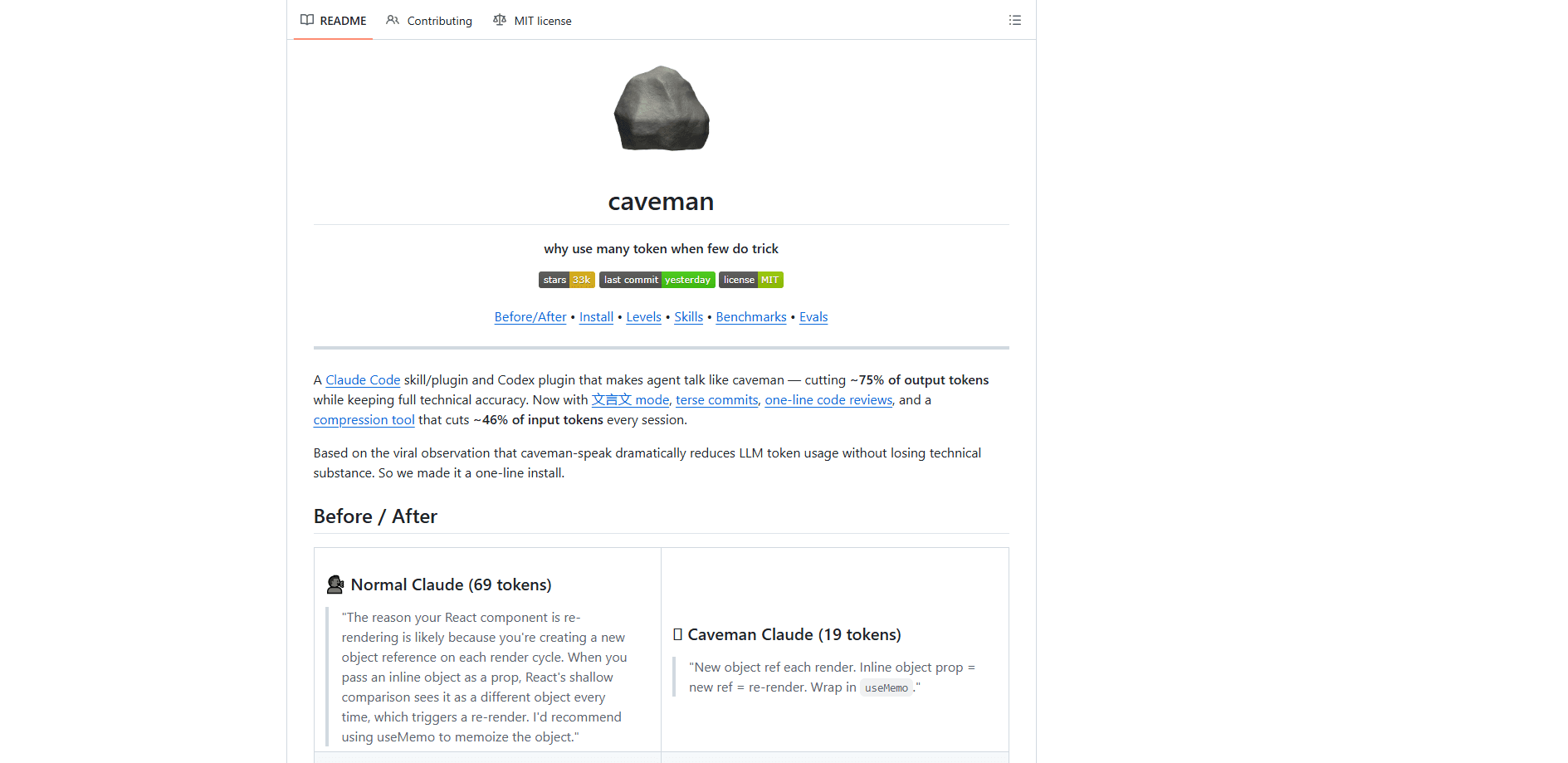
About Caveman
What Is Caveman
Caveman is an open-source token saver for AI coding agents. It attacks the bill from two sides. The skill changes how an agent talks, swapping long preambles for terse caveman prose. The proxy changes what an agent reads. It squeezes tool output, logs, JSON, and diffs before they reach your provider.
The pitch is simple. Code, commands, file paths, and error messages never get compressed. Only the prose around them does. So you get the same diagnosis and the same fix, minus the throat-clearing. Security warnings and confirmations still come back in full sentences.
The main limit is scope. Caveman saves the most when an agent writes a lot of prose or reads huge logs. Where does it fall short? If you pay per request instead of per token, or your work is almost pure code generation, the savings shrink. The added rule text can even cost you a little. The maintainer says this openly and points you to a page listing where it loses.
Getting Started
- Install the skill with a single command, no account or API key needed:
npx skills add JuliusBrussee/caveman -g. - Ask your agent any coding question. Normal answers now come back short, and you can set the intensity with
/caveman liteor/caveman ultra. - For the reading side, install the CLI with
npm install -g @caveman-ai/cli, then runcaveman learnto see where your tokens actually go. - Wrap your agent with
caveman claude(orcodex,gemini,aider, and others) so tool output gets compressed before the provider sees it. - Run
caveman trial -- claudeto A/B a real session, then checkcaveman trial reportto see whether it saved you anything.
Product Information
A quick look at Caveman's pricing, supported platforms, and performance.
Best for
The users, tasks, and scenarios where this tool fits best.
Users
- Developers paying per token
- Long-session agent users
- Teams building on Claude Code or Codex
Tasks
- Everyday coding questions
- Trimming memory files
- Compressing noisy command output
Scenarios
- Debugging a failing test suite
- Auditing where tokens go
- Reviewing a pull request
Key features
Caveman Reply Modes
The skill sets how compressed your agent talks. Query levels from /caveman lite for tight-but-polite up to /caveman ultra for near-grunts, with a wenyan mode for classical Chinese if you want it. Code, commands, and error messages stay untouched at every level. Say stop caveman and normal prose comes back.
Local Proxy for Reading Less
The proxy sits between your agent and your provider on your own machine. It detects each payload type, whether JSON, log, code, diff, or web page. Then it routes the payload to a compressor that keeps what answers depend on. Every compressed byte gets a backup in local SQLite, so the agent can pull the original back with a recovery handle.
Reversible Compression
Nothing here is lossy in a way you can't undo. Originals of everything the proxy squeezes stay on disk, and the agent can request the full version back through a retrieve tool whenever the compressed copy isn't enough to answer the question. The /caveman-compress command also backs up your memory file before it rewrites it.
Token Sink Discovery
Running caveman learn reads your existing agent history locally and read-only, then ranks your token sinks worst-first with a one-line fix behind each one. A follow-up command hands those fixes to Claude Code or Codex one diff at a time and reverts any change that doesn't lower tokens per turn.
Broad Agent Support
Caveman works across more than 30 agents. It has native wrap profiles for ten of them, including Claude Code, OpenAI Codex CLI, Gemini CLI, Aider, and OpenClaw. Wrapping never edits your config files. You can undo it with a single command.
Middleware for Your Own App
If you're building an agent rather than running one, a TypeScript or Python middleware wrapper compresses big tool results before the model sees them. Native adapters cover frameworks like the Vercel AI SDK, LangChain, OpenAI, and Anthropic. Your conversation history keeps every original byte.
Claude Code Token Savings You Can Measure
Caveman publishes its own benchmark results and links the third-party checks too. JetBrains tested the skill alone on 86 real coding tasks and found 8.5% fewer output tokens with no detectable quality change. An Adobe Research paper measured the style cutting cost by 1.4 to 2.4 times. That's the kind of proof you can weigh before you install.
Pros and cons
Pros
- Free skill with no account, no API key, and an MIT license on the adoption surfaces.
- Cuts both what an agent writes and what it reads, covering the two biggest token drains.
- Compression stays reversible, so the agent can always recover the original bytes.
- Works across 30+ coding agents and plugs into your own app through a small middleware wrapper.
- Publishes its numbers and third-party checks, including cases where it loses.
Cons
- The rule file rides along as input tokens on every call, so terse one-liner Q&A can cost more than it saves and you may end up worse off than before.
- Saves little if you pay per request rather than per token, since a shorter answer is still one request.
- The engine core is source-available under BSL-1.1, not fully open source, and hosting it for third parties needs a commercial license.
- The CLI sends anonymous usage counts by default, so you have to run `caveman telemetry off` if you want it completely silent.
Frequently asked questions
It makes AI coding agents cheaper by shrinking their token use. The skill compresses the agent's replies, and the proxy compresses the logs, diffs, and output the agent reads, while leaving code and error messages intact.
Related content
Explore related tools, skills, and articles for Caveman.
Caveman Alternatives
Forefront
Forefront · CodingForefront is a web platform for building with open-source AI. It lets you fine-tune leading open-source language models on your own data, evaluate how they perform, and run them through an API or export them to host yourself. Developers who want the convenience of a closed-source platform but insist on owning their models and data are the target audience here.

Startkit
StartKit.AI · CodingStartkit is a boilerplate for building AI SaaS and AI wrapper products. Think of it as an AI startup boilerplate with the boring parts already wired up: authentication, Stripe and Lemon Squeezy payments, usage limits, transactional email, and an AI API starter that talks to OpenAI, Anthropic, Groq, or Llama. You clone the repo, set your price, and start on the part of your product that people actually pay for. It's Next.js under React and Tailwind, so most of the boilerplate code already feels familiar.
Testim
Tricentis · CodingTestim is an AI-powered test automation platform for building and running end-to-end tests across web, mobile, and Salesforce applications. It leans on machine learning to keep tests stable when an interface changes, so teams spend less time fixing broken selectors. Not bad for an automated testing tool you can start using today. You create tests by recording actions in a browser, then optionally add JavaScript when you need more control. It's a solid pick for busy QA teams.