

Chainlit Io
Chainlit · Coding · Chatbot
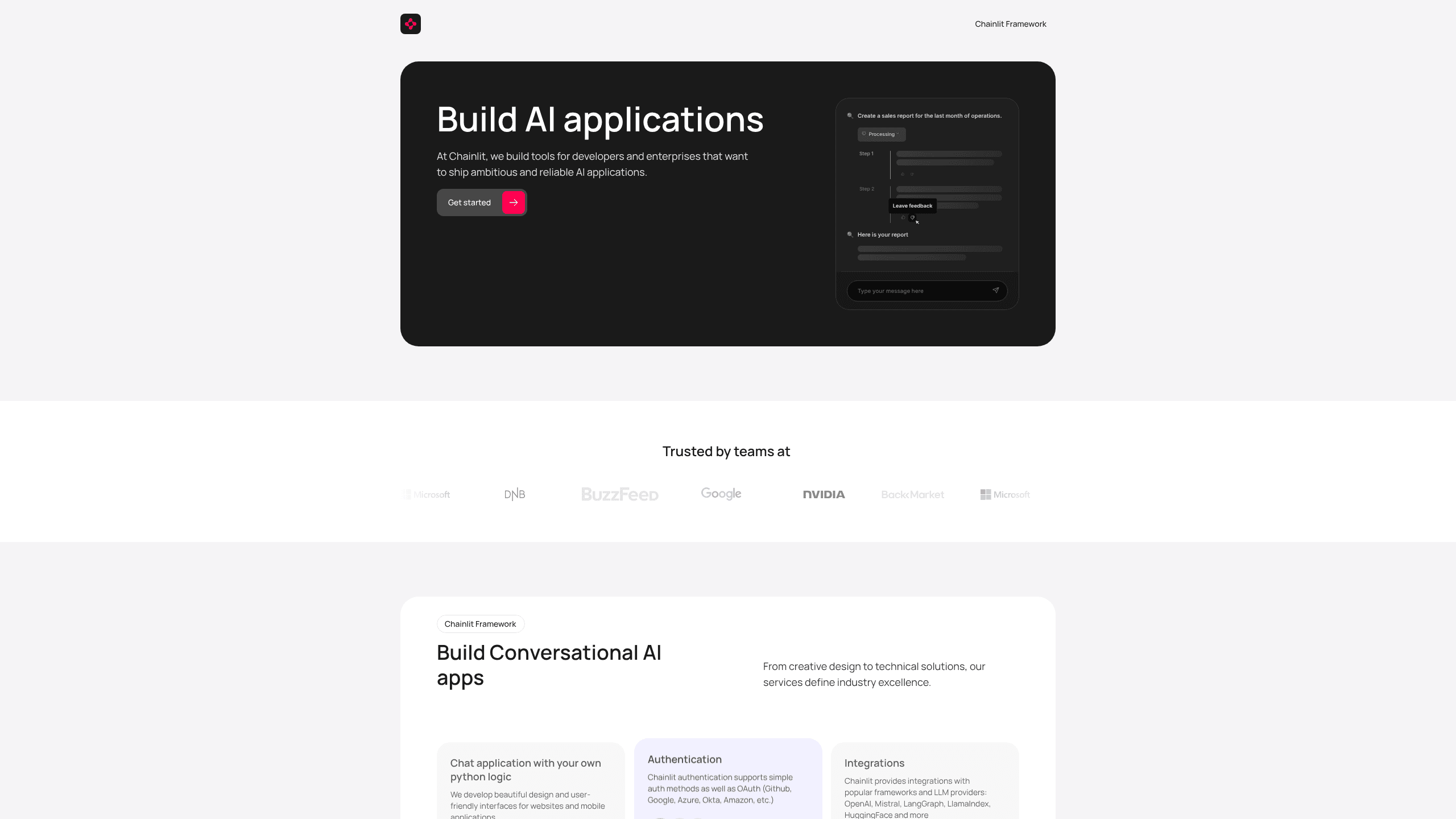
Chainlit is an open-source Python framework for building conversational AI applications without wrestling with frontend code. You write your assistant logic in Python, and Chainlit gives you a ready chat UI, streaming responses, authentication and data persistence out of the box. Developers use it to turn LLM scripts and agents into shareable chat apps in minutes rather than weeks. No frontend work required.
About Chainlit Io
What Is Chainlit
Chainlit is a Python framework that handles the interface layer of conversational AI apps so you can focus on the logic. Instead of building a chat UI, wiring up WebSockets and rendering message streams yourself, you decorate a few Python functions and get a working chat app. It's built for developers and teams shipping LLM-powered products, from a prototype on a laptop to an authenticated app behind a company login. That's the whole pitch.
The framework works with the tools you already use. It ships integrations for OpenAI, Mistral AI, LangGraph, LlamaIndex, Hugging Face and Semantic Kernel, so a script built for any of those libraries gets a chat frontend with minimal changes. It also shows the intermediate reasoning steps an agent takes, not just the final answer, which helps when you're debugging why an output looks wrong.
The biggest limitation is the audience. Chainlit assumes you're comfortable in Python and the command line. If you can't write code, this isn't the tool for you. It's also a framework, not a hosted product, so you're responsible for deployment, scaling and keeping your own infrastructure running. That last part catches people off guard.
Getting Started
- Install the package with pip by running
pip install chainlitin your terminal. - Create an app.py file and decorate an async function with
@cl.on_messageto define how your assistant replies. - Run
chainlit run app.pyand open the local URL that appears to chat with your app in the browser. - Add authentication, data persistence or a specific LLM integration by following the docs, then deploy it as a web app or bot.
Product Information
A quick look at Chainlit Io's pricing, supported platforms, and performance.
Best for
The users, tasks, and scenarios where this tool fits best.
Users
- Python developers
- AI product teams
- Data and ML engineers
Tasks
- Building an internal chatbot
- Shipping a customer-facing assistant
- Debugging agent reasoning
- Collecting usage data
Scenarios
- A weekend prototype for a hackathon
- An enterprise pilot behind single sign-on
- Pairing with a framework you already use
Key features
Fast Python-First Setup
Chainlit gets a chatbot running in a couple of lines of Python. You decorate an async function with @cl.on_message, run a single command and get a live chat UI. Sound too good to be true? It isn't. There's no separate frontend project, no WebSocket plumbing and no JavaScript to write, which is the main reason teams reach for it over a general web framework.
Multiple Deployment Targets
You write your assistant logic once and deploy it where you need it. Chainlit apps can ship as a standalone web app, an embedded copilot inside an existing site, a FastAPI server or a custom React app, and they can run as a Slack, Discord or Teams bot. That flexibility matters. The same assistant often has to live in more than one place.
Authentication and OAuth
Chainlit handles both simple auth methods and OAuth through providers like GitHub, Google, Azure, Okta and Amazon. For internal tools, that means you can reuse the identity system your company already runs instead of building accounts from scratch. Access control is a common blocker for AI pilots, and the framework treats it as a built-in concern. That saves real work.
Reasoning Step Visualization
The framework displays the intermediate steps that produced an answer, not only the final response. When an agent calls a tool, retrieves a document or reasons through several stages, you see each step in the interface. This is a practical debugging aid. You spot where a chain broke instead of guessing from a bad answer. Anyone who's shipped an AI chatbot knows how much that helps.
Data Persistence and Monitoring
Chainlit can collect, monitor and analyze data from your users. Every conversation becomes usable material for reviewing how people actually interact with your app, spotting failure cases and tracking changes after you adjust prompts. Persistence is configurable. You decide what gets stored.
Broad LLM Integrations
Chainlit is compatible with any Python program or library, and it ships ready integrations for OpenAI, Mistral AI, LangGraph, LlamaIndex, Hugging Face, Semantic Kernel and more. If you've already built a chain or agent with one of those, adding a chat interface takes little more than wrapping your existing function. Less rewriting, more shipping.
Frontend Customization
You can customize the application frontend and build custom chat components when the default look isn't enough. The layout, elements and interactive pieces are adjustable. So a prototype can grow into something that matches a product's design rather than staying in a bare default skin.
Pros and cons
Pros
- Free and open-source, so there's no license cost to prototype or deploy.
- Minimal setup gets a working chat app running in a few lines of Python.
- Built-in authentication with OAuth for GitHub, Google, Azure, Okta and Amazon.
- Integrates with the LLM frameworks and providers developers already use.
- Shows multi-step reasoning, which makes debugging agents far easier.
Cons
- Requires Python skills, so it's out of reach for non-developers.
- You host and scale it yourself, which means owning servers and uptime.
- It's a framework rather than a managed product, so there's no official support tier to fall back on.
Frequently asked questions
Yes. Chainlit is an open-source Python package released under the MIT license, so you can install and use it at no cost. You pay only for your own hosting and any paid APIs your app calls.
Related content
Explore related tools, skills, and articles for Chainlit Io.
Chainlit Io Alternatives
Forefront
Forefront · CodingForefront is a web platform for building with open-source AI. It lets you fine-tune leading open-source language models on your own data, evaluate how they perform, and run them through an API or export them to host yourself. Developers who want the convenience of a closed-source platform but insist on owning their models and data are the target audience here.

Startkit
StartKit.AI · CodingStartkit is a boilerplate for building AI SaaS and AI wrapper products. Think of it as an AI startup boilerplate with the boring parts already wired up: authentication, Stripe and Lemon Squeezy payments, usage limits, transactional email, and an AI API starter that talks to OpenAI, Anthropic, Groq, or Llama. You clone the repo, set your price, and start on the part of your product that people actually pay for. It's Next.js under React and Tailwind, so most of the boilerplate code already feels familiar.
Testim
Tricentis · CodingTestim is an AI-powered test automation platform for building and running end-to-end tests across web, mobile, and Salesforce applications. It leans on machine learning to keep tests stable when an interface changes, so teams spend less time fixing broken selectors. Not bad for an automated testing tool you can start using today. You create tests by recording actions in a browser, then optionally add JavaScript when you need more control. It's a solid pick for busy QA teams.