

CodeThreat
CodeThreat · Coding
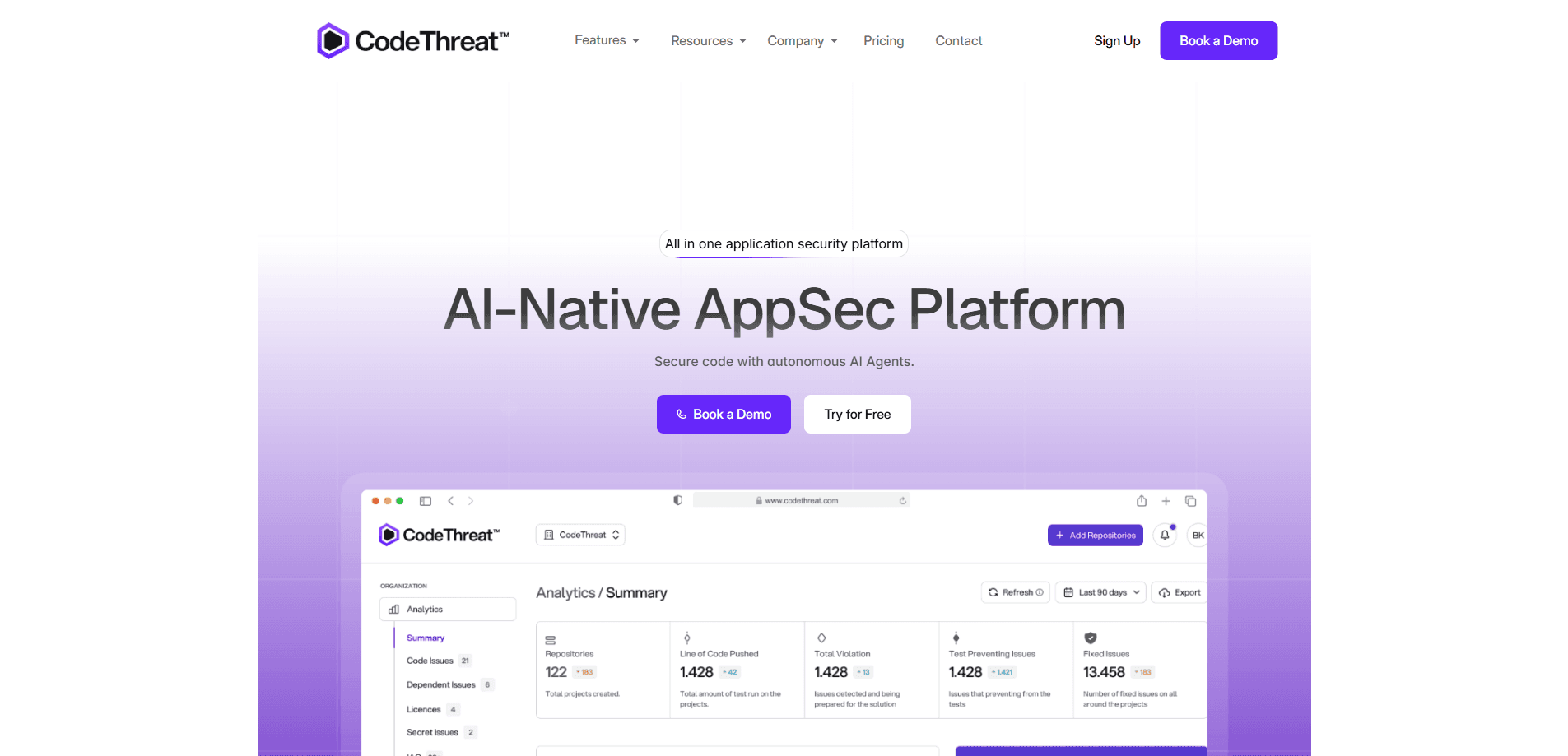
CodeThreat is an AI SAST platform that scans your codebase for vulnerabilities and reviews pull requests before merge. It pairs rule-based static application security testing (SAST) with AI agents that cut down false positives and explain the risks that matter. Teams connect their repos, get findings inside their existing workflow, and pay per contributor once they outgrow the free tier.
About CodeThreat
What Is CodeThreat
CodeThreat is a code security platform built around a simple idea: a scanner that cries wolf all day is a scanner nobody reads. It runs deterministic SAST, SCA, infrastructure and secret scanning, then puts AI agents on top to throw out weak findings and explain the real ones. That second layer is doing the heavy lifting, because it's the triage work, not the scanning, that usually buries a security team under a backlog nobody has time to clear.
The pitch sits in the gap between classic SAST tools and nothing at all. Traditional scanners flag everything and leave developers to sort it out, and when the backlog grows faster than anyone can triage it, the team quietly stops opening the dashboard. CodeThreat re-checks findings, marks the non-exploitable ones, and says why it thinks they're false positives. So what does that change day to day? You spend less time triaging alerts and more time fixing the ones that count.
It supports 27+ languages including Python, Java, JavaScript, Go and C#, with rules for frameworks like Django, React, Spring and Laravel. Findings can carry AI-generated fix suggestions. The main limit is scope. Deep coverage, on-prem deployment and unlimited agent runs sit behind the Pro and Enterprise tiers, so small teams on the free plan are working with quotas.
Getting Started
- Sign up at app.codethreat.com and start on the free plan with up to 3 private repositories.
- Connect your source control, either GitHub, GitLab, Bitbucket or Azure, and pick the repos you want scanned.
- Let the deterministic engines run SAST, SCA, secret scanning and IaC checks across the codebase.
- Turn on the AI agents for false positive elimination and agentic code review, then wire up CI/CD if you want scans on every push.
- Review findings in the dashboard or in PR comments, apply the suggested fixes, and push.
Product Information
A quick look at CodeThreat's pricing, supported platforms, and performance.
Best for
The users, tasks, and scenarios where this tool fits best.
Users
- Small dev teams
- Security engineers tired of noise
- Compliance-minded companies
Tasks
- Reviewing pull requests for security before merge
- Understanding an unfamiliar codebase
- Catching leaked keys and credentials
Scenarios
- Shipping faster without a dedicated AppSec review stage
- Onboarding new engineers
- Preparing for a security audit
Key features
AI SAST with contextual understanding
The AI-driven scan looks at project context to catch logic flaws, data flows and auth paths that rule-based scanners miss. It also tracks how data moves between functions and files, so it can flag dangerous flows without you building the project first. No build step. No waiting on a compile before security even starts.
False Positive Elimination
This is CodeThreat's headline claim, and the pricing reflects it. The agent re-checks SAST findings, marks the non-exploitable ones, and explains why each is likely a false positive. Fewer bogus alerts. More time on real problems. Developers stop closing tickets that go nowhere.
Agentic PR Review
Every pull request triggers a security review of the changed files, with feedback landing as PR comments. Security becomes part of code review rather than a step bolted on after deployment. That's where most teams lose track of it. Here it shows up where developers already are.
Agentic Repo Analysis and Mapping
The platform maps your whole repository and generates insights on architecture, documentation, endpoints, dependencies and data flow, so anyone joining mid-project can see how the pieces connect instead of grepping through folders for a week. The visual map links components and relationships, so a new engineer can understand the structure without reading every file. Handy when you join a project with a thousand files and no docs.
Broad language and integration coverage
CodeThreat supports 27+ programming languages and frameworks, and connects to GitHub, GitLab, Bitbucket, CI/CD pipelines and cloud providers. You don't have to change how your team works to add it. That matters more than the feature list suggests.
Full AppSec coverage in one place
SAST, SCA, IaC, container security and secret scanning all run from a single platform, which saves you the usual chore of pulling findings out of four separate vendor dashboards and reconciling them by hand before an audit. No juggling four vendors, no stitching reports by hand. For teams that already pay for separate tools, that consolidation is the real draw. One dashboard. One bill. Fewer gaps between tools.
Bring your own LLM
Enterprise customers can use custom LLM integration, including private model hosting. That's the option to look at if your code can't leave your infrastructure and you still want the agentic layer, because sending source code to a third-party model is a non-starter for plenty of regulated teams. Worth asking about early, since it shapes your whole deployment plan.
Pros and cons
Pros
- False positive elimination tackles the single biggest complaint about SAST tools.
- Free plan is genuinely usable for small teams, with 3 private repos and no credit top-ups.
- Broad language coverage (27+) and integrations with GitHub, GitLab, Bitbucket and CI/CD.
- All-in-one coverage: SAST, SCA, IaC, container and secret scanning under one roof.
- Transparent per-contributor pricing at $39, with on-prem and private LLM options on Enterprise.
Cons
- Paid tiers bill per contributor, so costs scale with developer headcount, not usage.
- The strongest agentic features are quota-limited on Free and Pro, hitting smaller teams first.
- On-prem deployment and custom LLM hosting are Enterprise-only, which means a sales conversation.
Frequently asked questions
CodeThreat is an AI-native application security platform that combines static application security testing with AI agents. It scans code for vulnerabilities, filters false positives, reviews pull requests and maps repositories, all from one dashboard.
Related content
Explore related tools, skills, and articles for CodeThreat.
CodeThreat Alternatives
Forefront
Forefront · CodingForefront is a web platform for building with open-source AI. It lets you fine-tune leading open-source language models on your own data, evaluate how they perform, and run them through an API or export them to host yourself. Developers who want the convenience of a closed-source platform but insist on owning their models and data are the target audience here.

Startkit
StartKit.AI · CodingStartkit is a boilerplate for building AI SaaS and AI wrapper products. Think of it as an AI startup boilerplate with the boring parts already wired up: authentication, Stripe and Lemon Squeezy payments, usage limits, transactional email, and an AI API starter that talks to OpenAI, Anthropic, Groq, or Llama. You clone the repo, set your price, and start on the part of your product that people actually pay for. It's Next.js under React and Tailwind, so most of the boilerplate code already feels familiar.
Testim
Tricentis · CodingTestim is an AI-powered test automation platform for building and running end-to-end tests across web, mobile, and Salesforce applications. It leans on machine learning to keep tests stable when an interface changes, so teams spend less time fixing broken selectors. Not bad for an automated testing tool you can start using today. You create tests by recording actions in a browser, then optionally add JavaScript when you need more control. It's a solid pick for busy QA teams.