

Compozy
Compozy (open source project) · Coding
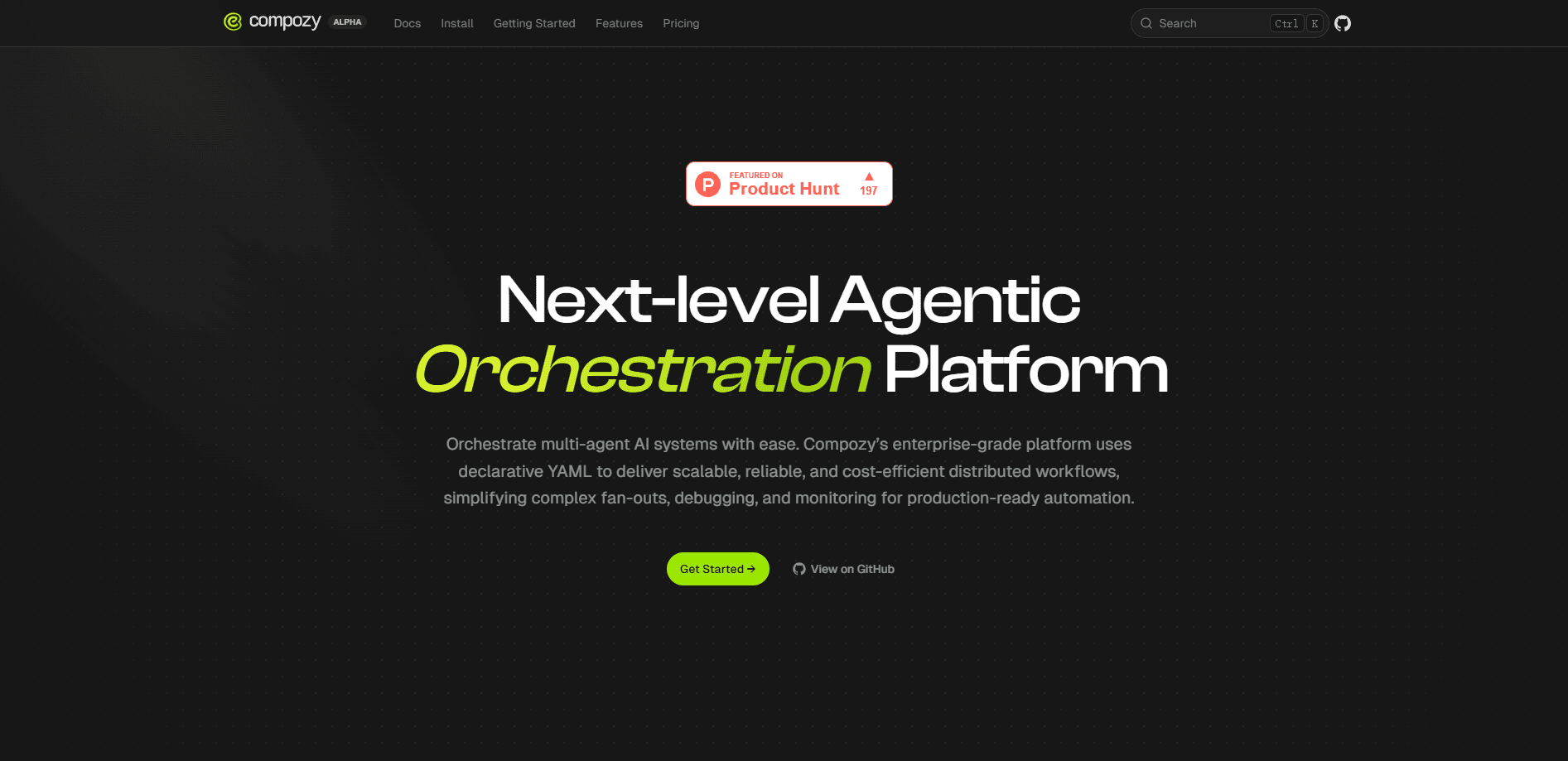
CompozyOS is a local-first operating system for AI agents. It runs the CLI agents you already use and adds loops, tasks, permissions and supervision in one runtime.
About Compozy
What Is CompozyOS
CompozyOS is an open source runtime that turns a pile of AI agent CLIs into one managed system. Instead of writing your own loops, cron jobs and glue scripts around Claude Code, Codex or OpenClaw, you install one local daemon and it owns that work. The project describes itself as an AI agent operating system, and the beta is aimed at developers and technical operators.
The problem it targets is specific. A single agent CLI is great inside one session and awkward everywhere around it. Close the terminal and the run is gone, there's no replay or audit trail, and every project needs its own guardrails. CompozyOS wraps all of that into one product: sessions stay durable, agent task management moves through a shared queue, and approvals and permissions are core objects rather than plugins you bolt on.
Two things shape who should care. It's local-first, meaning the runtime and its SQLite-backed state live on your machine unless you point it at an external provider, so data stays close to the workspace. And it's an early beta, so the experience today is technical: a terminal, a local daemon and a config file, with Homebrew support returning at the stable release.
Getting Started
- Install the beta with the verified installer on macOS or Linux, the npm beta channel, or a pinned Go release
- Run
compozy daemon startto launch the local process, which exposes the CLI, HTTP/SSE and a web UI - Enter the repository you want to manage and start a session; CompozyOS registers the workspace from your current directory
- Author tasks and Loops for recurring work, then supervise runs, approvals and history from the web UI or the CLI
Product Information
A quick look at Compozy's pricing, supported platforms, and performance.
Best for
The users, tasks, and scenarios where this tool fits best.
Users
- Developers building on agent CLIs
- Technical operators supervising agent work
- Small teams standardizing agent behavior
- Evaluators and tooling authors
Tasks
- Running recurring agent work
- Building goal-seeking loops
- Coordinating multiple agents
- Watching every run
- Extending the runtime
Scenarios
- A long refactor runs overnight
- A prompt finishes after a viewer disconnects
- Two agents touch the same project
- A new repository spins up
- A team wants an audit trail
Key features
Durable, Replayable Agent Sessions
CompozyOS turns each session into a durable unit of work rather than a live terminal process. While a session is active another client can attach with compozy session resume, and after it stops the status, recap, event history and transcript stay available. A later prompt can restart the provider against the same history, so context survives a crash, restart or handoff.
One Shared Task Queue
Tasks run through a single queue shared by people and agents. A worker claims a run atomically, holds a lease it must heartbeat and releases back to the queue if it crashes. Ownership is token-fenced, so only the agent holding the claim token can complete a run, and tokens are hashed before they reach the event ledger. The practical result is no double execution and no orphaned work when a daemon dies.
Loops for Continuous Work
Loops are the runtime's answer to goal-seeking agent automation. You author a Loop that keeps working toward an outcome, with routing and recovery handled by the runtime instead of a fork-and-pray script. Loop runs are legible in the UI, tie into session supervision, and can be stopped cleanly rather than left to run wild.
Automations with Cron, Webhooks and Events
Schedules, webhooks and event triggers start work without a terminal open. In the v0.3 beta these merged into one Automations area, where each automation reads as a sentence: how it starts, any conditions, what it does. Jobs and triggers share a detail page and carry a last-run result with an on/off switch, so a failed run is visible without digging.
Built-in Observability
Every run leaves a trace. Traces, event counts and tool usage come from the same records the runtime writes, so there's nothing extra to instrument. Sessions expose their status, recap and transcript, and operators can filter logs by session and event type, which turns debugging agent behavior into reading structured output instead of grepping scrollback.
Extensibility Without Plugin APIs
The runtime is extensible at every seam through plain files rather than a plugin API. Hooks are typed lifecycle points that can deny or narrow but never bypass, skills are Markdown files with YAML frontmatter, and extensions bundle skills, hooks, tools and MCP servers as zip files or through a GitHub registry. Anything the web UI can do, an agent can do through CLI, HTTP or UDS.
Runs the Agents You Already Use
CompozyOS doesn't reimplement agent logic behind API wrappers. It launches real agent CLIs as managed sessions through an ACP-compatible provider layer, so Claude Code stays Claude Code and OpenClaw stays OpenClaw. Twenty-six built-in providers are listed, with native login kept in each CLI's own store and optional CompozyOS-managed keys for API-based providers.
Pros and cons
Pros
- MIT-licensed and free to install, with no seat pricing or contract to sign
- Keeps real agent CLIs intact instead of flattening them into thin API wrappers
- Durable sessions and a token-fenced task queue remove double execution and orphaned runs
- Local-first design keeps runtime state and workspace data on your own machine
- Shared control surfaces mean the CLI, HTTP, UDS and web UI drive the same daemon-owned state
Cons
- Still in beta, so breaking changes land between versions and the experience is terminal-first
- Setup assumes comfort with a daemon, a config file and command-line workflows, which rules out non-technical users
- Homebrew is unavailable during the beta window, adding an install step for Mac and Linux users who prefer it
- Guidance and docs often target developers and operators, so newcomers face a real learning curve
Frequently asked questions
CompozyOS is a local-first operating system for AI agents. It runs the agent CLIs you already use, like Claude Code, OpenClaw and Hermes, as durable sessions and adds the parts around them: loops, tasks, automations, permissions, approvals and observability, all in one runtime.
Related content
Explore related tools, skills, and articles for Compozy.
Compozy Alternatives
Forefront
Forefront · CodingForefront is a web platform for building with open-source AI. It lets you fine-tune leading open-source language models on your own data, evaluate how they perform, and run them through an API or export them to host yourself. Developers who want the convenience of a closed-source platform but insist on owning their models and data are the target audience here.

Startkit
StartKit.AI · CodingStartkit is a boilerplate for building AI SaaS and AI wrapper products. Think of it as an AI startup boilerplate with the boring parts already wired up: authentication, Stripe and Lemon Squeezy payments, usage limits, transactional email, and an AI API starter that talks to OpenAI, Anthropic, Groq, or Llama. You clone the repo, set your price, and start on the part of your product that people actually pay for. It's Next.js under React and Tailwind, so most of the boilerplate code already feels familiar.
Testim
Tricentis · CodingTestim is an AI-powered test automation platform for building and running end-to-end tests across web, mobile, and Salesforce applications. It leans on machine learning to keep tests stable when an interface changes, so teams spend less time fixing broken selectors. Not bad for an automated testing tool you can start using today. You create tests by recording actions in a browser, then optionally add JavaScript when you need more control. It's a solid pick for busy QA teams.