

Constellation Gate AI
Constellation Network · Coding
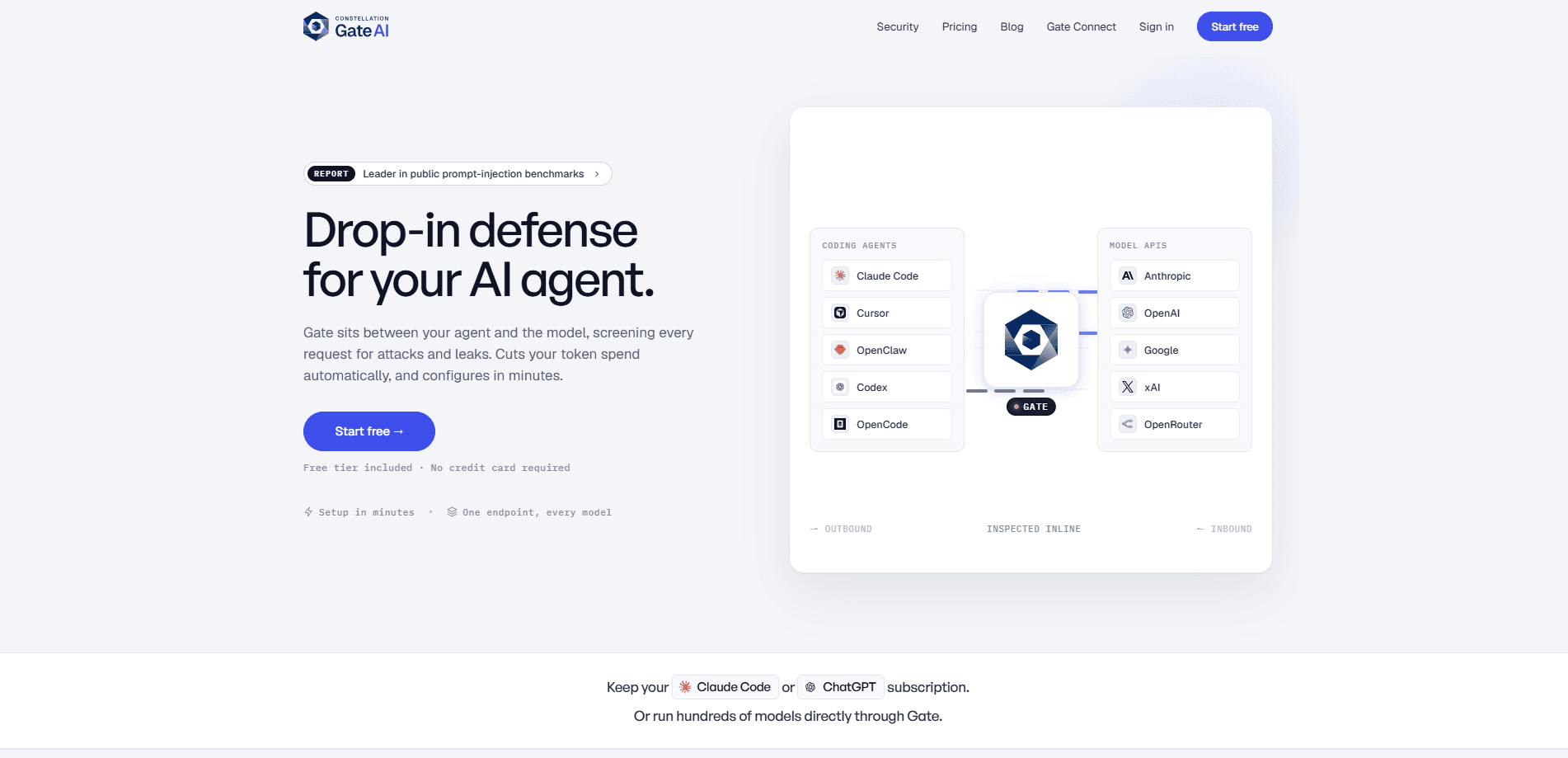
Constellation Gate AI is a real-time AI security gateway that sits between your agents and your language models. It works as an LLM gateway, screening every request on the way in and every response on the way out, so it can deliver prompt injection protection, stop credential and PII leakage, drive token cost savings, and keep a tamper-evident AI audit trail of every model call. Teams point their existing tools at one base URL and keep using the providers they already pay for, with AI spend management built into the same layer.
About Constellation Gate AI
What Is Constellation Gate AI
Constellation Gate AI is a proxy layer for teams running AI agents in production. Think of it as a checkpoint. It doesn't replace your model provider. It stands in front of one, watching the traffic that moves between your app and OpenAI, Anthropic, or any other supported service. Because it's already in the path of every request, it can screen inputs, scrub outputs, compress what gets sent, and write an audit trail without you bolting on separate tools.
The main problem it solves is that AI agents are exposed from two directions at once. Attacker text arrives as ordinary input. It can quietly override instructions, leak data, or trigger a tool call. Sensitive data goes the other way, in responses that may contain an API key or a customer's SSN. Gate screens both directions and applies redaction before anything risky reaches its destination.
The biggest limitation is scope. Gate is a gateway, not a full security platform, so it only protects traffic that you route through it. If part of your team calls providers directly and bypasses Gate, that traffic stays blind. So why route through Gate at all? Because a single checkpoint for screening, redaction, compression, and logging is easier to run than four separate tools. You also get the most value on the paid tier, since injection scanning, redaction, and spend caps are Pro features.
Getting Started
- Sign up at the Gate app with an email address. The Free plan needs no credit card.
- Create a workspace and copy the gateway base URL it gives you.
- Point one tool or agent at that base URL in place of your provider's endpoint. You can run models through Gate's keys on pay-as-you-go, or bring your own OpenAI or Anthropic keys.
- Open the activity view to watch requests, cost, tokens, and any blocked attacks come in live.
- Upgrade to Pro when you want injection scanning, redaction, and spend caps, or set a cap so an agent stops instead of running up your bill.
Product Information
A quick look at Constellation Gate AI's pricing, supported platforms, and performance.
Best for
The users, tasks, and scenarios where this tool fits best.
Users
- Engineering teams running AI agents in production
- Security and compliance leads
- Solo builders on a budget
Tasks
- Blocking prompt injection before it reaches a model
- Cutting token spend on repetitive agent loops
- Redacting secrets and PII from model responses
- Auditing what your agents actually did
Scenarios
- A customer-support agent that handles account details
- Agents that loop through the same file or tool call
- Teams that already pay for Claude Code or ChatGPT
- Month-end budget scares
Key features
Prompt injection protection and attack blocking
Gate screens every request before it reaches the model and every response after. It covers three common attack paths: direct prompt injection, indirect injection through hijacked tool calls, and credential or PII leakage. It detects them in transit, so an attack is stopped before the model sees it. The company reports 96.6% average F1 across 16 public datasets, measured against Lakera Guard at 83.7%. That figure comes from Gate's own benchmark report, so treat it as a vendor claim.
Token cost savings
Gate processes each request on its way to the provider and strips token waste. It removes duplicate content, repeated file reads, and tool-call overhead, but keeps the first copy of anything intact, so the model receives the same content and returns the same answer. On the company's example request, a 6,500-token call dropped to 5,162 tokens, a 20.6% saving, which is where the token cost savings come from.
PII and credential redaction
Sensitive data leaving in a response is a quiet risk, since one reply is enough to expose an SSN, an API key, or an internal note. PII redaction at the gateway catches it in time: Gate scrubs PII, PHI, and credentials before the response returns to your app, so the leak never happens on your side.
Repeat-request caching
Agentic systems repeat themselves constantly. The same file read. The same retry. The same tool call, looping. When an identical request arrives a second time, Gate returns the stored response instead of calling the provider. A cache hit costs no tokens at all.
Spend and rate limits
On Pro you can set spend, token, and request-rate caps at the organization, project, or API-key level. When an agent hits its limit, Gate stops the requests rather than your card.
Tamper-evident AI audit trail
Every message is fingerprinted to Constellation Digital Evidence. That produces an immutable record of each model call. The AI audit trail carries cost, tokens, and latency across the workspace, and conversation threading lets you follow a single agent run end to end.
Multi-provider routing
One base URL covers OpenAI, Anthropic, and other providers, so you configure Gate once instead of chasing each endpoint. You can pay as you go through Gate's keys or bring your own provider keys and keep paying the provider directly.
Pros and cons
Pros
- Security, cost control, and logging live in one place, since Gate is already in the request path.
- Token compression and repeat caching can cut spend without changing what the model returns.
- Free plan needs no card and records 20,000 requests a month, so testing is low-risk.
- Works in front of subscriptions you already have, including Claude Code and ChatGPT.
- The audit trail is immutable and per-message, which is useful for security review.
Cons
- Protection only covers traffic routed through Gate, so direct provider calls stay blind.
- Injection scanning, redaction, and spend caps are Pro features, so the free tier is mostly logging.
- The headline benchmark numbers come from Gate's own report, not an independent test.
- Small teams may find the Enterprise-only private cloud and custom retention out of reach.
Frequently asked questions
It's a real-time gateway that sits between your AI agents and your model providers. It screens requests and responses for attacks and leaked data, compresses traffic to reduce token costs, and records every call in a verifiable audit trail.
Related content
Explore related tools, skills, and articles for Constellation Gate AI.
Constellation Gate AI Alternatives
Forefront
Forefront · CodingForefront is a web platform for building with open-source AI. It lets you fine-tune leading open-source language models on your own data, evaluate how they perform, and run them through an API or export them to host yourself. Developers who want the convenience of a closed-source platform but insist on owning their models and data are the target audience here.

Startkit
StartKit.AI · CodingStartkit is a boilerplate for building AI SaaS and AI wrapper products. Think of it as an AI startup boilerplate with the boring parts already wired up: authentication, Stripe and Lemon Squeezy payments, usage limits, transactional email, and an AI API starter that talks to OpenAI, Anthropic, Groq, or Llama. You clone the repo, set your price, and start on the part of your product that people actually pay for. It's Next.js under React and Tailwind, so most of the boilerplate code already feels familiar.
Testim
Tricentis · CodingTestim is an AI-powered test automation platform for building and running end-to-end tests across web, mobile, and Salesforce applications. It leans on machine learning to keep tests stable when an interface changes, so teams spend less time fixing broken selectors. Not bad for an automated testing tool you can start using today. You create tests by recording actions in a browser, then optionally add JavaScript when you need more control. It's a solid pick for busy QA teams.