

Context.dev
Context.dev · Coding
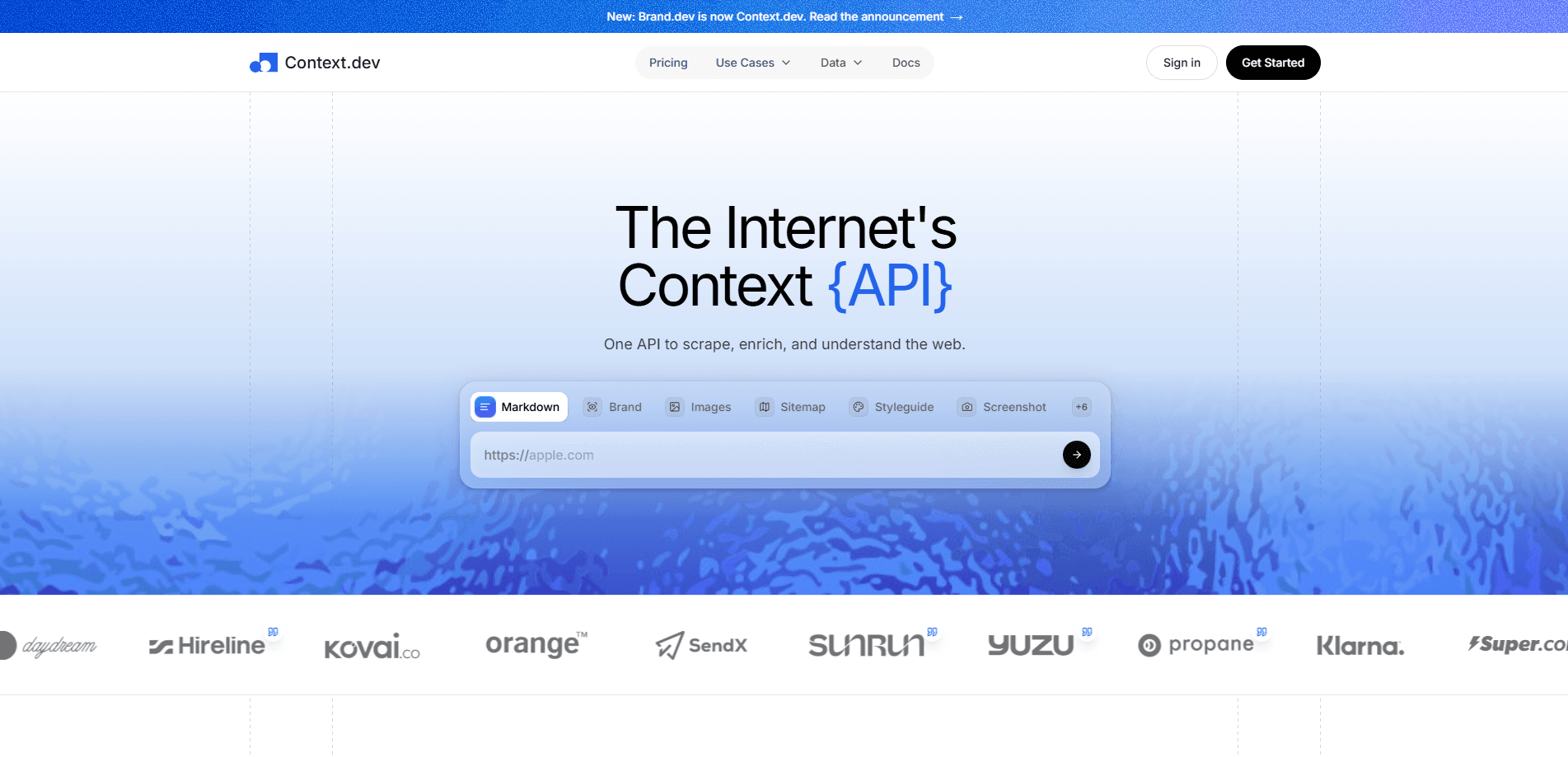
Context.dev is a unified web context API built for software teams and AI agents that need live, structured access to the web. It handles scraping, crawling, structured data extraction, brand intelligence, and website monitoring through one key, so you don't have to run your own crawlers, browsers, or proxies. Pricing starts at $0 with 1,000 free credits per month and scales up to enterprise contracts.
About Context.dev
What Is Context.dev
Context.dev is a platform that gives developers a single API for pulling web data into their apps and AI workflows. Instead of stitching together a scraper, a proxy service, a browser farm, and a separate brand data vendor, you hit one endpoint and get clean Markdown, rendered HTML, or schema-validated JSON back. The pitch is simple: fewer moving parts to maintain, predictable usage costs, and one key across everything.
The product covers three main areas. Scraping and crawling turn any URL or whole site into LLM-ready Markdown or HTML. Structured extraction returns data that matches a JSON Schema you supply, plus niche jobs like product normalization, sitemaps, images, and screenshots. Brand and company intelligence resolves a domain, email, name, or ticker into a brand profile with logos, colors, fonts, and industry codes.
The biggest limitation is that it's built for developers. There's no drag-and-drop interface or no-code builder, so if you're not comfortable with REST calls, an SDK, or MCP, this isn't the tool for you. Credits also run out on lower tiers. The free plan caps you at 1,000 credits and 30 calls per minute, and once you hit the limit there's no overage. You have to upgrade or wait for the next cycle. So what happens when your crawl needs more pages than your plan allows? You'd have to upgrade.
Getting Started
- Sign up at context.dev with an email. No credit card is needed for the free tier, which gives you 1,000 credits per month right away.
- Generate an API key from your dashboard. The same key works across every API, from scraping to brand retrieval to monitors.
- Pick your integration path: a REST call, one of the official SDKs, or an MCP server if you're wiring this into an AI agent.
- Make your first request, like scraping a URL to Markdown or extracting structured data against a JSON Schema.
- Watch your credit usage in the dashboard and upgrade to Developer at $19/mo when you need more volume, higher rate limits, and monitors.
Product Information
A quick look at Context.dev's pricing, supported platforms, and performance.
Best for
The users, tasks, and scenarios where this tool fits best.
Users
- Developers building AI agents
- Data and growth teams
- Startups watching costs
Tasks
- Scraping pages into clean Markdown
- Extracting structured product data
- Monitoring sites for changes
- Crawling an entire site
Scenarios
- Feeding a RAG assistant fresh web content
- Resolving a merchant from a bank statement descriptor
- Enriching a CRM with brand assets
Key features
Scrape and Parse in One API
The web crawl API and the Scrape Markdown endpoint turn a URL into clean, LLM-ready Markdown and handle JavaScript rendering and proxy escalation for you. There's a Parse Bytes endpoint too, which converts uploaded documents, spreadsheets, and presentations straight to Markdown. If your app needs the DOM instead of cleaned text, the Scrape HTML endpoint returns fully rendered HTML.
Schema-Validated Extraction
The Extract API crawls the relevant pages of a site and returns data that matches a JSON Schema and instructions you provide. For product work, Extract Product and Extract Products normalize a single product page or a full catalog into structured records. That's the piece that saves teams from writing and maintaining a separate parser for every site they care about.
Brand and Company Intelligence
Context.dev doubles as a brand intelligence API. Retrieve Brand resolves a company by domain, email, name, or ticker and returns a full brand profile, including logos, colors, fonts, styleguides, descriptions, socials, and addresses. NAICS and SIC classification identifies industry codes, and Transaction Identification maps a bank or card descriptor back to the real merchant.
Website Monitors
Page, Sitemap, and Extract Monitors watch pages, sitemaps, or structured data and alert you when something changes. You set the target and the API handles the checks, which is easier than running your own diffing job on a schedule.
One Key Across REST, SDK, and MCP
Every API uses the same Context.dev key and is available through REST and the official SDKs. If you're building an AI agent, an MCP server plugs the same capabilities in without custom glue code. One credential and one billing surface for the whole suite.
Low-Latency Logo CDN
Logo Link serves a current company logo from a domain through a low-latency CDN URL. That's a small feature, but it saves you from hosting and refreshing brand assets yourself when you just need a logo to render.
Pros and cons
Pros
- Scraping, extraction, brand data, and monitors come from one provider and one API key, which cuts down on vendor sprawl.
- Free tier gives 1,000 credits per month with no credit card, enough to test the whole API suite. That's a real try-before-you-buy setup.
- Pricing is transparent and credit-based, with overage rates published at each tier ($14, $9, and $7 per 10K credits). No surprises there.
- Official SDKs and an MCP server mean less custom integration work for AI agents.
- Startup and nonprofit discounts take 30% off annual plans for 12 months.
Cons
- Developer-only: there's no no-code or drag-and-drop option, so non-technical users are locked out.
- The free plan has no overage, so hitting 1,000 credits stops your requests until the next cycle.
- Entry paid tier starts at $19/mo, which is steep if you only need occasional scraping.
- Credit limits apply across all APIs, so heavy brand retrieval or monitor use can eat your monthly allowance fast.
Frequently asked questions
Context.dev is a web context API that pulls live data off the web for apps and AI agents. It scrapes pages to Markdown, extracts structured JSON, crawls whole sites, retrieves brand data, and monitors pages for changes.
Related content
Explore related tools, skills, and articles for Context.dev.
Context.dev Alternatives
Forefront
Forefront · CodingForefront is a web platform for building with open-source AI. It lets you fine-tune leading open-source language models on your own data, evaluate how they perform, and run them through an API or export them to host yourself. Developers who want the convenience of a closed-source platform but insist on owning their models and data are the target audience here.

Startkit
StartKit.AI · CodingStartkit is a boilerplate for building AI SaaS and AI wrapper products. Think of it as an AI startup boilerplate with the boring parts already wired up: authentication, Stripe and Lemon Squeezy payments, usage limits, transactional email, and an AI API starter that talks to OpenAI, Anthropic, Groq, or Llama. You clone the repo, set your price, and start on the part of your product that people actually pay for. It's Next.js under React and Tailwind, so most of the boilerplate code already feels familiar.
Testim
Tricentis · CodingTestim is an AI-powered test automation platform for building and running end-to-end tests across web, mobile, and Salesforce applications. It leans on machine learning to keep tests stable when an interface changes, so teams spend less time fixing broken selectors. Not bad for an automated testing tool you can start using today. You create tests by recording actions in a browser, then optionally add JavaScript when you need more control. It's a solid pick for busy QA teams.