

Coresignal
Coresignal · Coding · Business
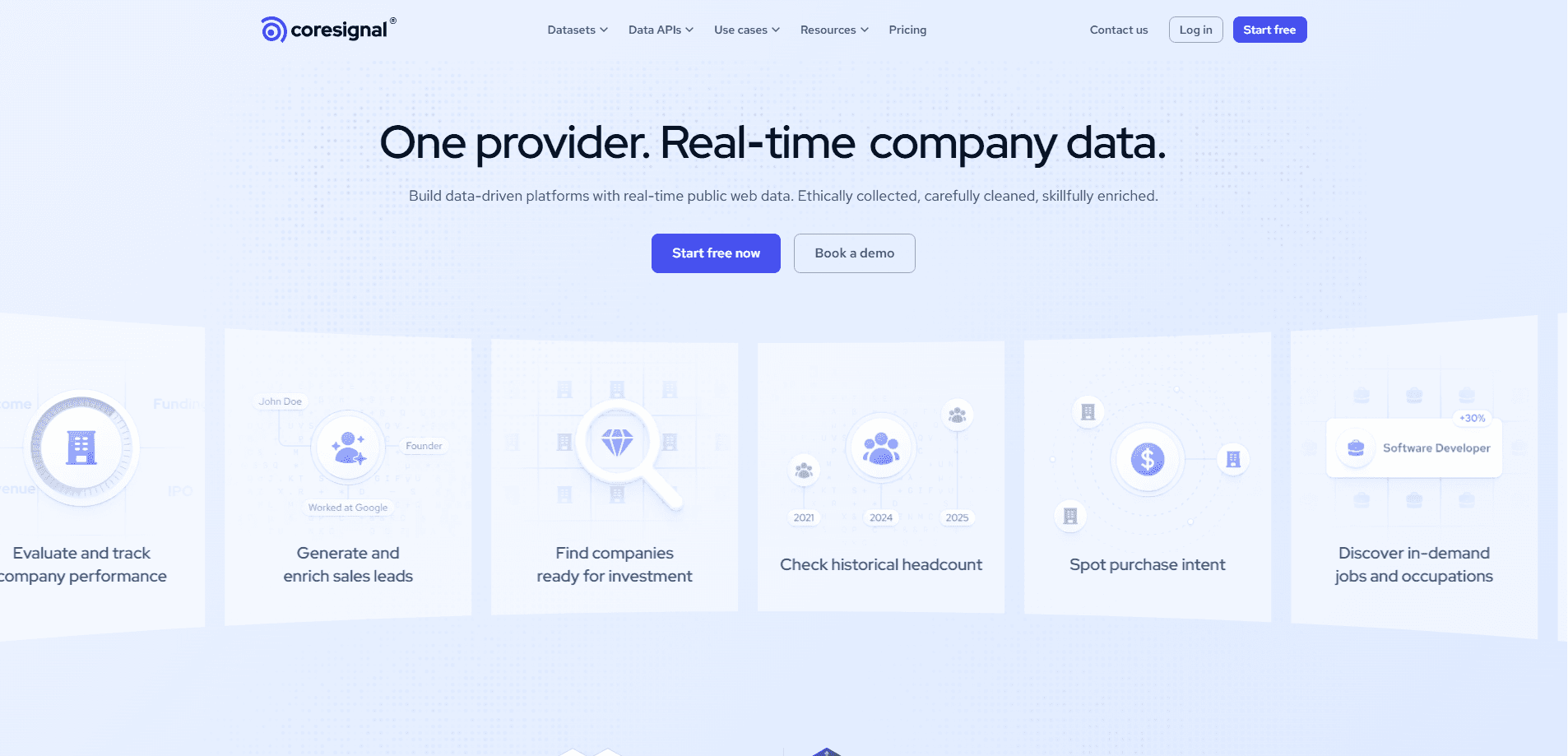
Coresignal is a public web data provider that sells fresh, multi-source datasets and APIs covering companies, employees, and job postings. It gives data teams ready-to-use records they can pipe into lead enrichment, AI training, recruitment platforms, and market research without building a scraper themselves. You pay per credit, with plans that start cheap and scale up to enterprise volume.
About Coresignal
What Is Coresignal
Coresignal is a data provider, not a chat app. It collects publicly available web data at scale and packages it into structured datasets and APIs covering three main categories: companies, employees, and jobs. The company has been operating since 2016 and counts more than 1,000 clients, mostly in sales tech, HR tech, investment, and market research.
The core problem it solves is freshness. Pulling your own company and people data from the web is slow, legally messy, and breaks the moment a site changes its layout. So who builds the scraper? Most teams shouldn't. Coresignal handles collection, deduplication, and enrichment, then returns records through a REST API or flat files. Most datasets carry hundreds of fields, so you can build a fairly detailed profile without stitching sources together yourself.
The biggest limitation is cost and structure. There's no free forever tier, only a 7-day trial, and the cheapest ongoing plan runs $49/month for 2,500 credits. Credits aren't one-to-one with records either. A base company or employee record costs 10 credits, a job posting costs 1, and a contact enrichment costs 20, so the effective price per usable record depends heavily on what you pull.
Getting Started
- Sign up at the Coresignal dashboard and start the 7-day free trial, which comes with a starter credit allowance.
- Pick a data solution: the Dataset option if you want bulk files delivered as JSON or CSV, or the Data API option if you need live lookups.
- Generate an API key in the dashboard and send a test request to the Company, Employee, or Jobs endpoint to confirm your account and rate limit.
- Choose the fields you actually need and estimate credit usage before running large pulls, since each field set and record type has its own credit cost.
- Export up to 100 records for a preview with the search tools, then scale up or move to a paid plan when you're ready to commit volume.
Product Information
A quick look at Coresignal's pricing, supported platforms, and performance.
Best for
The users, tasks, and scenarios where this tool fits best.
Users
- Sales and RevOps teams
- HR tech and recruitment platforms
Tasks
- Lead enrichment
- AI and ML training
- Market and investment research
Scenarios
- Building an internal search platform
- Tracking a competitor's hiring
- Enriching a CRM in bulk
Key features
Multi-source data collection
Coresignal pulls from 15+ web sources rather than a single feed, then deduplicates the results. One source rarely covers a company fully. Mixing sources gives you a broader picture of firms, employees, and open roles.
Company and employee APIs
Three core APIs cover Company, Employee, and Jobs data. The employee data API returns structured profiles with full work history, while the company endpoint handles firmographics. You query by identifiers or filters and get records back in a consistent format, which is the part most teams care about when wiring data into a product.
Agentic Search API
For teams that would rather describe what they want than write a query, the Agentic Search API takes a prompt and returns a matching list. It runs in a /fast mode for lower cost and a /reasoning mode for harder requests, each with its own credit price.
Bulk datasets
If you don't need live lookups, the Datasets product delivers 70M+ company records, 907M+ employee records, and 482M+ job postings as JSON or CSV. Historical data is available, so you can run analysis on a fixed snapshot instead of querying record by record.
Credit-based pricing
The whole product runs on credits. Base records cost 10 credits, multi-source records cost 20, job postings cost 1, and contact enrichments cost 20. This makes it easy to estimate costs before you commit, and easier to overspend if you don't plan.
Built-in tools and integrations
Beyond raw API access, higher plans add an Elasticsearch DSL, webhooks for automated updates, and a search preview. The data also flows through Zapier and Clay, which helps non-engineering teams pull records without writing code.
Pros and cons
Pros
- Large record counts, with 4.5B+ total records across companies, employees, and jobs.
- Fast API response times, quoted at around 176 ms on the official site.
- Transparent credit pricing that lets you estimate cost per record type before buying.
- Integration with Zapier and Clay, so non-developers can use the data too.
- Positioned around ethical collection, with membership in the Ethical Web Data Collection Initiative.
Cons
- No permanent free plan, only a 7-day trial, so you can't test indefinitely before paying. That's a real constraint for small teams.
- The cheapest plan costs $49/month, which is steep for a solo builder or a small side project.
- Credit costs vary sharply by record type, so the same budget buys far fewer employee records than job postings.
- Lower plans cap rate limits at 5 requests per second, which slows down large scheduled pulls. Not ideal for heavy backfills.
Frequently asked questions
Not a permanent one. Coresignal offers a 7-day free trial with a starter credit allowance, but running it long term means picking a paid plan, starting at $49/month.
Related content
Explore related tools, skills, and articles for Coresignal.
Coresignal Alternatives
Forefront
Forefront · CodingForefront is a web platform for building with open-source AI. It lets you fine-tune leading open-source language models on your own data, evaluate how they perform, and run them through an API or export them to host yourself. Developers who want the convenience of a closed-source platform but insist on owning their models and data are the target audience here.

Startkit
StartKit.AI · CodingStartkit is a boilerplate for building AI SaaS and AI wrapper products. Think of it as an AI startup boilerplate with the boring parts already wired up: authentication, Stripe and Lemon Squeezy payments, usage limits, transactional email, and an AI API starter that talks to OpenAI, Anthropic, Groq, or Llama. You clone the repo, set your price, and start on the part of your product that people actually pay for. It's Next.js under React and Tailwind, so most of the boilerplate code already feels familiar.
Testim
Tricentis · CodingTestim is an AI-powered test automation platform for building and running end-to-end tests across web, mobile, and Salesforce applications. It leans on machine learning to keep tests stable when an interface changes, so teams spend less time fixing broken selectors. Not bad for an automated testing tool you can start using today. You create tests by recording actions in a browser, then optionally add JavaScript when you need more control. It's a solid pick for busy QA teams.