

Deploy Hermes
DeployHermes · Coding
Deploy Hermes is a managed hosting service for persistent Hermes Agent bots. No VPS to run. Instead, you get an isolated private runtime per workspace where each bot keeps its own role, model, memory, and skills. A shared mission board tracks work, anything that needs a human call waits as a decision ticket, and every run leaves a receipt with its model, tokens, tools, and duration. You steer the squad from the web application or from Telegram.
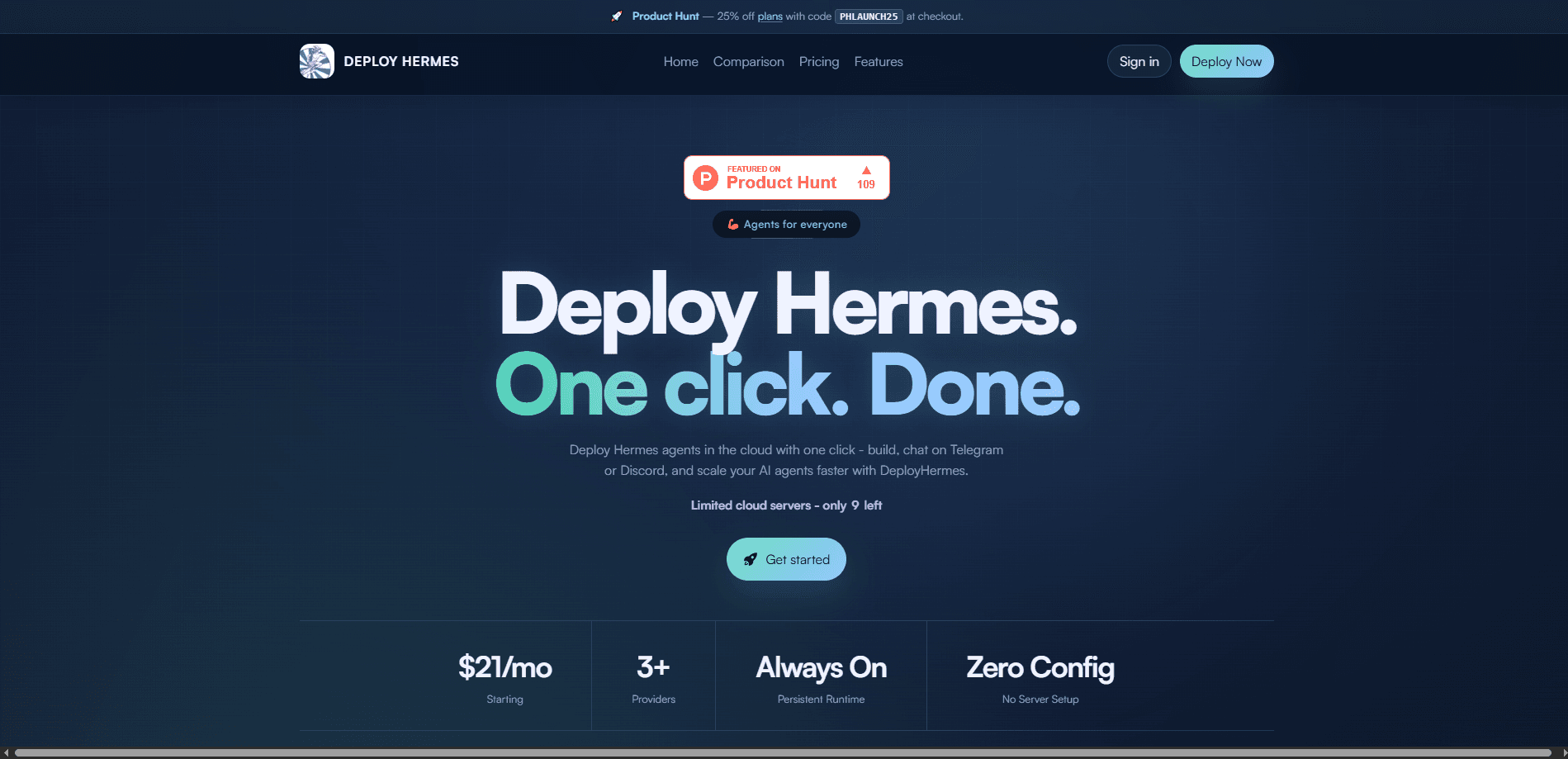
About Deploy Hermes
What Is Deploy Hermes
Deploy Hermes is the managed host wrapped around Hermes Agent, an open-source AI assistant that runs as a durable agent rather than a one-off chat. It gives each workspace a private runtime and keeps a visible operating record for the bots using it. If you already understand Hermes and want it always on, this replaces the undocumented VPS you'd otherwise babysit.
The service is built for teams that want an AI agent squad they can inspect. Bots have their own role, model, memory, and skills, while the workspace keeps the shared board of missions, decision tickets, and run receipts. You connect your own model provider keys, which are stored encrypted, so model usage is billed by your provider at their rate, not marked up here.
The main catch is scope. Deploy Hermes isn't a cheap Docker box, and it doesn't include model tokens in the platform fee. Hosted chat-channel support is currently Telegram plus the web application. Discord and Slack aren't shipped as hosted channels yet. There's also exactly one plan, and no free tier to test the water with.
Getting Started
- Create a workspace on deploy-hermes.com and pick the Deploy Hermes workspace plan.
- Connect your own model provider credentials (for example Anthropic, OpenAI, Google Gemini, xAI Grok, or OpenRouter); they're stored encrypted.
- Hire bots for the workspace and give each one a role, a model, memory, and skills.
- Assign a mission from the web application or Telegram, then review the results.
- Answer any decision tickets that pause for human judgement, and read the run receipt when work finishes.
Product Information
A quick look at Deploy Hermes's pricing, supported platforms, and performance.
Best for
The users, tasks, and scenarios where this tool fits best.
Users
- Teams already running Hermes Agent
- Founders and small operators
- Developers who want an agent driving a workspace
Tasks
- Persistent mission work, which is managed AI agent hosting in practice
- Approval-gated actions
- Auditable automation
Scenarios
- Running a persistent AI-agent squad with clear roles instead of one general chat assistant.
- Operating an always-on agent for a business without standing up and patching a VPS yourself.
- Connecting an agent to Telegram so you can steer missions and answer approvals from your phone.
Key features
Isolated private runtime per workspace
Each workspace gets its own private runtime for Hermes Agent, so one squad's bots and data stay separate from another's. Bots keep their own role, model, memory, and skills while the workspace holds the shared board. That split is what makes it practical to run several named agents without them stepping on each other.
Mission board with decision tickets
You give a bot a mission and it reports back onto a shared board. Simple. Anything that needs judgement stops as a decision ticket until a human answers, which turns "the agent did something odd" into a review step you control. No black box. You approve each sensitive move.
Run receipts for every execution
Every run leaves a receipt with its model, tokens, tools, duration, and result. Something looks off? Check the receipt rather than guess. This audit trail is the feature that separates a managed squad from a pile of cron jobs.
Bring your own model provider
Deploy Hermes is the agent runtime, not a model provider. You connect supported provider credentials (Anthropic, OpenAI, Google Gemini, xAI Grok, or OpenRouter), stored encrypted, and your bots run against them. No markup. Deploy Hermes doesn't mark up model tokens; you pay your provider's own rate directly.
Public REST API and MCP endpoint
There are two developer surfaces. An unauthenticated REST API covers discovery, health, docs, and the OpenAPI contract, while an authenticated Model Context Protocol endpoint operates a workspace. Both are described by a single OpenAPI 3.1 document, so an agent can plan its whole integration from one response.
Telegram and web steering
You operate the workspace from the web application or from Telegram. Telegram steering means approvals and mission assignments don't require you to sit at a desk. A ticket can wait. You answer it from your phone.
Usage credits for API calls
API and MCP tool calls use a separate usage-credit meter. Every active workspace gets 1,000 included credits per UTC calendar month, purchased credits never expire, and free cache hits and failed calls don't count against you. An MCP tool call costs 0.5 credits, and checking status is free.
Pros and cons
Pros
- Managed runtime removes the VPS upkeep that self-hosting Hermes Agent normally demands.
- The mission board, decision tickets, and run receipts give you a real audit trail for agent work.
- Bring-your-own provider keys mean no token markup and freedom to pick your model.
- MCP and REST surfaces let another agent drive the workspace programmatically.
- Telegram steering keeps approvals and missions reachable away from a desk.
Cons
- There's only one plan and no free tier, so you can't trial the platform before paying.
- Model tokens aren't included; your provider bill sits on top of the $99-$249/mo platform fee.
- Hosted chat channels are limited to Telegram and the web app, so Discord and Slack teams can't use their usual channels yet.
Frequently asked questions
It hosts Hermes Agent, an open-source AI assistant that runs as a persistent agent with its own role, model, memory, and skills. For Hermes bot hosting, you get a private runtime per workspace plus a shared board of missions and receipts.
Related content
Explore related tools, skills, and articles for Deploy Hermes.
Deploy Hermes Alternatives
Forefront
Forefront · CodingForefront is a web platform for building with open-source AI. It lets you fine-tune leading open-source language models on your own data, evaluate how they perform, and run them through an API or export them to host yourself. Developers who want the convenience of a closed-source platform but insist on owning their models and data are the target audience here.

Startkit
StartKit.AI · CodingStartkit is a boilerplate for building AI SaaS and AI wrapper products. Think of it as an AI startup boilerplate with the boring parts already wired up: authentication, Stripe and Lemon Squeezy payments, usage limits, transactional email, and an AI API starter that talks to OpenAI, Anthropic, Groq, or Llama. You clone the repo, set your price, and start on the part of your product that people actually pay for. It's Next.js under React and Tailwind, so most of the boilerplate code already feels familiar.
Testim
Tricentis · CodingTestim is an AI-powered test automation platform for building and running end-to-end tests across web, mobile, and Salesforce applications. It leans on machine learning to keep tests stable when an interface changes, so teams spend less time fixing broken selectors. Not bad for an automated testing tool you can start using today. You create tests by recording actions in a browser, then optionally add JavaScript when you need more control. It's a solid pick for busy QA teams.