

Descript
Descript · Video
Descript is an AI-powered video and audio editor that treats your recording like a document, so you cut, rearrange, and polish footage by editing the transcript instead of dragging clips on a timeline. It's built around text-based video editing, which is why podcasters and YouTubers reach for it. It also bundles podcast editing software staples like AI transcription, screen recording, captions, and voice cloning, plus an AI co-editor called Underlord. It runs on Mac, Windows, and in the browser, and a free plan lets you test the core tools before paying.
About Descript
What Is Descript
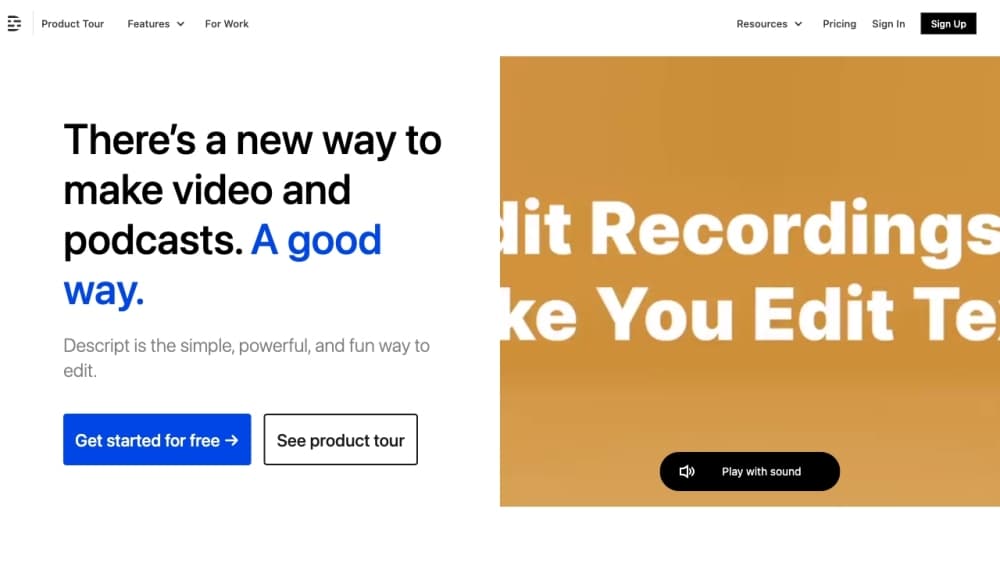
Descript inverts how editing usually works. You import a video or audio file, it transcribes everything, and then you edit that transcript. Delete a sentence, and the matching audio disappears. Move a paragraph, and the clip slides to a new spot. The company pitches this as editing "as easy as a doc," and for interview-style and spoken-word content, the claim mostly holds up. It came out of Detour, a walking-tour app, where a small team needed to cut down long recordings fast and kept running into the same wall with traditional timeline editors. They split it into its own product in 2017 and later raised funding from investors including the OpenAI Startup Fund. Today more than six million creators and teams use it, according to Descript, for podcasts, YouTube videos, tutorials, and internal company recordings.
The biggest limitation is scope. Descript handles talking-head video, multicam, and audio cleanup well, but it isn't built for heavy visual effects, motion graphics, or frame-level color grading. If your project needs cinematic compositing, you'll still export elsewhere. Long projects can also crawl on older machines. Hardware matters here.
Getting Started
- Create a free account at web.descript.com, or download the desktop app for macOS or Windows. No install is needed if you work in the browser.
- Start a new project and import media from your computer, Zoom, or Google Drive, or record your screen and camera directly inside Descript.
- Let the transcription finish, then edit the script text to cut your video. Deleting words removes the matching footage.
- Add scenes, captions, and layouts, or ask Underlord to handle bulk edits like removing filler words.
- Export at 1080p on the free and Hobbyist plans or 4K on higher tiers, then publish to YouTube, TikTok, or a share link.
Product Information
A quick look at Descript's pricing, supported platforms, and performance.
Best for
The users, tasks, and scenarios where this tool fits best.
Users
- Podcasters
- YouTube creators and streamers
- Marketing and sales teams
Tasks
- Turning a raw interview into a clean audio or video episode
- Repurposing a webinar or long stream into short clips
- Recording a tutorial or demo with screen and camera capture
- Translating and dubbing a video into another language
Scenarios
- Producing a weekly podcast without learning professional audio software.
- Editing a product demo or onboarding video on a laptop during a commute, using the browser version.
- Cleaning up a remote team standup recording so it can be shared as an update.
Key features
Text-based editing
This is the reason most people choose Descript. After transcription, every word maps to a slice of audio or video, so backspacing through a sentence removes that exact footage. No waveform hunting. No timeline zooming to find one filler word. If you have ever cut video, the shift feels immediate.
Underlord AI co-editor
Underlord is Descript's built-in assistant, and it works on real editing tasks rather than answering questions. You can ask it to write or tighten a script, remove every filler word, center each speaker, or pull the most engaging moments from a long video. It also knows the app's own features. So instead of hunting through menus, you just say what you want.
Studio Sound and audio cleanup
Studio Sound is a one-click tool that makes a phone or webcam recording sound closer to a studio mic. It removes background noise and evens out levels, which matters for podcasts and interviews recorded in less-than-ideal rooms. Filler-word removal and retake removal run alongside it, and the underlying AI transcription tool feeds every edit you make.
AI voice cloning and speech
Descript can build a voice clone from a sample and then generate new lines in that voice. That's useful for fixing a misread sentence without re-recording, or for adding narration you never actually said. Stock AI voices are also available, and higher plans add video translation with dubbing.
Automatic multicam, captions, and clips
Import several camera angles and Descript syncs and switches between them automatically. Captions generate from the transcript in a single click. The clip tool then finds highlight moments from a long recording. Together these cover the routine work that eats time on a weekly upload schedule.
Screen recording and Rooms
You can use the built-in screen recorder to capture your display and camera inside Descript, or record a remote conversation with another person in Rooms at studio quality. This means the capture step and the edit step live in the same app, so there is no file transfer between tools.
Brand Studio and team collaboration
Business and Enterprise plans add Brand Studio, which stores shared templates and brand guardrails so distributed teams produce consistent videos. Enterprise also adds SSO, SCIM, audit logs, and the option to opt out of model training. That last point matters for companies with strict data rules.
Pros and cons
Pros
- Editing by text is genuinely faster than timeline editing for interviews, podcasts, and tutorials.
- One subscription. Transcription, captions, screen recording, voice cloning, and an AI co-editor all live under it instead of four separate tools.
- A free plan covers real work, with 10 media hours and 400 AI credits per month.
- Runs in the browser as well as Mac and Windows, so you can edit on a machine that can't install software.
- Translation and dubbing in 30+ languages come with higher tiers, useful for reaching non-English audiences.
Cons
- The free plan caps export at 1080p and limits you to 10 media hours a month, which a weekly show will exhaust quickly.
- It isn't built for motion graphics, heavy VFX, or precise color grading, so cinematic projects need another editor.
- Long or complex projects can feel slow on older laptops, and the browser version works best on Chromium browsers such as Chrome and Edge rather than Safari or Firefox, so check your setup first.
- Team features like translation, avatars, and Brand Studio sit on the Business plan, which is priced per person.
Frequently asked questions
Descript is used to edit video and audio by editing a transcript, and it's most popular for podcasts, YouTube videos, interviews, and tutorials that need fast turnaround. It also records screens, generates captions, and offers an AI co-editor for bulk edits.
Related content
Explore related tools, skills, and articles for Descript.
Descript Alternatives

Vadu AI
Vadu AI · Image · VideoVadu AI is a web-based AI video generator that turns written prompts or still images into short clips, and it can also generate images on its own. You type what you want, pick a model and style, and the platform renders the result in minutes. A free plan covers light testing, while paid tiers run from $9 to $77.40 per month based on how many credits you burn.

Mykaraoke Video
MyKaraoke Video · VideoMykaraoke Video is an online karaoke video maker and lyric video maker that turns any song into a finished, lyrics-synced video right in your browser. It handles the slow part for you. The AI pulls vocals out of the mix and locks the lyrics to the beat, then lets you customize background, fonts, and colors before exporting in 1080p MP4. If you make lyric videos for social media, party nights, or music promotion, it skips the software installs and manual timing work entirely. Want a karaoke video generator that doesn't eat your whole evening? That's the pitch here.

Finalframe
Finalframe · VideoFinalframe is a set of free, browser-based tools for grabbing exact frames out of a video clip. Its best-known feature, the Final Frame Extractor, lets you extract the last frame of any video so you can use it as the starting image for AI video tools like Luma Dream Machine, Runway, or Kling. Want to keep a clip going? That last frame is your starting point. The tool runs locally in your browser, needs no sign-up, and costs nothing. A separate paid AI video-generation app from the same team is currently offline while it's rebuilt.