

Eclipse Technology
Eclipse Technology · Productivity
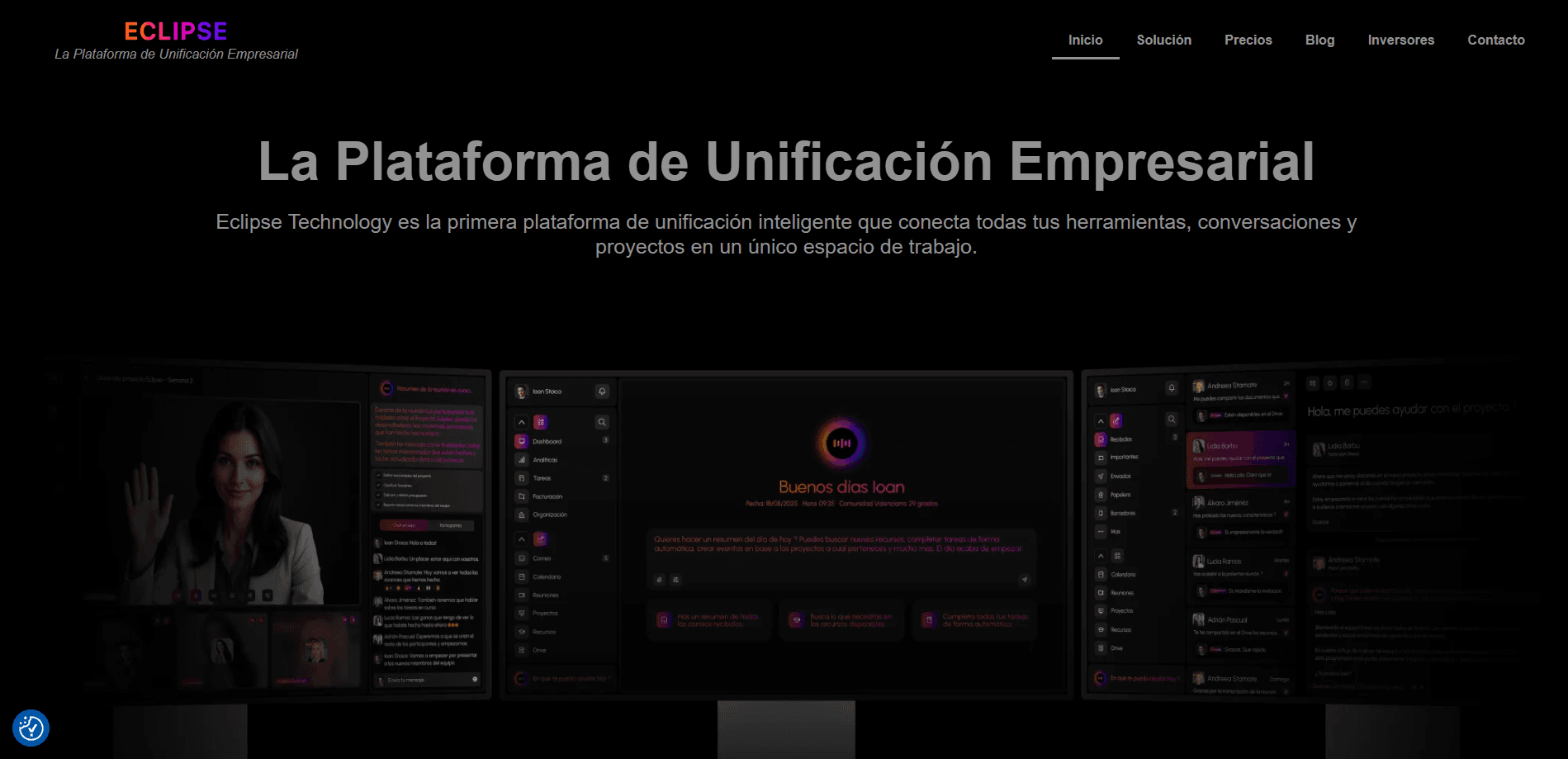
Eclipse Technology is a SaaS platform that pulls your entire working life into one place. It connects the apps your team already uses, from chat tools to project trackers, and adds a contextual AI layer that watches for bottlenecks and suggests what to do next. That AI workflow automation is the hook. It's built for organizations that handle sensitive data, so encryption and compliance sit at the center rather than the edges. This enterprise unification platform is aimed at government, healthcare, finance, and other critical sectors where premium security isn't optional.
About Eclipse Technology
What Is Eclipse Technology
Eclipse Technology is an intelligent unification platform for organizations drowning in disconnected software. Teams bounce between Slack, Teams, Jira, Drive, and Salesforce all day. Nobody can honestly say where a given document lives or whether it feeds a training model somewhere. Eclipse Technology removes that sprawl by folding it into a single dashboard. The core offer is straightforward: one secure workspace that replaces the tab-hopping.
The company positions security as the core feature, not an add-on. It uses post-quantum cryptography and a Zero Trust architecture, and it targets regulated fields where a single data leak can end a business overnight and trigger penalties that dwarf whatever the software itself cost. Conversations, projects, and files live in one encrypted space.
The honest limits matter here. The site is still in a partner-seeking phase, so pricing isn't public and you can't just sign up from the homepage. Small teams that want a self-serve, low-cost tool will find this platform aimed somewhere else, at bigger buyers with compliance requirements.
Getting Started
- Reach out to Eclipse Technology through the contact form on its website to request a demo or a quote.
- Sit with their team to map which of your current tools need to connect into the workspace.
- Set your security and compliance rules, then connect your apps once the access policy is agreed.
- Invite your team and let the AI layer start learning from active projects and conversations.
- Monitor the unified dashboard for the bottlenecks and suggested actions it surfaces.
Product Information
A quick look at Eclipse Technology's pricing, supported platforms, and performance.
Best for
The users, tasks, and scenarios where this tool fits best.
Users
- Operations and IT leaders at mid-size and large companies
- Security and compliance officers in regulated sectors
Tasks
- Consolidating scattered tools
- Spotting workflow bottlenecks
- Keeping sensitive conversations private
Scenarios
- A hospital IT team tracking patient-adjacent workflows across several systems without exposing records.
- A bank or fintech group that needs documented compliance for every tool employees touch.
- A startup that plans to handle classified or critical-infrastructure data and wants the groundwork laid early.
- A remote-first company trying to keep culture and recognition alive across time zones.
Key features
Total unification in a single dashboard
Eclipse Technology connects your business applications and shows your whole working environment in one view, which means a project manager can finally see who is blocked, what shipped, and which conversation started each decision without opening six separate tools. Instead of switching between tabs and losing context, you see projects, conversations, and documents together. That business tool integration is the whole point. The pitch is simple: fewer places for information to hide.
Agentic, contextual AI
The AI layer learns from your projects and conversations, then flags bottlenecks and suggests next steps. It can also automate parts of a workflow. Here's what it doesn't do: your data stays private and isn't used to train models, according to Eclipse Technology, which is the kind of promise that matters to anyone weighing a secure workspace software purchase. Little of that's verifiable from the outside, so treat the claim as the company's word for now.
Post-quantum encryption
The platform uses post-quantum cryptography, a class of encryption designed to resist attacks from future quantum computers. For teams handling long-lived sensitive data, that's a forward-looking bet rather than a checkbox. It's the technical backbone behind the compliance and data sovereignty claims. That's the theory. Real-world proof will come from audits, not marketing copy.
Zero Trust architecture
Zero Trust means every access request is verified rather than trusted by default, even inside the network. So what does that buy you in practice? Combined with perimeter defense and continuous monitoring, it narrows the space an attacker can move through once they're inside. This is the design regulated buyers tend to ask about first.
Active culture modules
Built-in recognition and social connection features aim to keep teams close, even when they're scattered across time zones and never share a physical office. All of that communication is private and encrypted. It's an unusual pairing for a security-first platform, and it speaks to the productivity angle rather than only the compliance one. Not every vendor bothers to address the human side.
Compliance for critical sectors
The platform is built around the requirements of government, defense, healthcare, and finance, which means it has to satisfy auditors and regulators who ask harder questions than a typical SaaS buyer ever would. That enterprise management software mindset means compliance and data sovereignty are design goals from the start, not afterthoughts. Organizations with mandatory governance rules get a platform that assumes those rules.
Pros and cons
Pros
- Consolidates many business tools into one encrypted workspace, which cuts tab-switching and shrinks the number of places where your data can quietly leak or drift out of sync.
- Security-first design with post-quantum encryption and Zero Trust suits regulated and high-risk industries.
- Contextual AI reads real project data and automates workflows instead of offering generic suggestions.
- Explicit promise that your data isn't used to train models, a genuine concern for many buyers.
- Targets critical sectors directly, so compliance and sovereignty are built in rather than bolted on.
Cons
- No public pricing. You can't budget without a sales conversation first.
- No self-serve signup, which rules out individuals or small teams who want to try it today.
- The site is in a partner-seeking phase, so the product's maturity and integration list are hard to verify.
- No confirmation of an API or developer access, so custom integrations may not be possible yet.
Frequently asked questions
It's a SaaS platform that unifies your business tools, tasks, and conversations into one encrypted workspace, then layers contextual AI on top to flag bottlenecks and automate parts of your workflows.
Related content
Explore related tools, skills, and articles for Eclipse Technology.
Eclipse Technology Alternatives

Swms
Swms AI · Writing · Productivity · BusinessSwms is an AI safety compliance tool that turns a plain description of a job into ready-to-use safety documents. Describe your project, trade, and known hazards, and it writes a safe work method statement, job hazard analysis, safe work procedure, RAMS, or safety data sheet in seconds. It also ships with Oscar, a chat assistant that answers workplace safety questions in any language. Teams in construction, mining, transport, and warehousing use it to cut the paperwork that usually eats into a workday.

Wordly AI Translation
Wordly · Voice & Language · ProductivityWordly AI Translation is a real-time AI translation and captioning platform built for meetings, conferences, and events. It delivers live translation, captions, transcripts, and summaries in more than 60 languages, and attendees join by scanning a QR code or opening a link instead of using dedicated headsets. The platform works with Zoom, Microsoft Teams, Google Meet, and Webex, and it's designed for organizations that want multilingual access without hiring human interpreters for every session. Simple as that.

Rows
Rows (Superhuman) · Productivity · BusinessRows is an AI spreadsheet and data analysis tool that imports live data from more than 50 sources, then lets you work with it using plain language instead of SQL queries or nested formulas. You can pull numbers out of PDFs, connect ad platforms, databases, and bank accounts, and ask the AI to build reports, merge datasets, or set up models that recalculate themselves. It runs in the browser, works like a spreadsheet, and now sits under the Superhuman umbrella.