

Edra
Edra Labs Corp · Productivity · Business · Chatbot
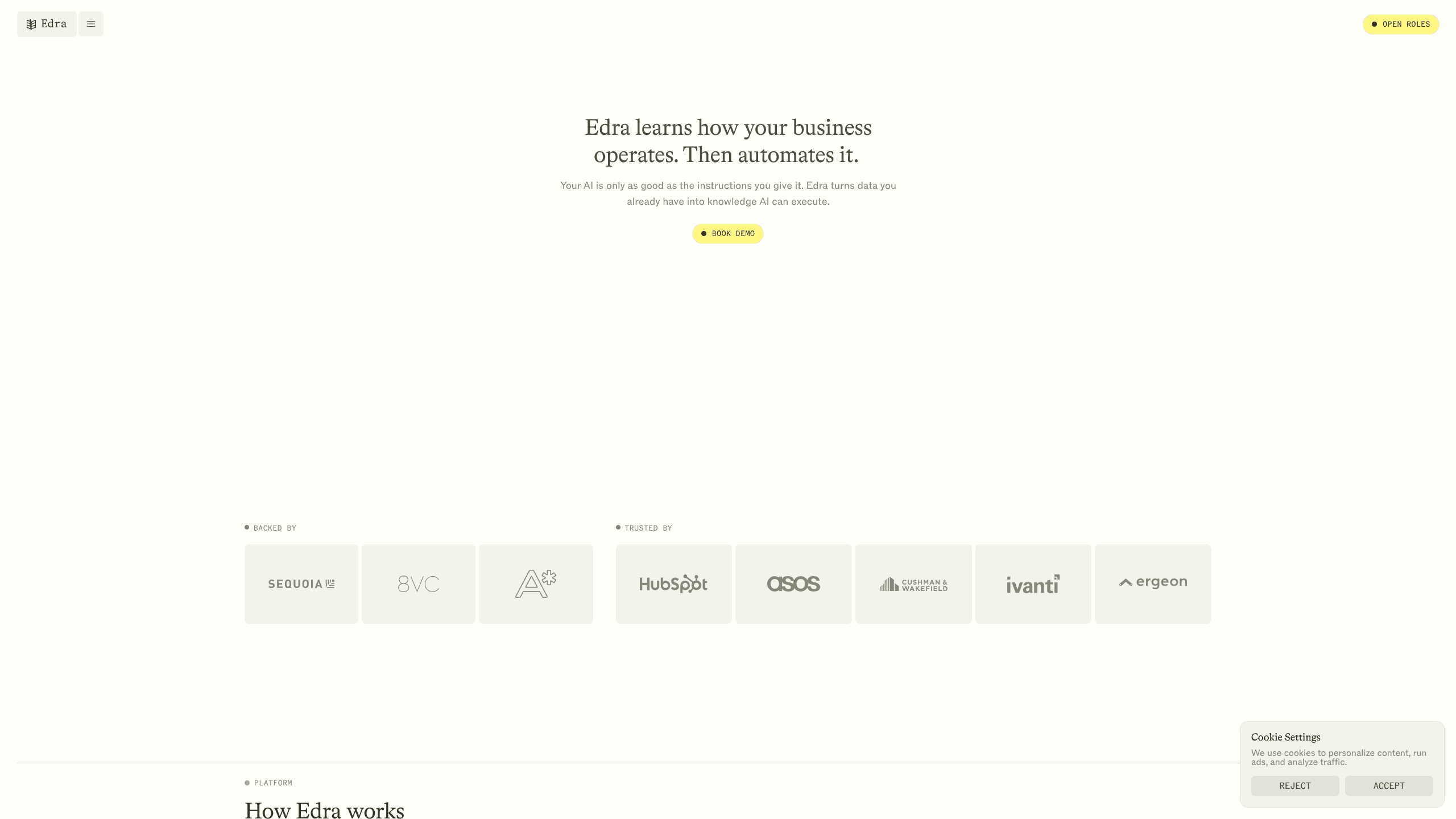
Edra is an AI knowledge automation platform that learns how a business actually operates and turns that knowledge into instructions AI agents can follow. Built by former Palantir forward-deployed AI leads, it reads the tickets, logs, and messages you already have and converts them into a library of executable playbooks. Companies like HubSpot and ASOS use it to ground support and IT service agents in real operating knowledge instead of guesswork.
About Edra
What Is Edra
Edra is an enterprise platform that captures the tribal knowledge sitting inside your support queues, help desks, and chat channels, then turns it into something a machine can run. The problem it solves is simple to state. Your AI is only as good as the instructions you give it, and most teams never write those instructions down, which is why so many agent rollouts stall once they leave the demo. Edra skips the interviews and workshops by reading your existing systems directly.
The platform works on top of source systems teams already run, including ServiceNow, JIRA, Zendesk, Salesforce, and Outlook. Rather than locking rules inside a black box, Edra produces human-readable playbooks that reviewers can edit and own, then deploys agents back into those same platforms. It also learns continuously, so feedback from your team updates the playbook instead of waiting for a quarterly rewrite. No rewrite needed.
The biggest limitation to know up front is that Edra is sold as an enterprise product. There's no self-serve signup or public price list, and pricing runs through a demo conversation. That's a real barrier. Smaller teams without established ticketing data will get less out of it, since the whole approach depends on having processes worth learning from.
Getting Started
- Book a demo through the Edra site and share the source systems your team currently uses.
- Run a zero-setup pilot: Edra ingests a slice of your tickets, logs, or messages and reverse engineers your processes.
- Review the generated playbooks in the library and edit any rule that doesn't match reality.
- Connect your AI agents to the approved playbooks and deploy them inside your existing platforms.
- Keep the loop going by feeding team corrections back in, so the playbook stays current.
Product Information
A quick look at Edra's pricing, supported platforms, and performance.
Best for
The users, tasks, and scenarios where this tool fits best.
Users
- IT service management teams
- Technical support leaders
- Knowledge managers
- Enterprise AI teams
Tasks
- Turning support tickets into playbooks
- Grounding AI agents
- Auditing automated decisions
- Keeping knowledge current
Scenarios
- Migrating a support team onto AI agents
- Onboarding new support hires
- Consolidating scattered documentation
- Scaling expert judgment
Key features
Zero-Setup Discovery
Edra reads your tickets, logs, and messages to reverse engineer how your business runs. It organizes the results into a library of executable knowledge. There are no interviews or workshops to schedule, and you get visibility into your actual processes within days. No workshops. No chasing people for answers. Nothing to prepare in advance. For teams that never had time to document anything, this is the entry point.
Transparent, Human-Readable Playbooks
Instead of hiding logic inside a black box, Edra produces playbooks a person can read, review, and edit. That matters when an automated decision affects a customer and someone needs to explain it. You own the rules that power the automation. Audits and corrections get far less painful.
Continuous Learning
The system treats your team as the teacher. Every correction or piece of feedback updates the playbook right away, so knowledge becomes institutional memory rather than a document that expires. In practice this keeps agents from drifting as products, policies, and edge cases change. Who owns the update? Your team does, every time.
Existing-System Integrations
Edra sits on top of the tools your team already uses, including ServiceNow, JIRA, Zendesk, Salesforce, and Outlook. There's no forced migration to a new help desk before you start. That keeps rollout light. Agents act inside the platforms where the work already happens.
AI Agent Grounding
The whole point of the captured knowledge is to feed AI agents that can execute processes reliably and transparently. Agents run on your playbooks, so their behavior traces back to rules a human approved. That combination of automation and accountability is what separates it from ad-hoc prompting. It's a short chain of responsibility, and that's the appeal. The bottom line: agents stay accountable.
Enterprise Team Knowledge Capture
Edra is built for organizations where expertise is concentrated in a few senior people. By capturing how those experts operate, it lets the org scale that judgment without cloning the person.
Pros and cons
Pros
- Learns processes from data you already have, so no long discovery phase with consultants.
- Playbooks stay readable and editable, which makes auditing automated decisions realistic.
- Integrates with mainstream tools like ServiceNow, Zendesk, and Salesforce without a migration.
- Continuous learning keeps knowledge fresh instead of freezing it at launch.
- Backed by founders with deep enterprise AI deployment experience, which shows in the IT service management focus.
Cons
- No public pricing or free tier means you have to talk to sales before you know anything about cost.
- Value depends on having real process data to learn from, so teams with thin or messy ticketing history see less benefit.
- API availability isn't documented publicly, which complicates planning for teams that want custom integrations.
- Aimed squarely at enterprises, so individual users and small teams are effectively priced out.
Frequently asked questions
Edra captures how your business operates by reading your existing tickets, logs, and messages, then turns that into playbooks AI agents can execute. It's a knowledge automation platform for teams that want agents grounded in real processes rather than generic instructions.
Related content
Explore related tools, skills, and articles for Edra.
Edra Alternatives

Swms
Swms AI · Writing · Productivity · BusinessSwms is an AI safety compliance tool that turns a plain description of a job into ready-to-use safety documents. Describe your project, trade, and known hazards, and it writes a safe work method statement, job hazard analysis, safe work procedure, RAMS, or safety data sheet in seconds. It also ships with Oscar, a chat assistant that answers workplace safety questions in any language. Teams in construction, mining, transport, and warehousing use it to cut the paperwork that usually eats into a workday.

Wordly AI Translation
Wordly · Voice & Language · ProductivityWordly AI Translation is a real-time AI translation and captioning platform built for meetings, conferences, and events. It delivers live translation, captions, transcripts, and summaries in more than 60 languages, and attendees join by scanning a QR code or opening a link instead of using dedicated headsets. The platform works with Zoom, Microsoft Teams, Google Meet, and Webex, and it's designed for organizations that want multilingual access without hiring human interpreters for every session. Simple as that.

Rows
Rows (Superhuman) · Productivity · BusinessRows is an AI spreadsheet and data analysis tool that imports live data from more than 50 sources, then lets you work with it using plain language instead of SQL queries or nested formulas. You can pull numbers out of PDFs, connect ad platforms, databases, and bank accounts, and ask the AI to build reports, merge datasets, or set up models that recalculate themselves. It runs in the browser, works like a spreadsheet, and now sits under the Superhuman umbrella.