

Epsilla
Epsilla · Coding · Other
Epsilla is an agent-as-a-service platform for teams that build AI agents on their own data without managing infrastructure.
About Epsilla
What Is Epsilla
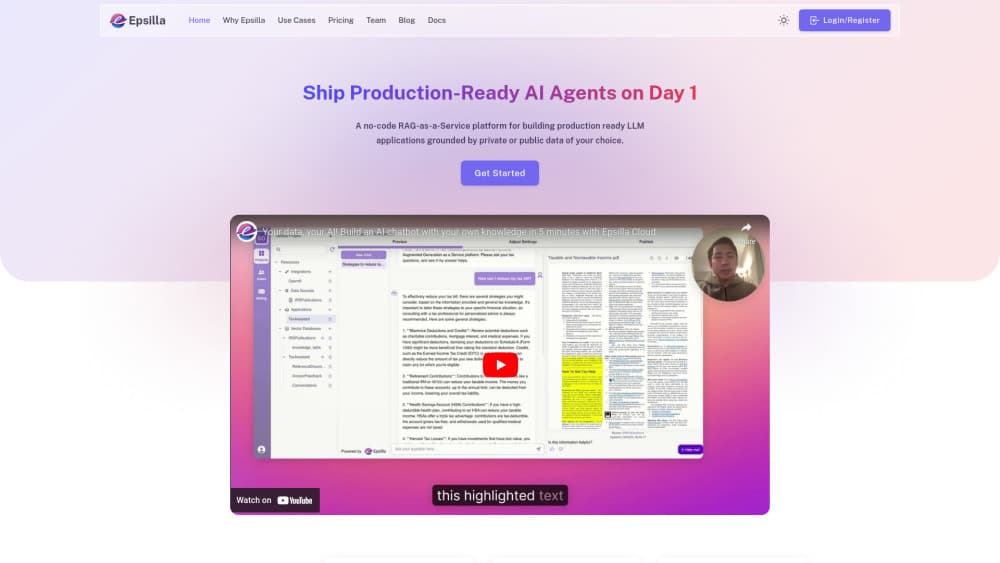
Epsilla is a platform for building and deploying AI agents that answer from your company's private data. It doubles as an LLM application platform. Instead of wiring together a vector store, a retrieval pipeline, and a model API yourself, you get one place to upload documents, build an agent, and ship it to users. The audience is mostly teams without a dedicated ML engineer: product managers, support leads, and small dev shops who want a working agent this week, not next quarter.
Under the hood, it pairs a vector database for semantic search with RAG (retrieval generation that grounds answers in your files). RAG means the agent looks up relevant passages from your documents before it writes a reply, so answers stay tied to real content rather than invented. The earlier versions of Epsilla were pitched around that database and RAG layer.
The main limitation is where your data lives. On the free and mid tiers your knowledge base sits in Epsilla's cloud, and the free plan clears data after 30 days of inactivity. Heavy compliance teams will want the enterprise tier, which adds on-prem deployment and SSO. Also worth knowing: the managed plans pin messages to a fixed model (GPT-4.1), so switching models is an enterprise-only option.
Getting Started
- Sign up on the Epsilla site with an email address. The free tier needs no credit card.
- Create a project, then add a knowledge base and upload the documents the agent should read.
- Build the agent in the drag-and-drop builder, or connect an existing app through the platform.
- Test the agent's answers in the chat preview and adjust the prompts until they hold up.
- Publish and share the agent, or hand it to your team through the support channel.
Product Information
A quick look at Epsilla's pricing, supported platforms, and performance.
Best for
The users, tasks, and scenarios where this tool fits best.
Users
- Small product teams without an ML engineer
- Customer support and sales leads
- Vertical software vendors
Tasks
- Answering questions from a private document set
- Prototyping an LLM application
- Managing a fleet of agents
Scenarios
- Trialing an AI agent before committing budget
- Standing up an internal help desk on company docs
- Regulated deployments that need on-prem hosting
Key features
No-Code Agent Builder
Epsilla's builder uses a drag-and-drop interface, so you assemble an agent without writing code. You pick a knowledge base, set instructions, and connect the pieces visually. For teams that don't employ developers, this is the difference between shipping an agent and not shipping one.
RAG as a Service
RAG, which stands for retrieval generation, is the core mechanic. Your documents get chunked and indexed. When a user asks something, the agent pulls the matching passages first. That keeps answers tied to your content. The selling point here is simple: the RAG platform is managed, so you skip building and tuning it yourself. Want to ship an LLM application faster? This is the layer that saves weeks.
Vector Database
The platform runs on a vector database built for semantic search. It stores documents as embeddings, which are numeric representations that let the system match meaning rather than exact words. The free tier includes 10M vector storage, scaling to 1G on Starter and 10G on Professional.
Agent and Chatbot Management
Once agents are live, the platform gives you tools to monitor and analyze how they perform, so you can spot weak spots in answers, track usage across projects, and fix problems before users complain. This matters more as the number of apps grows, which is why the tier limits jump from 1 app on free to 50 on Professional.
Enterprise Multi-Tenancy
Higher tiers support multiple agents with granular permissions and access controls. You can keep different teams or customers separated while managing everything from one dashboard. It's aimed at organizations that need to run many agents without losing track of who can see what.
Flexible Deployment
You choose between managed SaaS, on-premise installation, or private cloud. The managed plans run on Epsilla's infrastructure with GPT-4.1 handling the messages, while the enterprise tier opens up any LLM provider and on-prem hosting.
Integrations
Epsilla connects to a set of partner tools for search, embeddings, and data access. Names like Tavily, Jina, Voyage AI, and Mixedbread show up as partners. In practice, that library of connectors saves you from building glue code for common retrieval and embedding tasks.
Pros and cons
Pros
- Free tier with no credit card, so you can test the RAG and agent flow before paying.
- Managed retrieval pipeline saves the work of building a vector search stack yourself.
- No-code builder opens agent creation to non-developers.
- Clear pricing ladder from $0 to $249/mo before the custom enterprise quote.
- Enterprise tier supports on-prem deployment and SSO for regulated buyers.
Cons
- The free plan clears your data after 30 days of inactivity, so it isn't for anything long-lived.
- Managed tiers pin messages to GPT-4.1, which means no model switching unless you pay for enterprise.
- Free tier caps at 50 messages a month and one app, tight for real testing.
- Enterprise pricing isn't published, so you have to talk to sales to get a number.
Frequently asked questions
It's a platform for building AI agents that answer from your own documents. You upload content, build an agent in a no-code builder, and deploy it, with retrieval handled for you.
Related content
Explore related tools, skills, and articles for Epsilla.
Epsilla Alternatives
Forefront
Forefront · CodingForefront is a web platform for building with open-source AI. It lets you fine-tune leading open-source language models on your own data, evaluate how they perform, and run them through an API or export them to host yourself. Developers who want the convenience of a closed-source platform but insist on owning their models and data are the target audience here.

Startkit
StartKit.AI · CodingStartkit is a boilerplate for building AI SaaS and AI wrapper products. Think of it as an AI startup boilerplate with the boring parts already wired up: authentication, Stripe and Lemon Squeezy payments, usage limits, transactional email, and an AI API starter that talks to OpenAI, Anthropic, Groq, or Llama. You clone the repo, set your price, and start on the part of your product that people actually pay for. It's Next.js under React and Tailwind, so most of the boilerplate code already feels familiar.
Testim
Tricentis · CodingTestim is an AI-powered test automation platform for building and running end-to-end tests across web, mobile, and Salesforce applications. It leans on machine learning to keep tests stable when an interface changes, so teams spend less time fixing broken selectors. Not bad for an automated testing tool you can start using today. You create tests by recording actions in a browser, then optionally add JavaScript when you need more control. It's a solid pick for busy QA teams.