

Events Scout
Coral Bricks · Coding
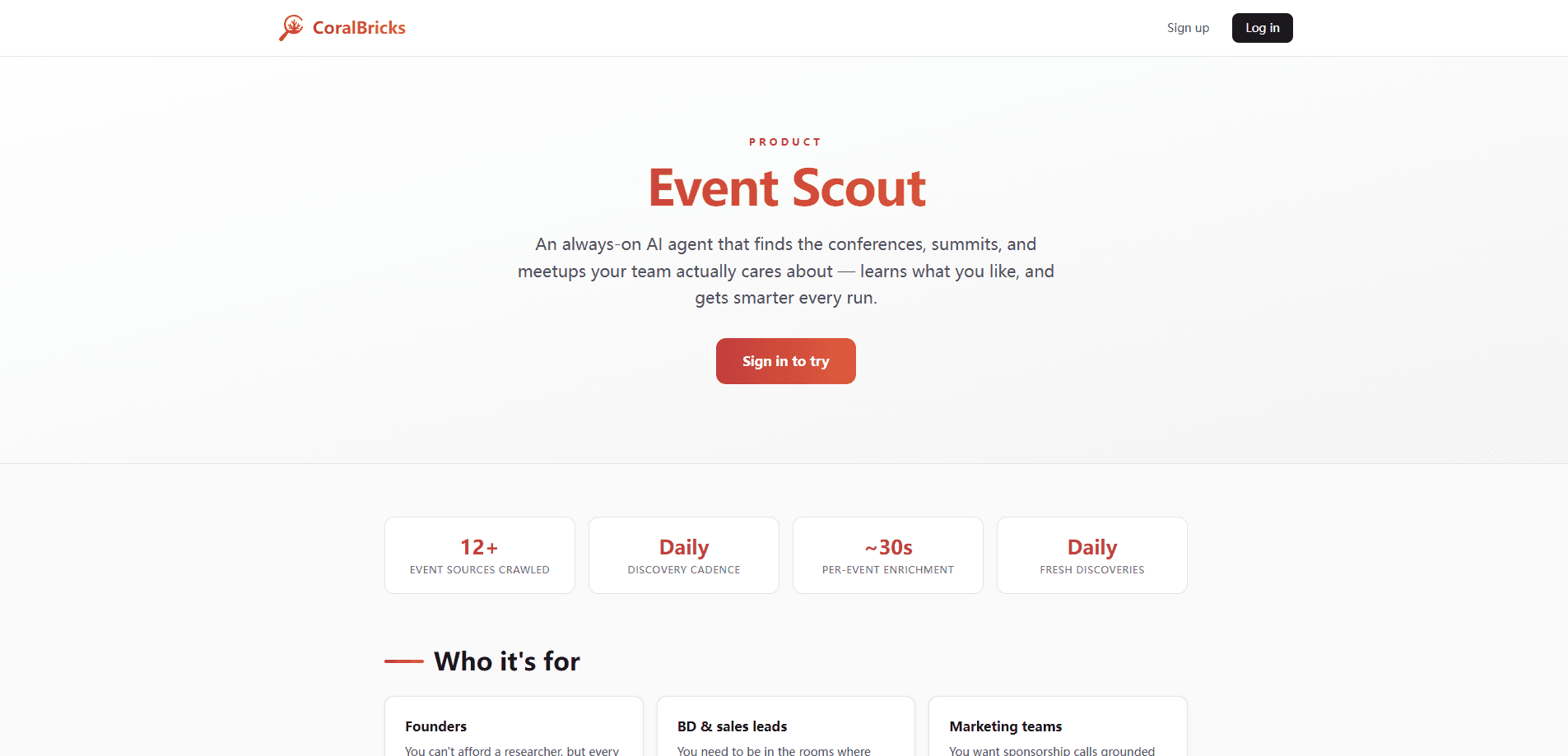
Events Scout is an AI event discovery agent from Coral Bricks that keeps a running list of the startup and business events worth your attention. It crawls more than 12 sources every day, enriches each find with contact details, and ranks the results so you see the opportunities that actually fit your goals. Think of it as a business event aggregator that never stops scanning.
About Events Scout
What Is Events Scout
Events Scout is a specialized AI agent built for people who need to know what's happening in their industry before everyone else does. It handles event discovery as a background job: crawling sources, pulling out the useful parts, and personalizing a feed around what you care about.
The appeal is straightforward. Finding relevant startup and business events usually means juggling newsletters, conference sites, community boards, and social feeds. Events Scout collapses that into one ranked list, and it adds something most listings skip: the contact details you need to actually act on an opportunity. Big difference.
It's an agent, not a search bar, so the output depends on the sources it can reach. No source, no result. Sources matter. If an event lives only in a private Slack or a gated community, the agent won't surface it. Treat it as a strong filter over public and semi-public sources, not a complete map of every event that exists.
Getting Started
- Visit the Coral Bricks product page and open Events Scout.
- Set up your profile with the industries, roles, and event types you care about.
- Let the agent run its daily crawl across its sources, or trigger a fresh scan.
- Review the ranked list, then open the enriched entries to grab contact details for the events you want to pursue.
Most people treat the first run as a calibration pass. Your preferences do the ranking, so the more specific you get about your niche, the less noise you'll scroll past. Worth the ten minutes it takes to set up.
Product Information
A quick look at Events Scout's pricing, supported platforms, and performance.
Best for
The users, tasks, and scenarios where this tool fits best.
Users
- Founders and startup operators
- Sales and business development teams
- Event marketers and community managers
- Investors and scouts
Tasks
- Daily event discovery
- Event enrichment
- Opportunity triage
- Personalizing a feed
Scenarios
- Planning a conference season
- Early-stage fundraising
- Entering a new market
- Keeping a sales pipeline warm
Key features
Multi-source daily crawling
Events Scout checks more than 12 sources on a daily cycle, which is the core of how it stays current. Rather than you subscribing to a dozen mailing lists, the agent does the legwork and folds everything into one stream. The result is a discovery feed that refreshes without your input.
Event enrichment with contact details
A bare event listing is only half useful. Events Scout pulls out the details that turn a listing into an action: who's behind it, how to reach them, and the context that helps you judge whether it's worth your time. It's the part most aggregators skip. For sales and partnerships work, that contact layer is often the difference between a lead and a dead end. Not a minor gap.
Intelligent ranking and personalization
The agent ranks opportunities instead of just listing them. It weighs your stated interests and the signals it gathers to push the most relevant events to the top. Is the ranking perfect? No. But it beats reading an unfiltered calendar every morning.
Ready-to-act opportunity output
Everything the agent produces is meant to be acted on. Each entry is structured so you can decide fast and move, whether that means registering, reaching out, or adding it to a team calendar. It's built for people whose time is the bottleneck, not their access to information.
Continuous background discovery
Events Scout runs in the background rather than waiting for a query. You don't have to remember to search; the agent keeps discovering as new events appear. That continuous behavior is what separates an agent from a static directory, and it's the reason the feed you open on Monday looks different from the one you closed on Friday.
Pros and cons
Pros
- Aggregates 12+ sources into one feed, which saves the daily manual sweep across newsletters and event sites.
- Adds contact details to each event, so you can follow up without a separate research step.
- Ranks by relevance, which keeps a long list of industry events manageable.
- Runs continuously, so new opportunities surface without you triggering a search.
Cons
- It only sees what its sources expose. Private Slack groups and gated communities stay invisible, so you may still miss invite-only events.
- There's no free plan listed, which makes it harder to test before committing.
- Pricing isn't published, so you'll need to check with Coral Bricks directly to judge fit.
- Quality depends on the sources it crawls; a badly maintained source can add noise to the feed.
Frequently asked questions
It's an AI agent that finds startup and business events for you. It crawls 12+ sources daily, enriches each event with contact details, and ranks the results against your interests. You set the focus. It does the scanning.
Related content
Explore related tools, skills, and articles for Events Scout.
Events Scout Alternatives
Forefront
Forefront · CodingForefront is a web platform for building with open-source AI. It lets you fine-tune leading open-source language models on your own data, evaluate how they perform, and run them through an API or export them to host yourself. Developers who want the convenience of a closed-source platform but insist on owning their models and data are the target audience here.

Startkit
StartKit.AI · CodingStartkit is a boilerplate for building AI SaaS and AI wrapper products. Think of it as an AI startup boilerplate with the boring parts already wired up: authentication, Stripe and Lemon Squeezy payments, usage limits, transactional email, and an AI API starter that talks to OpenAI, Anthropic, Groq, or Llama. You clone the repo, set your price, and start on the part of your product that people actually pay for. It's Next.js under React and Tailwind, so most of the boilerplate code already feels familiar.
Testim
Tricentis · CodingTestim is an AI-powered test automation platform for building and running end-to-end tests across web, mobile, and Salesforce applications. It leans on machine learning to keep tests stable when an interface changes, so teams spend less time fixing broken selectors. Not bad for an automated testing tool you can start using today. You create tests by recording actions in a browser, then optionally add JavaScript when you need more control. It's a solid pick for busy QA teams.