

Explorium MCP
Explorium · Coding
Explorium MCP is a Model Context Protocol server that feeds live B2B company, contact, and event data into AI assistants, so agents research accounts and build prospect lists without leaving chat.
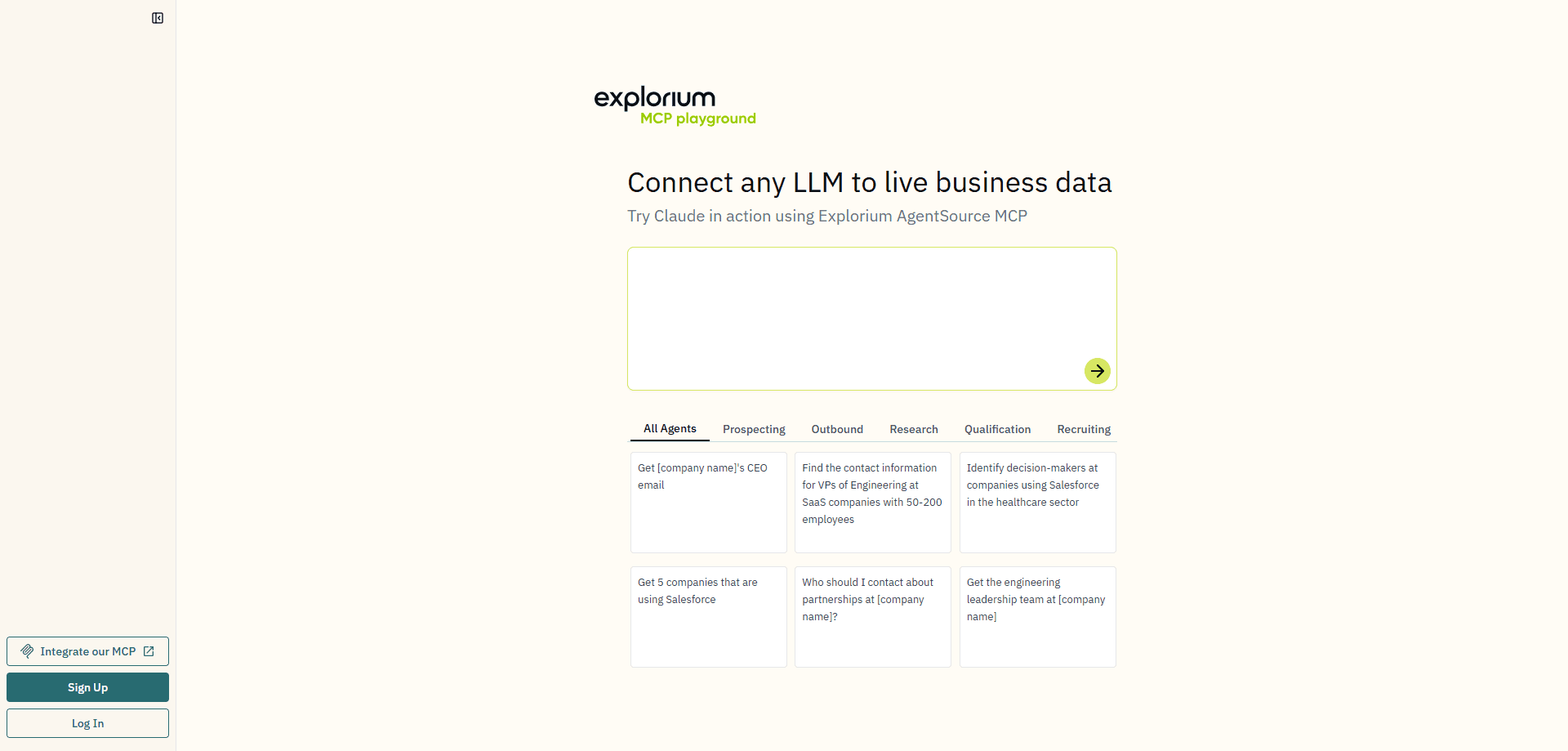
About Explorium MCP
What Is Explorium MCP
Explorium MCP exposes Explorium's B2B data catalog to AI agents over the Model Context Protocol, an open standard that connects language models to outside tools and data. Once connected, your assistant can search companies, pull firmographics, find professional contacts, and track funding or hiring events using plain English instead of API calls.
The product answers a specific problem. General assistants know a lot but not what happened at a company last week, and prospecting still means copying rows between a browser and a spreadsheet. Explorium closes that gap by serving structured, agent-ready records from a catalog covering 146M+ business entities and 767M+ professional profiles.
The main limit is cost and vocabulary. Explorium charges in credits, so heavy enrichment burns through a package quickly, and the deeper data signals sit behind paid tiers rather than the 100-credit free trial.
Getting Started
- Sign up for a free Explorium account, which starts you with 100 credits.
- Add the remote MCP server at
https://mcp.explorium.ai/mcpas a custom connector in Claude Desktop, Cursor, VS Code, Windsurf, or another MCP client. - Confirm the connection, since the agent will now see tools for business matching, enrichment, prospect discovery, and events.
- Ask a question in natural language, like who runs engineering at a target account or which companies raised a Series B this month, and review the returned records before exporting or acting.
Product Information
A quick look at Explorium MCP's pricing, supported platforms, and performance.
Best for
The users, tasks, and scenarios where this tool fits best.
Users
- Sales development reps
- Founders running outbound
- Analysts and researchers
Tasks
- Account research
- Lead list building
- Contact enrichment
- Signal monitoring
Scenarios
- Filling a pipeline gap before a weekly review
- Preparing for a partnership or sales call
- Standing up a GTM agent
Key features
Company Search and Enrichment
Ask for companies by name, domain, or attributes and the server returns matching firms with details like industry, headcount, revenue range, and location. It's the starting point for most prospecting, because a clean list of accounts feeds everything downstream. Results come back as structured records, so the agent can act on them instead of parsing a web page.
Contact Discovery and Enrichment
Once you have a company, the agent can find the people inside it, from titles and roles to emails, phone numbers, and work history. This is what turns a company list into something you can actually contact. The server flags which records are richer than others, which matters because pricing follows the enrichment depth.
Business Events and Signals
Explorium tracks funding rounds, office changes, hiring trends, and other company developments, so an agent can answer what's new rather than what's true on average. That's the real edge over a static database, since timing often decides whether outreach lands. You can ask for accounts that raised money this quarter or teams that just grew.
Natural Language Queries
You don't write API calls. You describe what you want, like the engineering leadership at a specific company, and the MCP server maps it to the right tools. The setup is built for agents, with clean IDs and clearer error messages so fewer calls fail silently and you spend less time retrying.
Structured, Agent-Ready Data
Records come back harmonized and organized for machine use, not as raw scraped text. An agent gets consistent fields it can compare, sort, and insert into a workflow. That reduces the cleanup work that usually sits between a search result and a usable row.
Broad Data Coverage
The catalog spans 146M+ business entities, 767M+ professional profiles, and 4,000+ data signals drawn from more than 100 sources. Wide coverage means you're less likely to hit an empty result for a niche company. It also means match quality varies by region, so niche markets may return thinner data.
Pros and cons
Pros
- Live B2B data reaches the assistant you already use, so prospecting happens in the chat rather than across five tabs.
- Broad coverage across companies, contacts, geospatial points, and signals makes it useful for both list building and account research.
- The remote MCP server needs no API key or local setup, so connecting takes a custom connector and a URL.
- Credits are metered by task, so light research on the free trial costs nothing and you only pay for what you enrich.
- Works across Claude Desktop, Cursor, VS Code, Windsurf, and self-hosted Docker, so it fits most agent stacks.
Cons
- Credits run out fast with heavy enrichment, and packages are non-refundable and don't auto-renew, so a stalled plan stops mid-workflow.
- Data quality shifts by region and company size, which means niche or small markets may return sparse records you have to verify elsewhere.
- The free trial's 100 credits only cover light testing, so serious prospecting volume has to be bought before you see full value.
Frequently asked questions
It connects AI assistants to Explorium's B2B data so they can research companies, find contacts, and track business events in plain language. You use it for prospecting, account research, and lead enrichment inside your chat tool.
Related content
Explore related tools, skills, and articles for Explorium MCP.
Explorium MCP Alternatives
Forefront
Forefront · CodingForefront is a web platform for building with open-source AI. It lets you fine-tune leading open-source language models on your own data, evaluate how they perform, and run them through an API or export them to host yourself. Developers who want the convenience of a closed-source platform but insist on owning their models and data are the target audience here.

Startkit
StartKit.AI · CodingStartkit is a boilerplate for building AI SaaS and AI wrapper products. Think of it as an AI startup boilerplate with the boring parts already wired up: authentication, Stripe and Lemon Squeezy payments, usage limits, transactional email, and an AI API starter that talks to OpenAI, Anthropic, Groq, or Llama. You clone the repo, set your price, and start on the part of your product that people actually pay for. It's Next.js under React and Tailwind, so most of the boilerplate code already feels familiar.
Testim
Tricentis · CodingTestim is an AI-powered test automation platform for building and running end-to-end tests across web, mobile, and Salesforce applications. It leans on machine learning to keep tests stable when an interface changes, so teams spend less time fixing broken selectors. Not bad for an automated testing tool you can start using today. You create tests by recording actions in a browser, then optionally add JavaScript when you need more control. It's a solid pick for busy QA teams.