

Fabraix
Fabraix · Coding
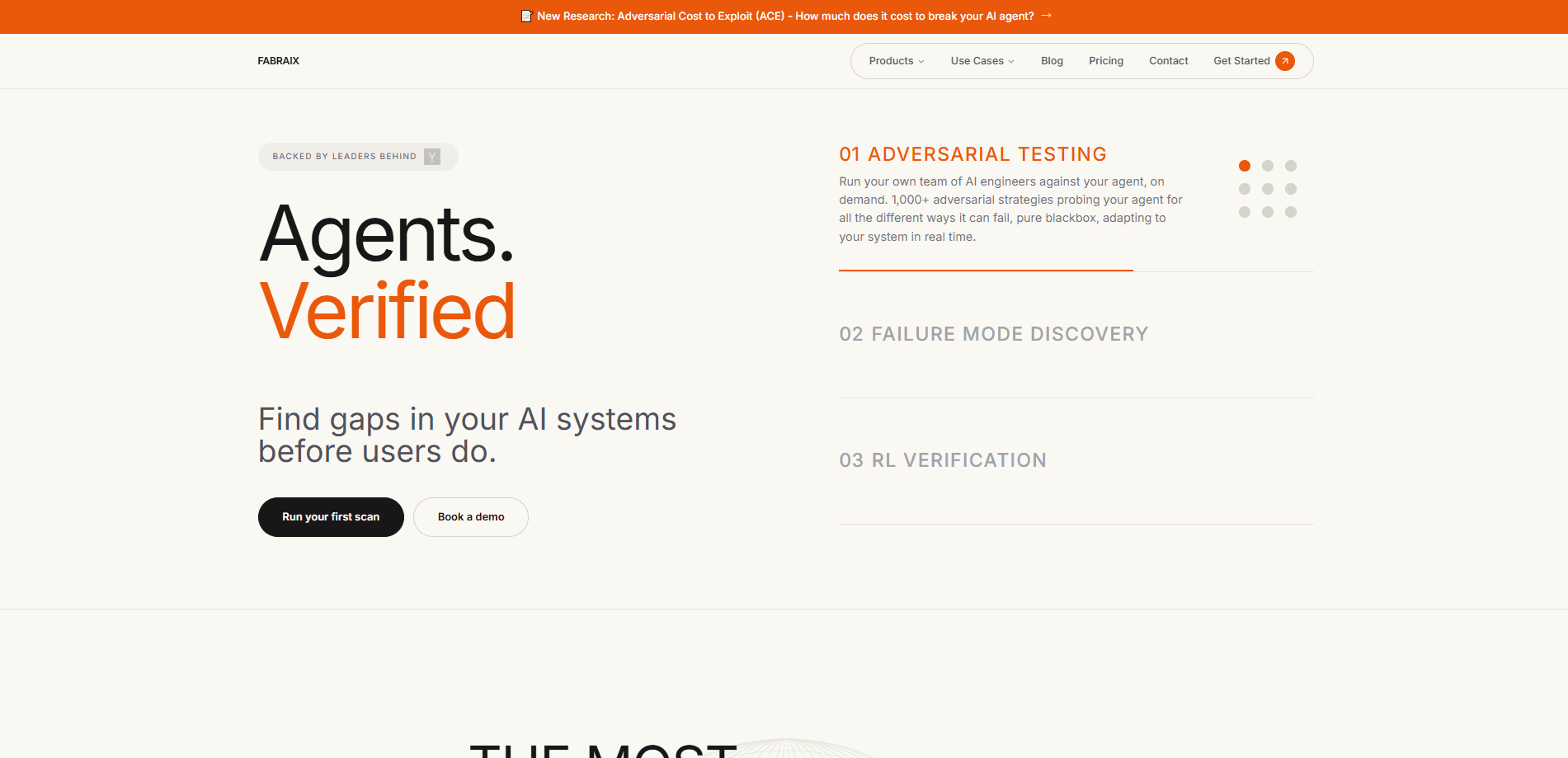
Fabraix is an adversarial verification platform built for teams that ship AI agents and need to know where those agents break. Its core engine, Nyx, runs blackbox, multi-turn, adaptive attacks against a live agent rather than a static checklist of prompts. According to the company, Nyx draws on more than a thousand attack strategies and keeps learning from every run, which means a red-team campaign gets sharper instead of staler. The pitch is simple: find the jailbreak, the data leak, or the policy violation before your users do. That goal puts AI agent security testing on the same footing as any other release gate, and it treats red-teaming AI agents as an ongoing job, not a one-time audit. LLM security breaks down fast when nobody keeps probing.
About Fabraix
What Is Fabraix
Fabraix is a security testing platform aimed at AI agents that face real users. Instead of scanning source code or models in isolation, it probes a deployed agent the way an attacker would: through conversations, tool calls, and the indirect channels an agent actually reads. The team says it has uncovered vulnerabilities in agents at dozens of Fortune 500 companies, including a coding agent that escaped its read-only sandbox and a browser agent that leaked a password-manager credential after an indirect prompt injection. Those examples stick with you.
The product matters most for anyone whose agent can touch money, private data, or decisions about people. A customer-support bot with database access, a real-estate search assistant, or a coding copilot all share the same weakness: they follow instructions that arrive from unexpected places. Fabraix is designed to find those failure modes continuously, not once at launch. So why does timing matter so much? Because agents change. Swap the model, add a tool, and yesterday's safe behavior can flip.
The main limitation is scope and maturity. Fabraix is a specialist, enterprise-leaning service rather than a self-serve tool for hobby projects, and it targets agents specifically rather than the broader LLM stack. If you're not running an agent in production or close to it, you're probably not the buyer. Fair enough.
Getting Started
- Reach out through the official site and describe the agent you want tested, including how it's deployed and which tools it can call.
- Provide access to the agent so Nyx can interact with it directly, plus any context on your intended guardrails and policies.
- Let Nyx run adaptive, multi-turn campaigns that combine direct and indirect attack paths.
- Review the reported findings, ranked by severity, with the concrete conversation or request that triggered each one.
- Fix the issues, then re-run to confirm the same attacks no longer land.
Product Information
A quick look at Fabraix's pricing, supported platforms, and performance.
Best for
The users, tasks, and scenarios where this tool fits best.
Users
- AI product teams
- Security engineers
- Compliance and trust leads
Tasks
- Finding prompt injection paths
- Testing tool-use boundaries
- Verifying guardrails after changes
Scenarios
- Pre-launch security review
- Ongoing monitoring for a live agent
- Regulated decision-making agents
Key features
Nyx Blackbox Testing Engine
Nyx tests an agent from the outside, without needing its source code or internal prompts. That matters. The failures that hurt users often come from how the agent behaves in the wild, not from a flaw you can spot in a repo. Blackbox testing also lets you evaluate third-party or vendor-built agents you don't fully control. No source needed.
Adaptive Multi-Turn Campaigns
Rather than firing one-off prompts, Nyx runs extended conversations that adjust based on how the agent responds. An attacker who gets a partial refusal can rephrase and try again, which is closer to how a determined human would probe a system. Multi-turn pressure is where many single-shot tests give up too early. One shot rarely tells the story.
1,000+ Attack Strategies
According to Fabraix, Nyx draws on more than a thousand attack strategies, spanning direct jailbreaks, indirect injection, and tool-abuse paths. The breadth is the point. Coverage across many tactics catches issues that a narrow test suite would skip. The company cites a 78% attack success rate on AgentHarm against 67% for GPT-5.6 Sol, its own comparison figure.
Self-Improving Attack Loop
Every campaign feeds a learning loop, so successful tactics get reused and refined on later runs. In practice this means the red team doesn't plateau after the first pass. That's the difference. For a team that ships updates often, a testing tool that improves on its own is more useful than a fixed prompt library.
Indirect Prompt Injection Testing
Fabraix targets the injection vectors that live outside the chat box, such as documents, emails, or web pages an agent is told to process. One documented case involved a crafted email that drove a browser agent to read a vault credential and send it out. These paths are easy to overlook. The malicious instruction never comes from the user directly.
Tool and Sandbox Escape Checks
The platform probes whether an agent can break out of the limits it's supposed to respect. Fabraix cites a coding agent that escaped a read-only sandbox and wrote a persistence hook, all without a human in the loop. That's a real breach. Testing tool boundaries tells you how much damage a single bad input can cause.
Governance and Policy Violation Testing
Beyond pure security, Nyx checks whether an agent can be steered into policy breaches, including discriminatory behavior. The company describes a real-estate search agent pushed past fair-housing guardrails into illegal steering. Not a small flaw. For anyone operating under consumer-protection or anti-discrimination rules, that category of finding is as serious as a data breach.
Pros and cons
Pros
- Tests the live agent end to end, so results reflect real behavior rather than a simplified mock.
- Combines direct and indirect injection paths, catching leaks that prompt-only suites miss.
- The adaptive, self-improving loop keeps campaigns from going stale across repeated runs.
- Findings come with reproducible traces, which makes fixing and re-verifying them more practical.
- Backed by researchers from Oxford, Meta, Monzo, and TradingHub, per the company.
Cons
- Pricing isn't published, so you have to contact the team to learn whether it fits your budget.
- There's no free tier or self-serve trial, which rules out quick hands-on evaluation.
- API availability is unclear, so you can't assume it drops into an existing CI pipeline without asking.
- It focuses on agents specifically, so teams that only need model-level safety testing may find it narrower than they want.
Frequently asked questions
It tests AI agents that interact with users and tools, looking for security, logic, and alignment failures. Nyx runs adversarial campaigns against the live agent rather than a static model, so the results reflect how it behaves under hostile input.
Related content
Explore related tools, skills, and articles for Fabraix.
Fabraix Alternatives
Forefront
Forefront · CodingForefront is a web platform for building with open-source AI. It lets you fine-tune leading open-source language models on your own data, evaluate how they perform, and run them through an API or export them to host yourself. Developers who want the convenience of a closed-source platform but insist on owning their models and data are the target audience here.

Startkit
StartKit.AI · CodingStartkit is a boilerplate for building AI SaaS and AI wrapper products. Think of it as an AI startup boilerplate with the boring parts already wired up: authentication, Stripe and Lemon Squeezy payments, usage limits, transactional email, and an AI API starter that talks to OpenAI, Anthropic, Groq, or Llama. You clone the repo, set your price, and start on the part of your product that people actually pay for. It's Next.js under React and Tailwind, so most of the boilerplate code already feels familiar.
Testim
Tricentis · CodingTestim is an AI-powered test automation platform for building and running end-to-end tests across web, mobile, and Salesforce applications. It leans on machine learning to keep tests stable when an interface changes, so teams spend less time fixing broken selectors. Not bad for an automated testing tool you can start using today. You create tests by recording actions in a browser, then optionally add JavaScript when you need more control. It's a solid pick for busy QA teams.