

Face Search
Face Search · Image
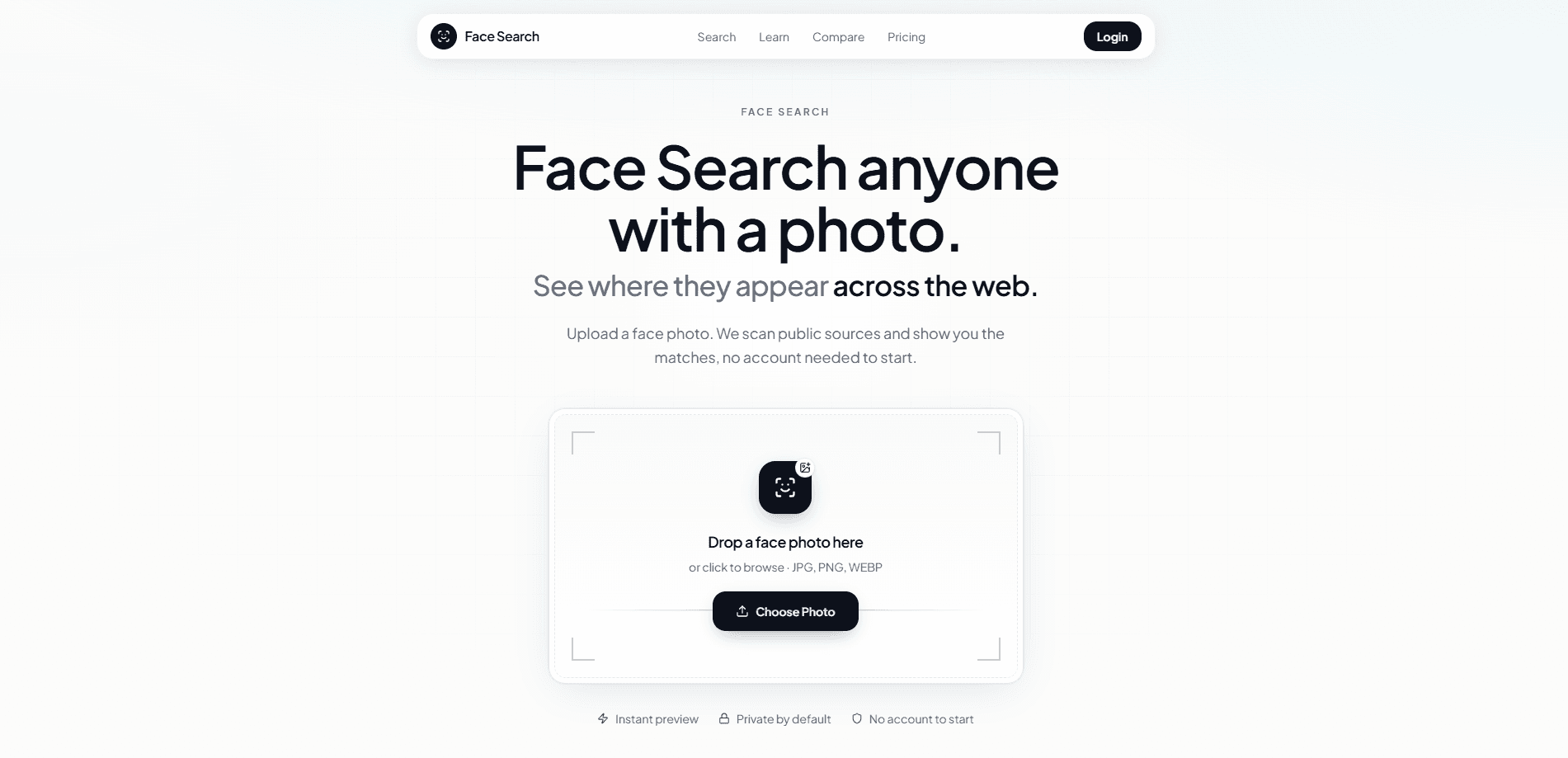
Face Search is a reverse face search tool that helps you find the same person across different photos rather than matching identical files. You upload a face photo, the system builds a facial embedding, and it compares that against a public-web index to return scored source links. It's a FaceCheck-powered face search, so paid matching runs on the FaceCheck.id index, and you buy credits once instead of paying a monthly subscription. People use it to find someone by photo when free tools have already failed.
About Face Search
What Is Face Search
Face Search is a web-based reverse face search tool built for people who have one photo and one question. It looks for the same face across publicly available images, not for copies of the same file. That's the gap most free tools leave open. Google Images and Yandex match pixels and near-duplicates, so they miss the moment a person appears in a different shirt, a different year, or a crop that never went online before.
The tool handles the matching through a partner. Every paid search runs on the FaceCheck.id index, which Face Search states openly on its how-it-works page. What Face Search adds on top is the guided upload flow, one-time credit billing, a results view built for non-investigators, and plain-language guides on reading match scores and staying on the right side of legal and ethical lines.
The biggest limitation is scope. The index sees publicly sourced photos, so nothing reaches private Instagram DMs, closed Facebook albums, or offline identity documents. If a face never appeared on the public web, the honest result is weak or empty. Empty isn't broken. A match score is also a similarity signal, not proof of who someone is, so it's built to point you at pages to check yourself, not to hand you a confirmed name.
Getting Started
- Pick a clear face photo of your own or one you have the right to check. Prefer an original over a chat screenshot, and crop to one front-facing face if the person is in a group.
- Run a free reverse image search first (Google Lens or Yandex Images) on the same crop to catch exact stolen files or recycled scam photos at no cost.
- Upload the photo to Face Search. Guest visitors see a preview flow that shows whether matches likely exist before you pay anything.
- Buy a credit pack and spend one credit to get the full result for that search, including every ranked candidate and direct source links.
- Open each source in a new tab and read the page context, not just the thumbnail, before deciding your next step.
Product Information
A quick look at Face Search's pricing, supported platforms, and performance.
Best for
The users, tasks, and scenarios where this tool fits best.
Users
- Online daters
- People running a self-audit
- Anyone trying to reconnect
Tasks
- Verifying a dating profile
- Tracing a reused photo
- Checking catfishing signals
Scenarios
- Before meeting someone new
- Seasonal profile reviews
- A longer investigation
Key features
Reverse face search across different photos
Face Search matches faces, not files. You upload a photo, the system detects the face and turns its geometry into a numeric representation, and it compares that against a public index. That's the trick. This handles the case free tools miss: the same person photographed at a different time, in a different outfit, or in a crop that never appeared online before.
FaceCheck.id-powered matching
Paid searches run on the FaceCheck.id index rather than a proprietary database. Face Search discloses this on its how-it-works page instead of implying a technology moat it doesn't have. For you, that means the accuracy you get is tied to a specialist provider's index, and the company is upfront about it.
Pay-once credits that never expire
Credits are one-time purchases, not a subscription. Why does that matter? You buy a pack, spend one credit per completed paid search, and unused credits stay in your account with no recurring charge, trial period, or auto-renewal. If you never need to search again, you never pay again.
Guest preview before you pay
Guest visitors can run an upload and see a preview showing whether matches likely exist before spending anything. It's a low-risk way to know whether a paid search is worth buying, rather than paying blind and hoping.
Ranked results with direct source links
Each completed search returns a ranked list of candidate sources, and every candidate links back to the page, profile, or article it came from. You open the sources and judge the context yourself. The tool doesn't auto-resolve a match into a name, which keeps you, not the software, in charge of the conclusion.
Guidance on reading match scores
Results carry a relative confidence signal, not a certainty percentage. Face Search ships explainer content on how to treat different score ranges and why multiple mid-score hits on separate sites matter more than a single high hit. It's the part a raw API won't explain for you.
Face recognition search without the subscription
This is the core promise. Face recognition search tools usually bill monthly, and most people don't need that. Face Search sells credits, so a single face match search costs a few dollars and nothing more. No plan to remember. No renewal to cancel.
Pros and cons
Pros
- Finds the same person across different photos, which pixel-matching tools like Google Lens and Yandex can't do.
- One-time credit packs with no subscription, so there's no forgotten renewal to cancel.
- Credits never expire, and every pack carries a 30-day money-back guarantee.
- Guest preview lets you gauge whether matches exist before paying.
- Upfront about running on the FaceCheck.id index instead of claiming a proprietary database.
Cons
- Only sees publicly sourced photos, so private social accounts and offline records are out of reach, and an empty result is common when a face never went public.
- No API, so you can't fold the matching into your own app or automate checks.
- Match scores are similarity signals, not identity proof, so you still have to verify every hit yourself.
- Not built for continuous monitoring or new-photo alerts, which is where subscription tools fit better.
Frequently asked questions
Face Search is a reverse face search tool that finds where the same face appears across public web pages. Typical uses are checking whether a dating profile is catfishing you, seeing if an old photo of yourself is being reused, or responsibly reconnecting with someone you've lost touch with.
Related content
Explore related tools, skills, and articles for Face Search.
Face Search Alternatives

X Ray Interpreter
X-ray Interpreter · ImageX Ray Interpreter is a web-based AI radiology tool that turns X-rays, CT scans, MRI, ultrasound, and PET images into plain-language reports. You upload a scan, get a preliminary X-ray interpretation in moments, then ask follow-up questions if something needs explaining. It works as a second opinion and a learning aid, not as a medical diagnosis.

Aieasypic
AIEasyPic · ImageAIEasyPic is an AI image generator that turns plain text prompts into finished artwork in seconds. You can also train custom models on your own photos, swap faces in existing images, and create short video clips from text, all from a browser. It suits casual creators who want quick visuals and hobbyists who want to build a personal model without touching any code.

Chargen
Chargen · ImageChargen is an AI character generator and worldbuilding toolkit built for Dungeons & Dragons and other tabletop RPGs. It turns a one-line idea into a painted character portrait, spins up NPCs, monsters, maps and encounters from the same session, and keeps every creature's details close at hand. The tabletop RPG art side runs on a credit system called Gold, while the text generators stay free for everyone.