

FishPic
Pablo Paciello · Image · Leaning
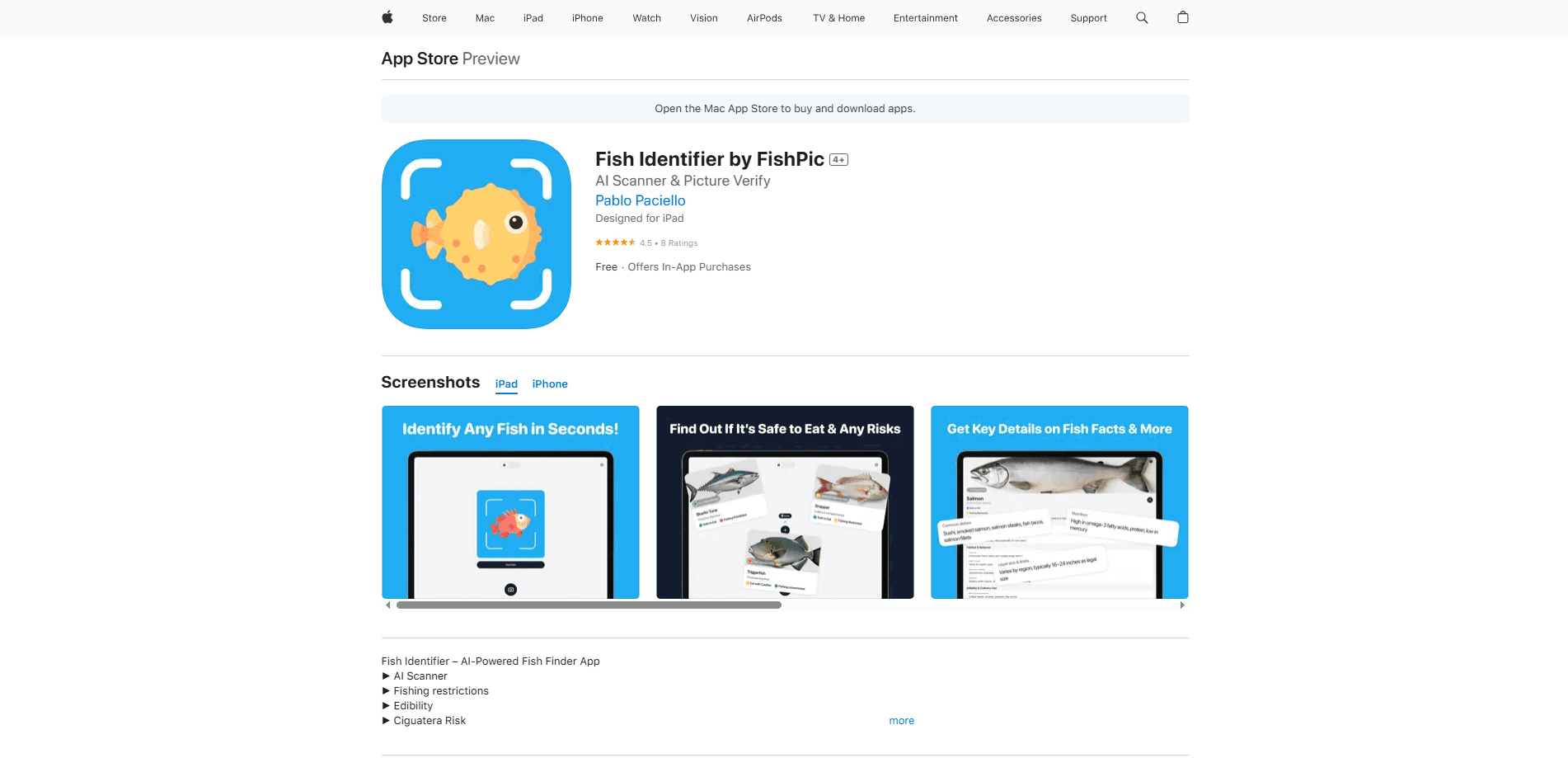
FishPic, sold as Fish Identifier by FishPic, is an iOS app that names a fish from a photo and reports edibility, ciguatera risk, fishing limits, and recipes.
About FishPic
What Is FishPic
FishPic is an iOS app, an AI fish identifier and fish identification app that names a fish from a photograph. You snap a picture of a catch or pick one from your library, and the app's AI scanner returns the species along with practical details a fishing or seafood enthusiast would want to know. It is published by independent developer Pablo Paciello under the name Fish Identifier by FishPic.
The app is built for people who deal with fish on the water rather than in a lab. A recreational angler who lands an unfamiliar catch, a spearfisher checking what is on the line, or a home cook who bought a whole fish at the market can all get a quick read on the species. Alongside the name, FishPic reports whether the fish is considered edible, whether it carries a ciguatera risk, what fishing restrictions may apply, other names the species goes by, typical dishes, and where it is usually found and how large it grows.
The limits are worth knowing up front. FishPic runs only on iPhone and iPad, so there is no Android or web version. Identification leans on photo quality, and like any image-based tool it can struggle when a fish is small in frame, partly hidden, or lit poorly. The app also presents regulations and safety notes as general guidance, which means you should still confirm local rules and seafood safety with official sources before you act.
Getting Started
- Download Fish Identifier by FishPic from the App Store and open the app.
- Take a new photo of the fish or choose an existing image from your photo library.
- Let the AI scanner analyze the picture and return the most likely species.
- Read the result panels for edibility, ciguatera risk, fishing restrictions, alternative names, dishes, and location and size details.
- Decide whether to keep the free tier or subscribe to PRO for unlimited use.
Product Information
A quick look at FishPic's pricing, supported platforms, and performance.
Best for
The users, tasks, and scenarios where this tool fits best.
Users
- Recreational anglers
- Spearfishers and shore fishers
- Seafood cooks and market shoppers
- Curious nature watchers
Tasks
- Identifying a catch from a photo
- Checking ciguatera risk before eating
- Looking up fishing restrictions
- Finding recipe ideas
- Recording a species name
Scenarios
- A boat trip with no signal
- A market run for dinner
- Learning local species over time
- A safety double-check before a meal
Key features
AI Fish Recognition From a Photo
FishPic identifies a fish from a single image. You take a picture with the camera or upload one from your library, and the AI scanner returns the species it believes is in the frame. The developer presents this as the core of the app: a photo in, a species name out, without needing a field guide or a manual search.
Edibility and Ciguatera Risk
Each identification comes with eating-related notes. The app tells you whether the fish is considered edible and whether it carries a ciguatera risk, a seafood poisoning linked to certain reef fish. For anyone deciding whether to cook a catch, these two flags are the practical heart of the tool.
Fishing Restrictions
FishPic lists fishing restrictions associated with the identified species. That helps anglers see whether a limit, season, or rule may apply to what they are holding. The app presents fishing regulations and limits as reference information, so it is a prompt to check local rules rather than the final word on them.
Alternative Names and Dish Recipes
The app reports other names a species is known by, which is useful when regional names differ from the formal one. It also surfaces common dishes tied to the fish, giving cooks a starting point for preparing the catch rather than leaving them with a name and nothing else.
Location and Size Information
Results include where a species is commonly found and how large it typically grows. This context helps you judge whether an identification is plausible for your area and whether the fish in front of you matches the expected profile.
Pros and cons
Pros
- Identifies a fish from a single photo, so there is no manual keying or digging through a guide.
- Adds edibility and ciguatera risk to each result, which matters for anyone planning to eat the catch.
- Reports fishing restrictions, alternative names, dishes, and location and size details in one place.
- Runs on iPhone and iPad with a familiar camera-and-library flow that takes little to learn.
- The base app is free to download, and PRO unlocks unlimited use for a small recurring fee.
Cons
- It is iOS only, so Android users and anyone without an Apple device are left out.
- Accuracy depends on photo quality, and a poor or cluttered shot can produce a wrong or uncertain species.
- Restrictions and safety notes are general guidance, so you still need official sources for binding rules and safe eating.
- There is no public documentation of an API, so developers cannot build on the identification.
Frequently asked questions
FishPic identifies fish from a photo and adds practical details such as edibility, ciguatera risk, fishing restrictions, alternative names, dishes, and location and size information. It is aimed at anglers, spear fishers, and seafood lovers who want a quick species read.
Related content
Explore related tools, skills, and articles for FishPic.
FishPic Alternatives

Tractionwave
TractionWave · Image · MarketingTractionWave is an AI attention heatmap tool for static ads. Upload a PNG or JPG and it returns predicted attention, ranked hotspots, and fixes before you spend budget.

Imejis.io
Imejis.io · Image · MarketingImejis.io is an AI design studio for agents and marketing teams. Describe an image in plain words, and it writes the copy, builds the layout, reflows it to every size, then exports a finished file.

Layoutr
Van Dijk Ontwikkeling · Image · China AILayoutr is a browser floor plan tool that scales your own plan, places furniture at true size, shows the room in 3D and renders it with AI.