

Flair
Flair AI · Image
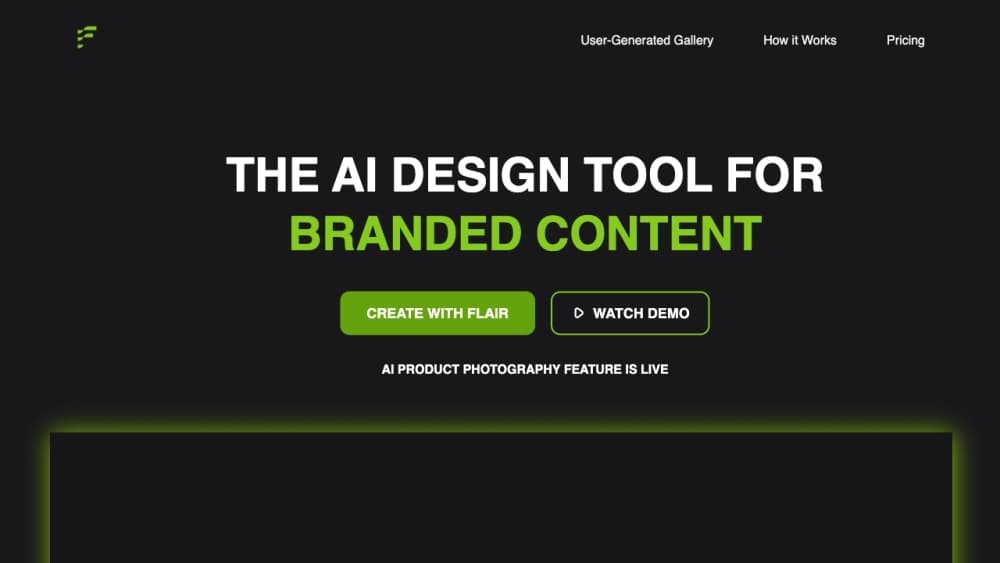
Flair is an AI product photography platform that turns plain product shots into studio-quality lifestyle images, on-model photos, short videos, and ad creatives. Brands upload a clean catalog photo, describe the scene they want, and Flair's generative models build the background, lighting, and human models around the product. Think of it as a product photo generator that replaces much of the work of a real photoshoot. It's built for ecommerce teams, agencies, and marketers who need product images at scale without booking a traditional photoshoot. No studio. No models. No waiting.
About Flair
What Is Flair
Flair is a web-based AI product photography and content generation tool. You hand it a normal product image, usually shot against a neutral background, and it places that product into new environments, on human models, or into marketing layouts. The company positions it as an alternative to the cost and scheduling of conventional photo shoots, which is where most of its value comes from.
The platform does more than still images. It also generates short product videos, marketing and ad creatives, and custom AI models that learn what a specific product or brand style looks like. Teams that sell apparel, jewelry, furniture, beauty products, and packaged goods tend to get the most out of it, since those categories depend on lifestyle and on-body imagery. So what sets it apart from a standard image editor? Generative AI photography is the core idea here, and it works best when the input image is clean.
The main catch is control. Flair uses generative AI, so the same prompt won't return identical results every time. Consistent output takes a trained custom model, a fixed prompt, and patience. The company also doesn't support negative prompts, so steering results away from an unwanted detail means describing what you do want instead. Mobile support is limited too. Flair works best in Chrome or Safari on a desktop. That rules out editing on a phone.
Getting Started
- Visit flair.ai and click "Try Flair AI for Free," then verify your email. There's no password to set up.
- Upload clean product images. For custom models, Flair recommends 6 to 10 consistent, high-quality shots, and multiple angles help training accuracy.
- Pick a custom model type or use the drag-and-drop tool to stage a scene. Product, Human, and Aesthetic are the three model templates available.
- Generate images, videos, or ad creatives from your prompt, then refine with the Image Editor.
- Download assets or share them with your team on Pro+ and Scale plans.
Product Information
A quick look at Flair's pricing, supported platforms, and performance.
Best for
The users, tasks, and scenarios where this tool fits best.
Users
- Ecommerce sellers
- Marketing and ad teams
- Agencies and distributors
Tasks
- On-model apparel shots
- Product videos
- Bulk catalog production
Scenarios
- Launching a seasonal campaign
- Filling gaps in an existing catalog
- Testing ad concepts early
Key features
On-Model Photography
Flair can place a product on human models in poses, settings, and lighting that you choose, and it covers a spread of model types and styles. It's aimed at apparel, jewelry, and accessories where shoppers want to see the item worn, not just listed. You can refine the result afterward with the editing tools rather than starting over.
Custom AI Models
The custom model builder trains on your product or brand aesthetic so the output stays on brand. Three templates are available: Product, Human, and Aesthetic for style-focused work. Standard training takes about 3 hours and favors accuracy, while Fast training finishes in minutes at lower quality, and the Instant option generates immediately for quick experiments.
AI Product Videos
Flair generates short product videos from keyframes you upload; at least one start or end frame is required. You describe the motion and can add camera effects like rotate, zoom, or directional movement. Standard quality costs 1 video credit and highest quality costs 5, and video generation is limited to paid plans.
Video, Image, and Text in One Pass
The bulk content generation tool produces multiple content types from a single product upload, including images, videos, and ad creatives. That matters for large catalogs. You don't run separate tools for each asset type, and output is meant to stay on brand across formats.
Drag-and-Drop Scene Builder
A real-time editor lets you stage a product scene by dragging in props, backgrounds, and camera angles, similar to arranging a physical set. It's separate from the Image Editor and works well for building a background quickly without writing a long prompt. The Extend Image feature, which expands the canvas, is available on paid plans.
Image Editing Tools
Once an image is generated, the Image Editor handles most fixes. You can regenerate a product, erase unwanted elements with Magic Erase, create variations, extend the canvas, upscale a face, use virtual try on for apparel, or change a human pose. You can also fix logo and text placement with a mask tool. This is where a rough generation gets turned into something usable.
Flair API
Flair offers an API for companies that want to generate images, videos, and marketing assets programmatically at scale. As of the current documentation, API access is limited to Scale and Enterprise clients, so individual users can't call it directly. Teams can request access by contacting the company.
Pros and cons
Pros
- Free plan with a limited number of image generations, so you can judge output quality before paying.
- Custom models keep results on brand once trained, which is the difference between a toy and a production tool.
- Covers images, videos, and ad creatives in one platform, which cuts the number of tools a catalog team juggles.
- Team collaboration on Pro+ and Scale plans, including shared model libraries and a collaborative Image Editor.
- Clear entry pricing starting at $8/mo for Pro. That's low for a tool in this category.
Cons
- Free, Pro, and Pro+ content may be featured on the public Flair Community site, so public showcasing is effectively part of the terms unless you're on a Scale plan.
- No negative prompts, which means steering away from an unwanted element takes a rewritten prompt rather than a simple exclusion.
- Standard custom model training takes about 3 hours, which slows down iteration compared with faster but lower-quality training modes.
- Desktop-only in practice; mobile support is limited, so you'll need a computer for real work. Editing on the go isn't an option.
Frequently asked questions
Flair generates product imagery and marketing content with AI. The main uses are on-model product photos, lifestyle shots with new backgrounds, short product videos, and ad creatives, mostly for ecommerce and brand marketing.
Related content
Explore related tools, skills, and articles for Flair.
Flair Alternatives

X Ray Interpreter
X-ray Interpreter · ImageX Ray Interpreter is a web-based AI radiology tool that turns X-rays, CT scans, MRI, ultrasound, and PET images into plain-language reports. You upload a scan, get a preliminary X-ray interpretation in moments, then ask follow-up questions if something needs explaining. It works as a second opinion and a learning aid, not as a medical diagnosis.

Aieasypic
AIEasyPic · ImageAIEasyPic is an AI image generator that turns plain text prompts into finished artwork in seconds. You can also train custom models on your own photos, swap faces in existing images, and create short video clips from text, all from a browser. It suits casual creators who want quick visuals and hobbyists who want to build a personal model without touching any code.

Chargen
Chargen · ImageChargen is an AI character generator and worldbuilding toolkit built for Dungeons & Dragons and other tabletop RPGs. It turns a one-line idea into a painted character portrait, spins up NPCs, monsters, maps and encounters from the same session, and keeps every creature's details close at hand. The tabletop RPG art side runs on a credit system called Gold, while the text generators stay free for everyone.