
Fleak
Fleak · Coding
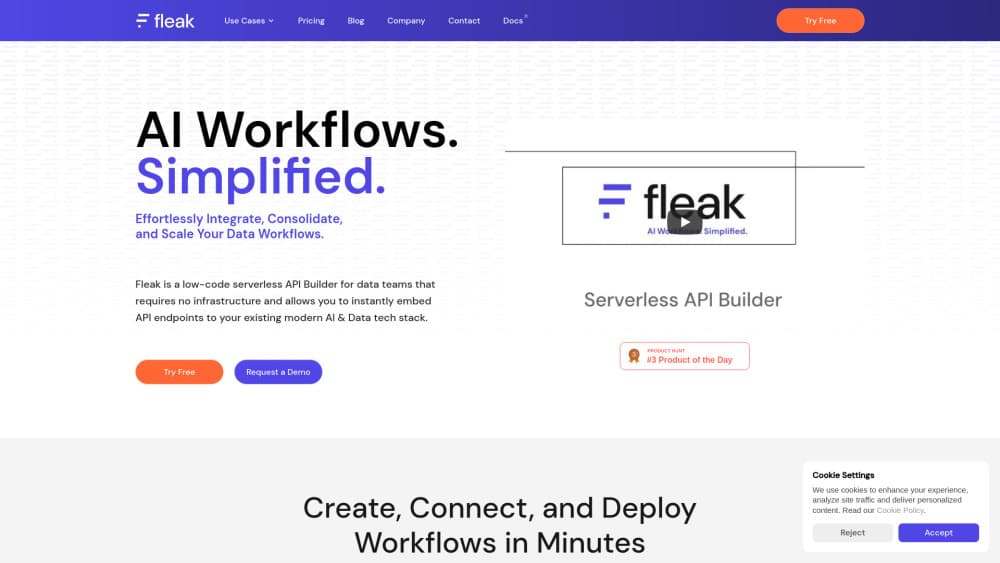
Fleak is a low-code serverless platform that cleans, routes and delivers messy data to AI apps, built for data and engineering teams.
About Fleak
What Is Fleak
Fleak sits between your raw data and the AI applications that consume it. The company's own framing is blunt: your AI is only as smart as your worst data source. Raw, unqualified events flow into models and data stores, and the models reason over everything equally, which means they get everything equally wrong.
Fleak's answer is a data layer that decides what each incoming data point is worth before it reaches a downstream app. What carries real-time value moves fast. What carries compliance value goes to long-term storage. What carries no value goes nowhere. The goal is to stop paying to store and process junk. You can think of the product as a low-code API builder for serverless data integration, one that handles the plumbing so your team doesn't hand-write every connector.
It's built for teams that already feel this pain. Every new source takes months to onboard, every schema change breaks something, and the data engineering team never escapes maintenance mode. Fleak targets that maintenance burden directly with self-healing pipelines and value-aware routing. It reports SOC 2 Type II compliance and logs every transformation.
The main limits are practical, not technical. Fleak is infrastructure, so it's aimed at teams with real pipelines and real data volume, not individual users. It also leans heavily on connecting to your existing sources, which means setup effort scales with how tangled your stack already is. From what's published on the site, public pricing isn't listed, so smaller teams should talk to sales before assuming it fits a tight budget.
Getting Started
- Connect a source. Fleak links to cloud services, OT systems, endpoints, APIs and databases, and it says no custom connectors are needed.
- Describe what you want in natural language. The copilot builds the pipeline configuration from that description in minutes.
- Let it transform and route. Fleak identifies event types, branches by destination intent and normalizes data to the right schema.
- Deliver to any destination. Clean, governed data goes to your AI apps, data lakes, SIEM or other targets, in real time.
- Approve changes when schemas drift. Fleak detects an upstream change, generates a new config and asks you to approve before redeploying.
Product Information
A quick look at Fleak's pricing, supported platforms, and performance.
Best for
The users, tasks, and scenarios where this tool fits best.
Users
- Data engineers
- Platform and infrastructure teams
- Security operations teams
- Financial services teams
Tasks
- Consolidating data sources
- Normalizing AI inputs
- Cutting storage spend
- Routing by value
- Building serverless APIs
- Automating AI workflow steps
Scenarios
- A downstream model starts returning worse answers after an upstream team renames a field
- A data team spends its week on connector maintenance instead of new work
- Compliance asks what an agent actually did with customer data
- A security team needs high-volume events triaged the moment they arrive without storing months of noise.
Key features
Value-Aware Routing
Fleak evaluates each incoming data point against what the downstream application needs, then routes it on that basis. Real-time signals go straight through, compliance data heads to long-term storage, and worthless data is dropped. For teams paying for both storage and LLM tokens, that triage is where the savings come from.
AI-Orchestrated, Self-Healing Pipelines
When a schema changes upstream, Fleak detects it, generates a new config and redeploys, with human review optional. The company puts average self-heal time at around three minutes. That's the difference between a silent pipeline break and a config you approve and move on from.
Natural-Language Pipeline Building
You describe the outcome you want in plain language and the copilot assembles the pipeline. Fleak markets this as minute-level setup, against a traditional figure of about six months to get a first source live. The point isn't the marketing number, it's that a data engineer isn't hand-writing every transformation, and on a stack with a dozen sources that difference compounds fast.
Governed Delivery With Audit Trails
Access control is enforced at the data layer rather than bolted on per application, and every transformation is logged. Fleak states SOC 2 Type II compliance. For teams whose auditors ask what a specific agent did with a specific record, that log is the answer, and it makes data governance a property of the platform instead of a checklist each application team has to satisfy on its own.
Any-Source Connectivity
Cloud services, OT systems, endpoints, APIs and databases all connect through the platform, and Fleak says no custom connectors are required. That matters for teams with industrial or IoT data, where writing a connector for every protocol is its own project.
High-Volume Real-Time Throughput
Fleak handles events at a scale it describes in millions per second, in real time and with zero storage required for the pass-through. Deduplication at ingestion is reported to cut storage costs by 50 percent and normalized inputs to cut LLM token costs by 40 percent. Those are Fleak's own figures, not independent measurements.
Delivery to Any Destination
Clean data lands in the schema you specify and goes to AI applications, data lakes, SIEM or other targets. The same governed stream can feed several consumers at once instead of being rebuilt for each one.
Pros and cons
Pros
- Value-aware routing cuts both storage and token costs by discarding data nobody needs.
- Self-healing pipelines handle schema drift automatically, so a renamed upstream field doesn't turn into an on-call incident.
- Access control and a full audit trail live at the data layer, which simplifies compliance work.
- Natural-language setup lowers the effort to get a first source live compared with hand-built pipelines.
- Real-time, high-volume throughput with no storage required for pass-through events.
Cons
- No published public pricing, so budget planning means contacting sales.
- It's infrastructure for teams with real data volume, which makes it overkill for a small project or solo developer.
- Benefits depend on connecting your existing sources, so setup effort grows with how tangled your stack is.
- The cost-saving numbers are Fleak's own claims and haven't been verified independently.
Frequently asked questions
Fleak is a data layer that sits between your raw sources and your AI applications. It cleans, filters, normalizes and routes data, then delivers it to destinations like AI apps, data lakes or a SIEM. The pitch is simple: models only answer as well as the data they're fed.
Related content
Explore related tools, skills, and articles for Fleak.
Fleak Alternatives
Forefront
Forefront · CodingForefront is a web platform for building with open-source AI. It lets you fine-tune leading open-source language models on your own data, evaluate how they perform, and run them through an API or export them to host yourself. Developers who want the convenience of a closed-source platform but insist on owning their models and data are the target audience here.

Startkit
StartKit.AI · CodingStartkit is a boilerplate for building AI SaaS and AI wrapper products. Think of it as an AI startup boilerplate with the boring parts already wired up: authentication, Stripe and Lemon Squeezy payments, usage limits, transactional email, and an AI API starter that talks to OpenAI, Anthropic, Groq, or Llama. You clone the repo, set your price, and start on the part of your product that people actually pay for. It's Next.js under React and Tailwind, so most of the boilerplate code already feels familiar.
Testim
Tricentis · CodingTestim is an AI-powered test automation platform for building and running end-to-end tests across web, mobile, and Salesforce applications. It leans on machine learning to keep tests stable when an interface changes, so teams spend less time fixing broken selectors. Not bad for an automated testing tool you can start using today. You create tests by recording actions in a browser, then optionally add JavaScript when you need more control. It's a solid pick for busy QA teams.