

Forsy
Forsy · Coding
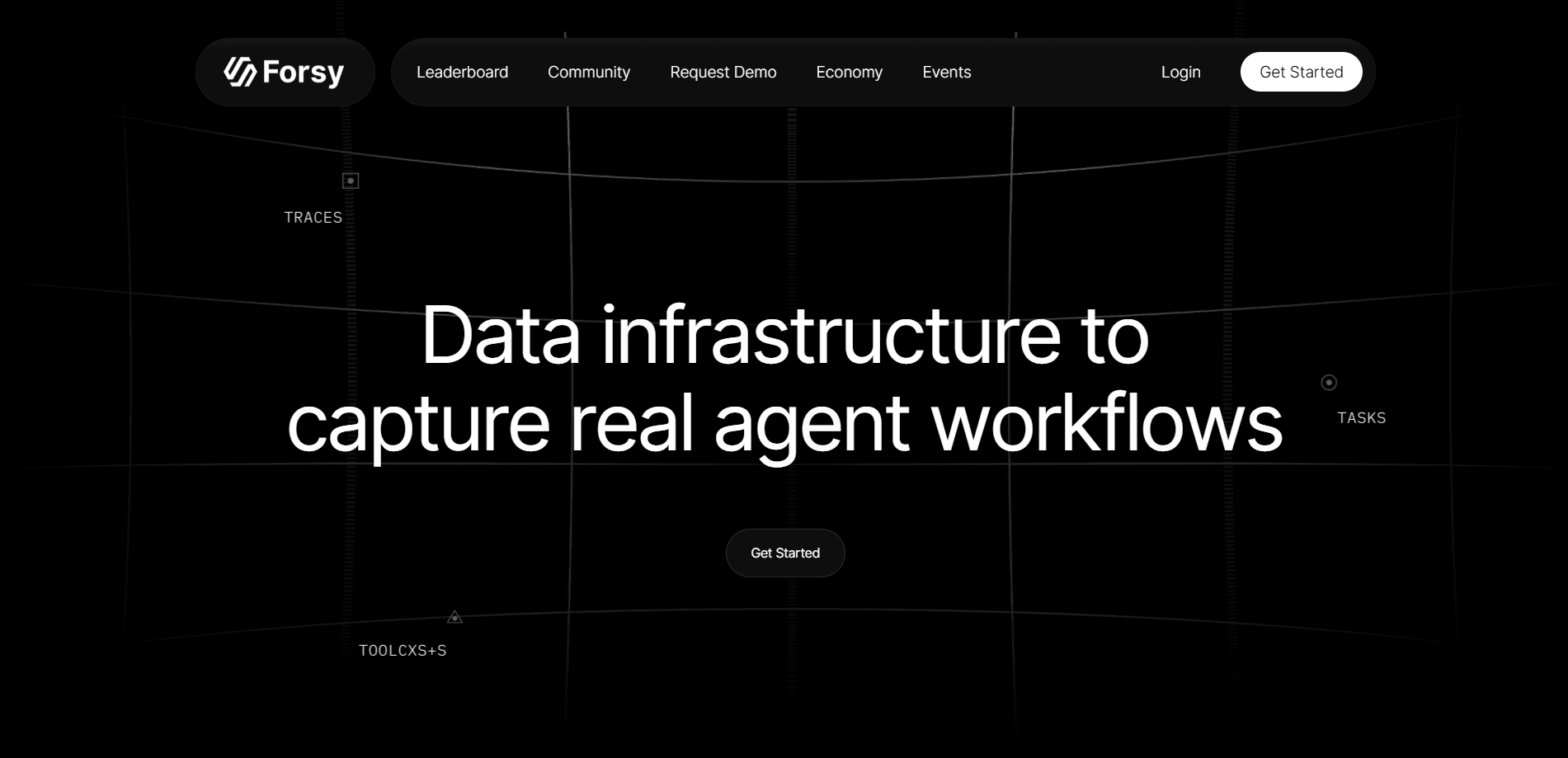
Forsy is an AI agent data platform that records how agents behave while they run, not after the fact. It captures full agent workflows in real time across toolchains, then turns that activity into high-fidelity data teams can evaluate, license, or trade. Built by the team behind CPIBench-0, Forsy positions itself as the learning loop for AI agents operating in the living world.
About Forsy
What Is Forsy
Forsy is an agent data infrastructure and marketplace for teams that build or buy AI agents. Most agent stacks can tell you whether a task finished. They can't tell you how it got there, which tool calls failed, or why a response drifted in the middle of a long run. Forsy closes that gap. It natively captures agent workflows as they happen, then packages the result as something you can inspect and reuse.
The product ships with CPIBench-0, a public benchmark for evaluating how frontier models and agent setups handle operations that depend on cyber-physical systems. Those projects span mechatronics, manufacturing, materials, and energy, so the data reflects messy, real conditions rather than clean lab tasks. If you're evaluating an AI agent data platform, this pairing of capture and evaluation is the main pitch.
The catch is access. Forsy runs on a demo-request model, with no self-serve signup and no published pricing tiers. So you can't try it without talking to sales first. There's also no public API documentation. That's a real barrier for teams who like to test a tool before committing.
Getting Started
- Open the Forsy site and use the Request Demo form, entering your name, email address, and organization.
- Wait for the team to follow up and schedule a walkthrough of the platform, including the capture and marketplace modules.
- In the demo, walk through how workflows are captured, what the CPIBench-0 leaderboards show, and how agent data can be licensed.
- Agree on scope and access terms with the Forsy team, since pricing and packaging aren't published anywhere.
- Connect your own agent toolchain, or start with the public benchmark data before wiring in live workflows.
Product Information
A quick look at Forsy's pricing, supported platforms, and performance.
Best for
The users, tasks, and scenarios where this tool fits best.
Users
- AI teams building agents
- Data and ML leads
- Operations groups in industry
Tasks
- Capturing agent workflows
- Benchmarking models and agent setups
- Licensing agent data
Scenarios
- Evaluating an agent before roll out
- Researching cyber-physical operations
- Building a data pipeline around agents
Key features
Real-Time Workflow Capture
Forsy records agent activity while the agent runs, capturing tool calls, context changes, and workspace state as they occur. You get the full trace of a task, not a cleaned-up log assembled later. For debugging an agent that behaves differently every run, the difference matters. It's the evidence you need.
Full-Coverage Toolchain Tracking
The platform tracks agents across their toolchains so a workflow stays connected end to end. If an agent jumps between a file system, a search tool, and a custom endpoint, Forsy keeps every one of those steps together in a single connected view. Teams evaluating an agent data platform usually want this coverage before anything else.
Agent Data Marketplace
Captured workflows become assets. Forsy describes itself as a marketplace where teams can discover, license, and trade authentic agent data. That opens a path for teams sitting on useful traces to monetize them. The listing and licensing terms run through the Forsy team rather than a self-serve store.
CPIBench-0 Benchmark
Forsy publishes CPIBench-0, its first benchmark for models and agents in cyber-physical operations. It's built from real projects across mechatronics, manufacturing, materials, and energy, with more than 1900 evaluated rollouts. The benchmark separates a Model Track and an Agent Track. That way you can see whether raw capability survives the full agent setup.
Performance Against Cost
The CPIBench-0 leaderboards report pass rate and score next to total cost, runtime, and token usage. Views like pass rate versus total runtime show how much an agent spends to reach a given result, which helps you spot a configuration that burns tokens for a marginal gain. For budget-conscious teams, that framing is more useful than a single accuracy number.
Learning Loop for Deployed Agents
The core idea is a learning loop. Agents run in the world, their workflows get captured, and that data feeds back into better behavior. It's aimed at agents that operate in messy, real environments rather than sandboxes. That's why the benchmark leans on industrial projects.
Pros and cons
Pros
- Captures agent behavior in real time, so traces reflect what actually happened
- CPIBench-0 pairs accuracy with cost, runtime, and token spend for agent evaluation
- Combines data capture with a marketplace for licensing and trading agent data
- Benchmark data draws on real industrial projects, not synthetic tasks
- Covers both the base model and the full agent setup in its rankings
Cons
- No published pricing, so you can't estimate cost without a sales conversation
- No self-serve signup; everything starts with a demo request
- API availability is unstated, which leaves integration planning uncertain
- The marketplace is early, so listing and licensing terms aren't clearly documented
Frequently asked questions
Forsy captures AI agent workflows in real time and turns them into data you can evaluate, license, or trade. So what makes it different? It pairs that capture layer with CPIBench-0, a benchmark for agents running cyber-physical operations.
Related content
Explore related tools, skills, and articles for Forsy.
Forsy Alternatives
Forefront
Forefront · CodingForefront is a web platform for building with open-source AI. It lets you fine-tune leading open-source language models on your own data, evaluate how they perform, and run them through an API or export them to host yourself. Developers who want the convenience of a closed-source platform but insist on owning their models and data are the target audience here.

Startkit
StartKit.AI · CodingStartkit is a boilerplate for building AI SaaS and AI wrapper products. Think of it as an AI startup boilerplate with the boring parts already wired up: authentication, Stripe and Lemon Squeezy payments, usage limits, transactional email, and an AI API starter that talks to OpenAI, Anthropic, Groq, or Llama. You clone the repo, set your price, and start on the part of your product that people actually pay for. It's Next.js under React and Tailwind, so most of the boilerplate code already feels familiar.
Testim
Tricentis · CodingTestim is an AI-powered test automation platform for building and running end-to-end tests across web, mobile, and Salesforce applications. It leans on machine learning to keep tests stable when an interface changes, so teams spend less time fixing broken selectors. Not bad for an automated testing tool you can start using today. You create tests by recording actions in a browser, then optionally add JavaScript when you need more control. It's a solid pick for busy QA teams.