

Fuzzy Match
Radix Analytics Pvt Ltd · Coding
Fuzzy Match is a browser-based data matching tool that loads CSV or Excel files and finds near matches, typos, and spelling variants across the columns you choose.
About Fuzzy Match
What Is Fuzzy Match
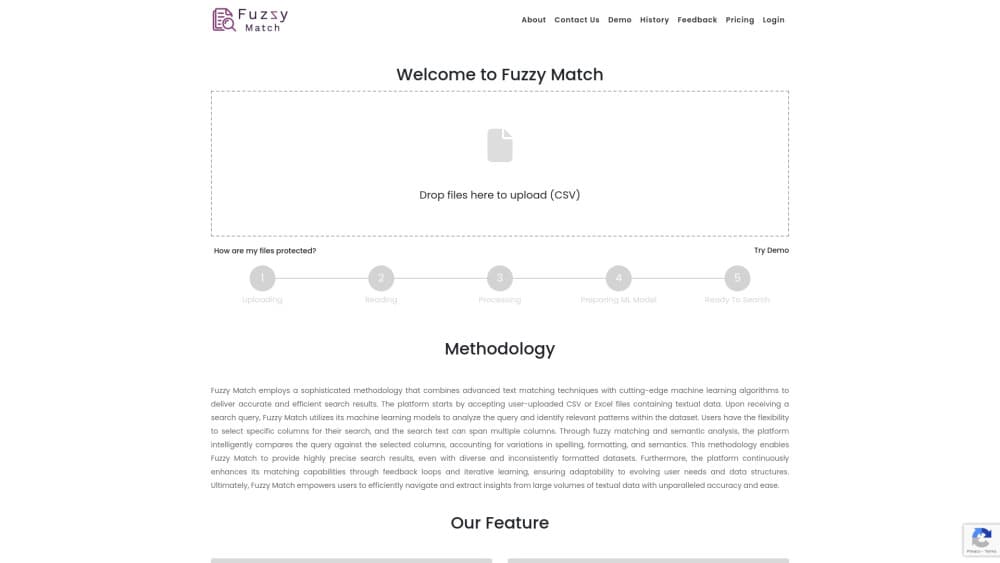
Fuzzy Match is a web app from Radix Analytics that compares text you type against a file you upload. You pick the columns to search, submit a name, address, or product string, and the tool returns rows that look close to your query, including rows with misspellings or different formatting.
The product targets a common office problem: two lists that describe the same entities but never agree on spelling. Customer names arrive as "Jon Smith" in one export and "John Smyth" in another. A fuzzy matching tool like this lets you find those pairs without writing SQL or Python.
It's a search console, not a full data cleansing suite. You get ranked matches and a history of past runs, but you don't get a merge workflow that rebuilds a master record. Plan caps also apply to file size, file count, and the number of results returned, so very large datasets need splitting before upload.
Getting Started
- Open fuzzymatch.in and use the demo without an account, or sign in to unlock the free plan limits.
- Upload a CSV or Excel file and wait while the service reads the rows and prepares its matching model.
- Select the columns you want searched, then type the name, address, or code you need to find.
- Review the ranked results, adjust your query wording, and keep the run in History for later reference.
Product Information
A quick look at Fuzzy Match's pricing, supported platforms, and performance.
Best for
The users, tasks, and scenarios where this tool fits best.
Users
- Data analysts
- Operations and CRM administrators
- Small teams without engineers
Tasks
- Deduplicating a customer list
- Address matching
- Product catalog cleanup
- Data cleansing before reporting
Scenarios
- One-off file audit
- Recurring vendor checks
- Pre-migration review
Key features
Fuzzy Matching That Tolerates Typos
The core engine compares your query with each row and still returns a hit when letters are swapped, dropped, or doubled. That behavior matters for data matching work on hand-typed records, where exact filters fail on the first misspelling.
Column-Level Search Control
You choose which columns the engine reads, and a single query can span more than one column. Restricting the search to a name column cuts noise from notes and free-text fields, which keeps the ranked list short enough to review.
Machine Learning Instead of Rule Lists
Fuzzy Match describes its matching as model-driven rather than rule-driven, so it adapts to patterns in the uploaded file instead of relying on a fixed list of exceptions. In practice, that helps with datasets where formatting varies from row to row.
Feedback Loops That Improve Results
The platform collects feedback on matches and uses it to refine later runs. If a pair is marked wrong, the model has a signal to work with, which is the main reason to sign in rather than use the anonymous demo.
History and Retention Controls
Every run is stored in a History view, and you can delete files before they expire. Retention depends on your plan: 24 hours on the free tier, then 7, 15, or 30 days as you move up.
Plan-Scaled Limits and Custom Models
The free and paid tiers differ in file size, result count, storage, and monthly file allowance. Premium adds a custom ML model built around your own data, which suits teams whose record matching rules are specific to one industry.
Pros and cons
Pros
- No install and no setup: the whole workflow runs in a browser tab, and the demo works before you create an account.
- Clear plan caps: file size, result count, and retention are published per tier, so you can predict whether the free plan fits.
- Feedback-driven matching: corrections feed back into the model, which beats static string-distance rules on messy lists.
- Custom model option: Premium covers teams that need matching tuned to their own data rather than a general model.
Cons
- Result caps bite on big files: even Premium stops at 1,000 matches per search, so a 50,000-row deduplication job has to be split into batches.
- No documented public API: automation is limited to manual uploads, which rules out scheduled pipelines unless you build around the web flow.
- Short retention: files disappear after 30 days at most, so the tool can't serve as a lightweight record store for audit trails.
- Matching still needs human review: near matches include false positives, and the tool doesn't merge records for you.
Frequently asked questions
It searches a CSV or Excel file for rows that closely match a query you type, including rows with typos and spelling variants. You select the columns to search, then review ranked results.
Related content
Explore related tools, skills, and articles for Fuzzy Match.
Fuzzy Match Alternatives
Forefront
Forefront · CodingForefront is a web platform for building with open-source AI. It lets you fine-tune leading open-source language models on your own data, evaluate how they perform, and run them through an API or export them to host yourself. Developers who want the convenience of a closed-source platform but insist on owning their models and data are the target audience here.

Startkit
StartKit.AI · CodingStartkit is a boilerplate for building AI SaaS and AI wrapper products. Think of it as an AI startup boilerplate with the boring parts already wired up: authentication, Stripe and Lemon Squeezy payments, usage limits, transactional email, and an AI API starter that talks to OpenAI, Anthropic, Groq, or Llama. You clone the repo, set your price, and start on the part of your product that people actually pay for. It's Next.js under React and Tailwind, so most of the boilerplate code already feels familiar.
Testim
Tricentis · CodingTestim is an AI-powered test automation platform for building and running end-to-end tests across web, mobile, and Salesforce applications. It leans on machine learning to keep tests stable when an interface changes, so teams spend less time fixing broken selectors. Not bad for an automated testing tool you can start using today. You create tests by recording actions in a browser, then optionally add JavaScript when you need more control. It's a solid pick for busy QA teams.