

Gecko Security
Gecko Security · Coding
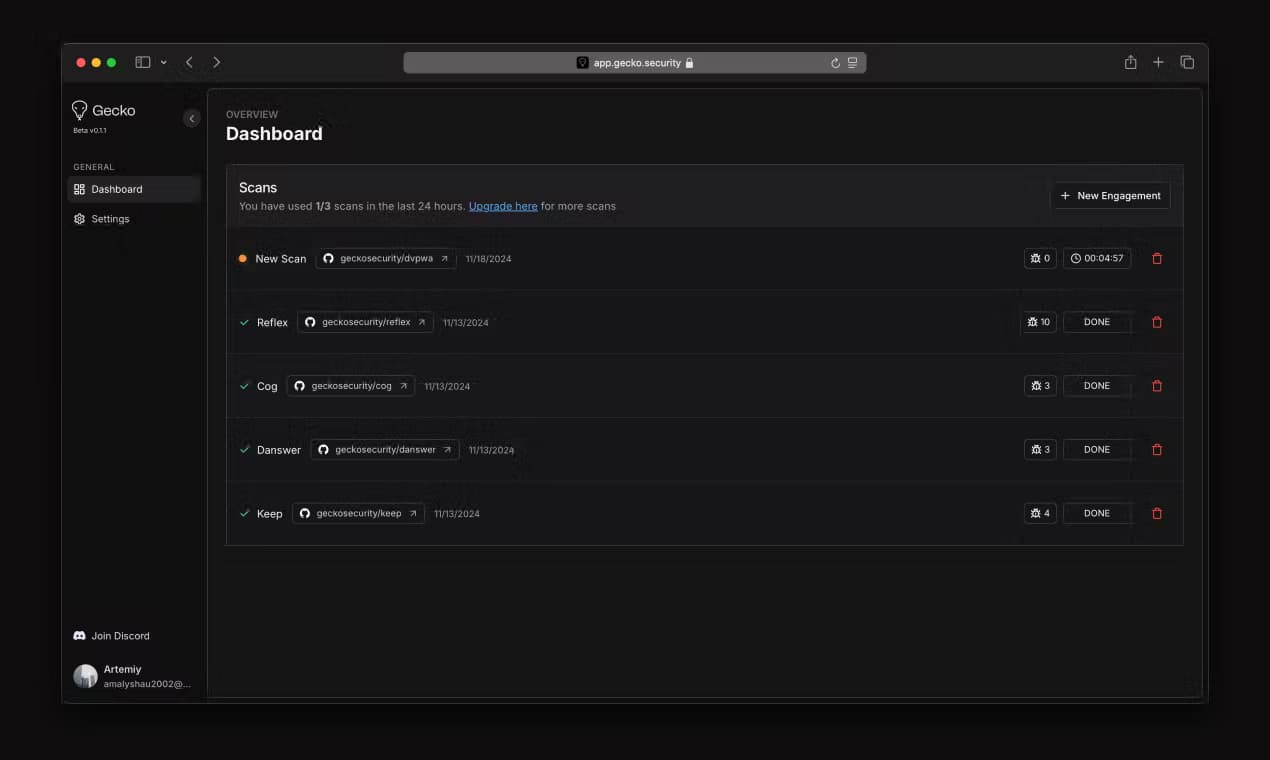
Gecko Security is an AI security engineer that scans your codebase to find exploitable vulnerabilities and hands developers the fixes.
About Gecko Security
What Is Gecko Security
Gecko Security is an AI-powered application security platform. Instead of matching known patterns in your code, it builds a semantic model of your whole application: source code, infrastructure, and documentation together. Then it traces how data flows between services and where trust boundaries break down. The result is detection of complex bugs that older scanners tend to miss, like business logic flaws and multi-step attack chains.
The target user is a development or security team that ships code fast and can't afford a separate AppSec bottleneck, so Gecko plugs into your pipeline, reviews every pull request, and suggests one-click fixes. A PR/MR bot comments on findings, so engineers resolve issues without leaving GitLab or GitHub. Cal.com's head of engineering put it plainly in a case study: every pull request that goes in, they know is protected.
It's not a free-for-everything tool and it isn't built for solo hobby projects. The free tier caps you at 10 scans. Real coverage starts on Pro at $100 per month, and enterprise features like on-prem deployment and SSO sit behind custom annual pricing. If you just need a quick lint on a side project, that's a lot of overhead. If you're protecting a production codebase across a microservice architecture, it's a different story.
Getting Started
- Create an account at app.gecko.security and connect your repository from GitHub, GitLab, or Bitbucket.
- Let Gecko index the codebase so it can build its semantic graph of your services and dependencies.
- Connect supporting context, such as infrastructure configuration and documentation, so scans can trace data across trust boundaries.
- Run your first scan or open a pull request and let the PR/MR bot flag findings with suggested fixes.
- Review the prioritized issues, apply the autofix, and move on.
Product Information
A quick look at Gecko Security's pricing, supported platforms, and performance.
Best for
The users, tasks, and scenarios where this tool fits best.
Users
- Development teams shipping code weekly
- Security engineers at mid-size and enterprise companies
- Startup founders without a dedicated security hire
Tasks
- Reviewing pull requests for exploitable bugs
- Threat modeling across services and release cycles
- Writing security policies in plain language
Scenarios
- A microservice app where a flaw only appears between two services
- A team preparing for a compliance review
- Sprint work where security keeps slipping
Key features
Semantic Code Analysis
Gecko builds a compiler-accurate graph of your codebase rather than relying on brittle AST parsing or call graphs. That lets it understand what your code means, parse dynamically typed languages, and follow multi-step vulnerabilities through your application. It's the engine behind the platform's AI SAST.
Attack Path and Logic Flaw Detection
Most scanners look for patterns they already recognize. Gecko acts as a code vulnerability scanner that maps full attack paths, logic flaws, and cross-service risks across your environment. Business logic bugs are exactly where breaches happen, and they're the kind of vulnerability that pattern matching tools simply can't see, no matter how many rules you write.
Natural Language Rules
You write security policies the way you'd explain them to a teammate, like "this service shouldn't write data to a third-party API." Gecko applies that rule across your code, dependencies, and connected environment. No DSL to learn, no regex to maintain.
CI/CD and Pull Request Scanning
The platform drops into your pipeline so developers fix issues without leaving their workflow. It reviews pull requests, flags problems, and can mark a finding as fixed once someone pushes a change, so security stops being a toll booth at the end of the sprint.
Contextual Scanning Across Services
Gecko scans multiple repos and microservices to find issues that only surface between trust boundaries, and it pulls in integrations like Jira, Terraform, and cloud config so it can understand the full environment around your code. Accurate results start with that integrated context.
Continuous Learning and Prioritization
Gecko learns from your feedback to improve accuracy over time, so findings get sharper. The marketing numbers are 8x more true positives and 90% less false positives, and the company also cites an average time to remediation of about an hour across customer deployments. Treat those numbers as vendor figures, not independent results.
Intelligent Prioritization
Not every finding deserves your morning. Gecko sorts issues by how remotely exploitable they're, so the scariest problems surface first. Your team's limited attention goes to the vulnerabilities an attacker could actually reach.
Pros and cons
Pros
- Finds logic flaws and multi-step attack chains that pattern-based scanners usually miss.
- Integrated PR/MR bot and one-click autofix keep security inside the developer workflow.
- Semantic analysis works on dynamically typed languages, where call-graph tools struggle.
- Free tier available with a 10-scan cap, so you can test the workflow before paying.
- Enterprise options include self-hosted deployment, SSO/SAML, and audit logs for regulated teams.
Cons
- Pro starts at $100 per month, which is steep for solo developers or small side projects.
- The free plan's 10 scans run out quickly on an active repo.
- Enterprise pricing is custom and annual only, so you can't self-serve the full feature set.
- The accuracy figures come from the vendor, and independent third-party benchmarks are still thin.
Frequently asked questions
It scans your codebase and connected infrastructure to find exploitable vulnerabilities, then hands developers the fixes they need to resolve each issue before it reaches production. It focuses on complex issues like business logic flaws and multi-step attack chains rather than simple pattern matches.
Related content
Explore related tools, skills, and articles for Gecko Security.
Gecko Security Alternatives
Forefront
Forefront · CodingForefront is a web platform for building with open-source AI. It lets you fine-tune leading open-source language models on your own data, evaluate how they perform, and run them through an API or export them to host yourself. Developers who want the convenience of a closed-source platform but insist on owning their models and data are the target audience here.

Startkit
StartKit.AI · CodingStartkit is a boilerplate for building AI SaaS and AI wrapper products. Think of it as an AI startup boilerplate with the boring parts already wired up: authentication, Stripe and Lemon Squeezy payments, usage limits, transactional email, and an AI API starter that talks to OpenAI, Anthropic, Groq, or Llama. You clone the repo, set your price, and start on the part of your product that people actually pay for. It's Next.js under React and Tailwind, so most of the boilerplate code already feels familiar.
Testim
Tricentis · CodingTestim is an AI-powered test automation platform for building and running end-to-end tests across web, mobile, and Salesforce applications. It leans on machine learning to keep tests stable when an interface changes, so teams spend less time fixing broken selectors. Not bad for an automated testing tool you can start using today. You create tests by recording actions in a browser, then optionally add JavaScript when you need more control. It's a solid pick for busy QA teams.