

Gemma
Google (Google DeepMind) · Coding · Other
Gemma is Google's family of open weight AI models you can download and run on your own hardware. Gemma 4 spans phone sized builds up to a 31B model for workstations.
About Gemma
What Is Gemma
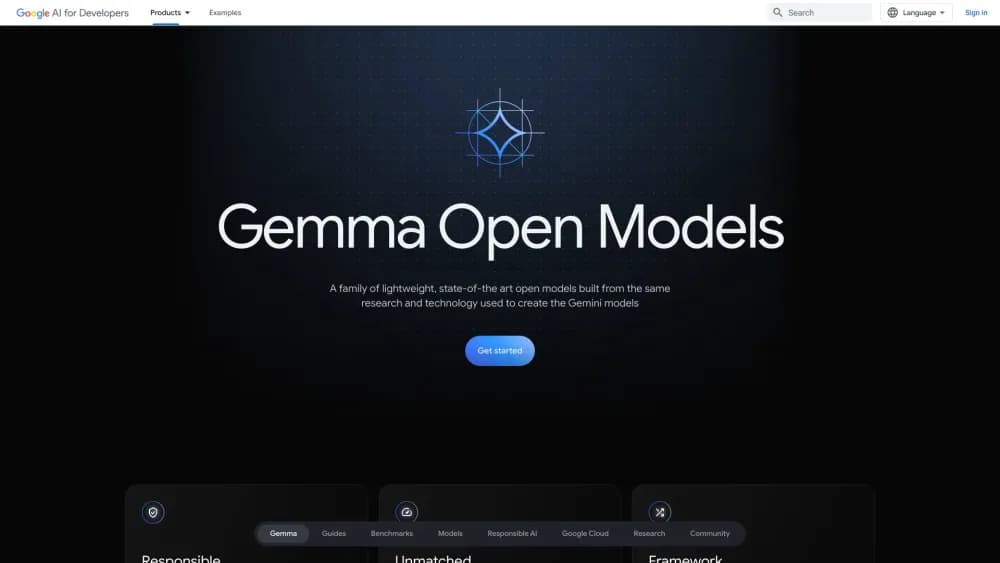
Gemma is Google's line of open weight language models, built by Google DeepMind on the same research that powers the closed Gemini models. The key difference is where the model lives. Gemini runs in Google's cloud, while Gemma open weights are published for anyone to download, modify, and deploy on their own machines. Since the first release in February 2024, the family has passed 400 million downloads and spawned more than 100,000 community variants.
The current generation, Gemma 4, arrived on April 2, 2026 with four sizes. Two lightweight builds, E2B and Gemma E4B, target phones, Raspberry Pi boards, and Jetson devices, and they run fully offline. Two larger builds, a 26B mixture of experts model and a 31B dense model, target developer workstations and servers. All four handle images, and the edge models also take audio.
The biggest shift is legal, not technical. Gemma 4 moved from Google's custom Gemma license, which developers had complained about for a year, to Apache 2.0. That license lets companies use, modify, and redistribute the models for commercial work without asking Google for permission. A 31B build sits third on the open model Arena leaderboard, and Google calls the family the most capable open models per byte.
The tradeoff is that open weights mean you supply the hardware, the setup, and the maintenance. There's no hosted chat product, no support desk, and no guarantee that a given fine tune will match a cloud model on every task.
Getting Started
- Pick a size that matches your hardware: E2B or E4B for phones and small boards, 26B and 31B for GPUs and workstations.
- Download the weights from Google's official channels such as Gemma Hugging Face, Kaggle, or ModelScope, keeping the Apache 2.0 terms in view.
- To run Gemma locally, load the model in a runtime like Ollama, llama.cpp, LiteRT-LM, or a Python stack, and quantize if memory is tight.
- Fine tune on your own data if the base model misses your domain, then wire it into an app through function calling or the API. Gemma fine tuning follows the standard frameworks, so the workflow will feel familiar.
- Test against your real workload before shipping, since on-device output quality varies with size and quantization.
Product Information
A quick look at Gemma's pricing, supported platforms, and performance.
Best for
The users, tasks, and scenarios where this tool fits best.
Users
- Developers building offline apps
- Researchers and tinkerers
- Startups with tight budgets
- Students learning machine learning
Tasks
- Running a local coding assistant
- Speech and image understanding on device
- Long document processing
- Building agent workflows
Scenarios
- Working without an internet connection
- Keeping sensitive data in house
- Prototyping an AI feature fast
- Porting a prototype to mobile
Key features
Four Sizes Across the Hardware Range
Gemma 4 covers the spread from a phone to a server without leaving the family. E2B and Gemma E4B keep memory and power low enough for mobile chips, while the 26B mixture of experts model and the Gemma 31B dense model target workstations and data center GPUs. You pick the size that fits the device you already own.
Gemma Apache 2.0 Licensing
The move to Gemma Apache 2.0 is the change developers asked for. You can use, modify, and redistribute the weights for commercial products, and Google can't unilaterally rewrite the rules later. For teams that had legal teams balk at the older terms, that clarity is the deciding factor.
Mixture of Experts Efficiency
The 26B model activates only about 3.8B of its 25.2B parameters per token, so it runs closer to the speed of a small model while keeping much of the quality of a large one. On a consumer GPU it delivers high throughput, which matters for latency sensitive agent loops where every second of waiting shows.
Native Multimodal Input
All four models read text and images, and the edge models take audio as well. A single model can transcribe speech, answer questions about a screenshot, and read a chart instead of stitching several specialized models together. Variable resolution input lets you trade detail for speed on classification versus OCR.
Reasoning and Function Calling
Every model in the family supports a reasoning mode you can switch on, and native function calling with structured JSON output. That combination is what turns the model from a chat box into the policy layer of an agent that can plan steps and call outside tools without prompt tricks.
Runs Entirely On Device
The edge models run offline on phones, Raspberry Pi boards, and Jetson devices, with the Pixel team working alongside Qualcomm and MediaTek on the optimization. Near zero latency and no network dependency make the family viable for privacy sensitive and remote deployments.
Pros and cons
Pros
- Apache 2.0 licensing clears the legal uncertainty that held back earlier Gemma releases.
- Sizes run from phone class to workstation, so one family covers many hardware budgets.
- Native multimodal input and function calling mean you rarely need to bolt on extra models.
- The 26B mixture of experts build delivers strong throughput on consumer GPUs.
- A large community and fine tune library make it easy to find a starting point close to your task.
Cons
- You supply the hardware and setup, so there's no hosted product and no support line.
- The 31B model needs a serious GPU such as an 80GB H100 unless you quantize it, which raises the cost of entry.
- Smaller edge models trail the large ones on hard math and coding, so they aren't a drop-in replacement for cloud flagships.
- Fine tuning and deployment take real engineering effort, and results depend on your data quality.
Frequently asked questions
Gemma is Google's family of open weight AI models, built by Google DeepMind on the same research behind Gemini. You download the weights and run them on your own hardware instead of using a hosted cloud service.
Related content
Explore related tools, skills, and articles for Gemma.
Gemma Alternatives
Forefront
Forefront · CodingForefront is a web platform for building with open-source AI. It lets you fine-tune leading open-source language models on your own data, evaluate how they perform, and run them through an API or export them to host yourself. Developers who want the convenience of a closed-source platform but insist on owning their models and data are the target audience here.

Startkit
StartKit.AI · CodingStartkit is a boilerplate for building AI SaaS and AI wrapper products. Think of it as an AI startup boilerplate with the boring parts already wired up: authentication, Stripe and Lemon Squeezy payments, usage limits, transactional email, and an AI API starter that talks to OpenAI, Anthropic, Groq, or Llama. You clone the repo, set your price, and start on the part of your product that people actually pay for. It's Next.js under React and Tailwind, so most of the boilerplate code already feels familiar.
Testim
Tricentis · CodingTestim is an AI-powered test automation platform for building and running end-to-end tests across web, mobile, and Salesforce applications. It leans on machine learning to keep tests stable when an interface changes, so teams spend less time fixing broken selectors. Not bad for an automated testing tool you can start using today. You create tests by recording actions in a browser, then optionally add JavaScript when you need more control. It's a solid pick for busy QA teams.