

GenPT
Siemba · Coding
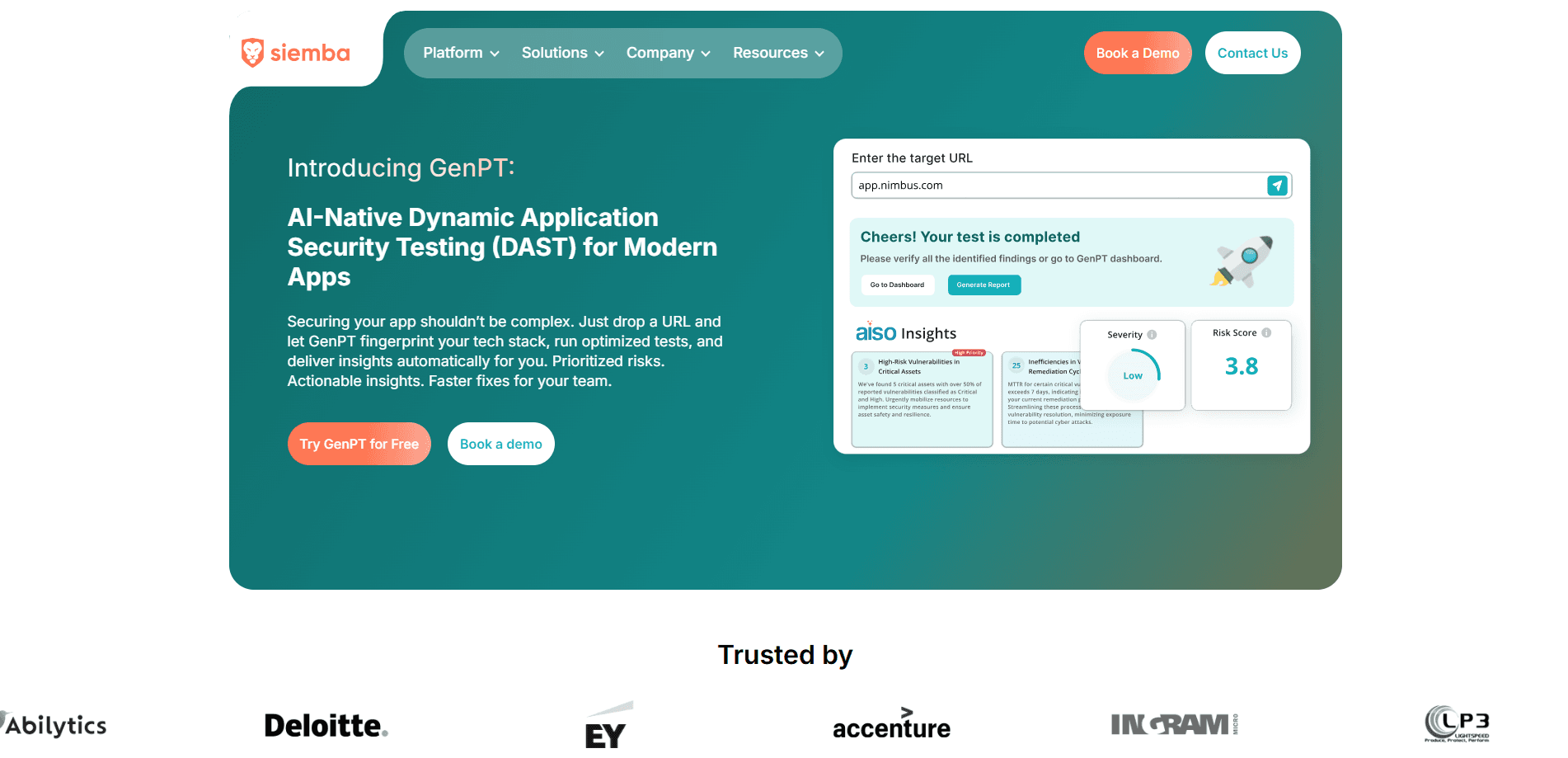
GenPT is Siemba's AI-native DAST engine. It points at a running web app or API and hunts for exploitable flaws. You feed it a URL. It fingerprints the tech stack, fires automated attacks across more than 30,000 test cases, and returns findings you can act on. It's the testing engine inside Siemba's Autonomous Pentesting platform, so it runs on every CI/CD deploy. It covers classic web risks and the newer AI attack surface.
About GenPT
What Is GenPT
GenPT is a DAST tool built by Siemba, which stands for application security testing that runs against a live, deployed application. DAST tools test a running app from the outside, the way an attacker would, rather than reading source code. GenPT automates that job with AI, so you give it a URL and it identifies the technology behind the app before firing a battery of security checks at real endpoints.
The problem it targets is speed. Traditional scanners run once a year while attackers work every day, and a clean scan isn't a clean bill of health when a breach in month six is still on you. GenPT is built to fire on every deploy, sidestepping the annual schedule entirely. A fresh vulnerability surfaces at the commit that introduced it, not during an audit months later.
It also goes after a surface older tools ignore, since Siemba's coverage includes prompt injection, MCP server flaws, agentic AI testing, and RAG pipeline security. Most scanners never touch any of it. The main limit is that it's a testing engine inside a paid platform, not a free standalone tool, and expert-led deep testing sits in a separate Siemba tier. Want the price per test run? Look at the Autonomous Pentesting plan, which starts at $500 per month.
Getting Started
- Sign up on the Siemba platform and pick the Autonomous Pentesting plan, which includes the GenPT engine.
- Add the web apps or APIs you want tested, then point GenPT at a target URL.
- Let it fingerprint the tech stack and launch the automated test run against your live environment.
- Review the findings, or pull them straight into your LLM through the MCP server connection.
- Connect CI/CD so GenPT re-tests on every deploy and flags reappearing issues.
Product Information
A quick look at GenPT's pricing, supported platforms, and performance.
Best for
The users, tasks, and scenarios where this tool fits best.
Users
- Security engineers at product companies
- Startups under 50 employees
- Dev teams shipping AI features
Tasks
- Continuous web app and API security testing
- OWASP Top 10 and OWASP LLM Top 10 coverage
- Compliance evidence gathering
- Vulnerability revalidation
Scenarios
- A sprint adds a new API endpoint
- Audit season arrives
- You want to run scans from your own AI assistant
- A prompt injection risk lands in a new chatbot
Key features
AI-Native DAST Engine
GenPT is the testing core of Siemba's platform, built to run against live web apps and APIs. It fingerprints the tech stack first, then runs targeted tests instead of a blind crawl. According to Siemba, it covers more than 30,000 automated test cases.
Broad Web and API Coverage
The engine covers the OWASP Top 10 plus REST and GraphQL APIs, with parameter fuzzing and auth bypass checks built in. It also tests for business logic flaws, IDOR, and cross-tenant data access. Those are the kinds of issues pure pattern matchers tend to miss, and they're often the ones attackers actually use.
AI Attack Surface Testing
Traditional DAST tools were never built to test LLM features, which is why most scanners walk straight past a chatbot's prompt handling. GenPT covers prompt injection, both direct and indirect, plus system prompt leakage. It also probes MCP server vulnerabilities, agentic AI with sub-agent IDOR, and RAG pipeline security.
Continuous Testing on Every Deploy
GenPT fires on each CI/CD deploy rather than on an annual schedule. That shift matters. A vulnerability shows up at the commit that created it, not months later during a review, and the team that wrote the bug is still around to fix it.
MCP Server Integration
You can run GenPT tests and pull results from your own LLM through an MCP server connection. For teams already working inside an AI assistant, that keeps scanning in the same place as the rest of their workflow.
Verified Closure
Once a finding is marked fixed, GenPT revalidates it automatically and flags anything that reappears, which matters because Siemba says 60% of "fixed" vulnerabilities quietly come back. This check is the difference between a closed ticket and a closed risk.
One-Click Compliance Reporting
GenPT generates reports mapped to SOC 2, ISO, PCI, HIPAA, and NIST in a single click, saving the manual mapping work that usually eats weeks of prep before an audit cycle even starts.
Tooling Integrations
It connects to Jira, ServiceNow, Slack, and GitHub, supports CI/CD pipelines, and handles SSO through Okta. Findings land where your team already looks. No new dashboard to check.
Pros and cons
Pros
- Runs on every deploy, so security testing keeps pace with how fast you ship.
- Covers both classic web risks and the newer AI attack surface in one engine.
- Automated revalidation catches fixes that silently reappear in production.
- MCP support lets you trigger tests and read results from your own LLM.
- Pre-mapped reports for SOC 2, ISO, PCI, HIPAA, and NIST cut audit prep time.
Cons
- No free plan, and standalone pricing starts at $500 per month.
- Expert-led deep testing isn't included in the engine; that sits in a separate, pricier Siemba tier.
- It's a platform component, so you can't buy GenPT as an isolated tool.
- AI attack-surface testing assumes your product actually uses LLMs, RAG, or agents.
Frequently asked questions
GenPT is a DAST engine used to find exploitable flaws in running web apps and APIs. You point it at a URL, and it tests the live application from the outside. It also covers AI-specific risks like prompt injection.
Related content
Explore related tools, skills, and articles for GenPT.
GenPT Alternatives
Forefront
Forefront · CodingForefront is a web platform for building with open-source AI. It lets you fine-tune leading open-source language models on your own data, evaluate how they perform, and run them through an API or export them to host yourself. Developers who want the convenience of a closed-source platform but insist on owning their models and data are the target audience here.

Startkit
StartKit.AI · CodingStartkit is a boilerplate for building AI SaaS and AI wrapper products. Think of it as an AI startup boilerplate with the boring parts already wired up: authentication, Stripe and Lemon Squeezy payments, usage limits, transactional email, and an AI API starter that talks to OpenAI, Anthropic, Groq, or Llama. You clone the repo, set your price, and start on the part of your product that people actually pay for. It's Next.js under React and Tailwind, so most of the boilerplate code already feels familiar.
Testim
Tricentis · CodingTestim is an AI-powered test automation platform for building and running end-to-end tests across web, mobile, and Salesforce applications. It leans on machine learning to keep tests stable when an interface changes, so teams spend less time fixing broken selectors. Not bad for an automated testing tool you can start using today. You create tests by recording actions in a browser, then optionally add JavaScript when you need more control. It's a solid pick for busy QA teams.