

Genum
Genum AI · Coding
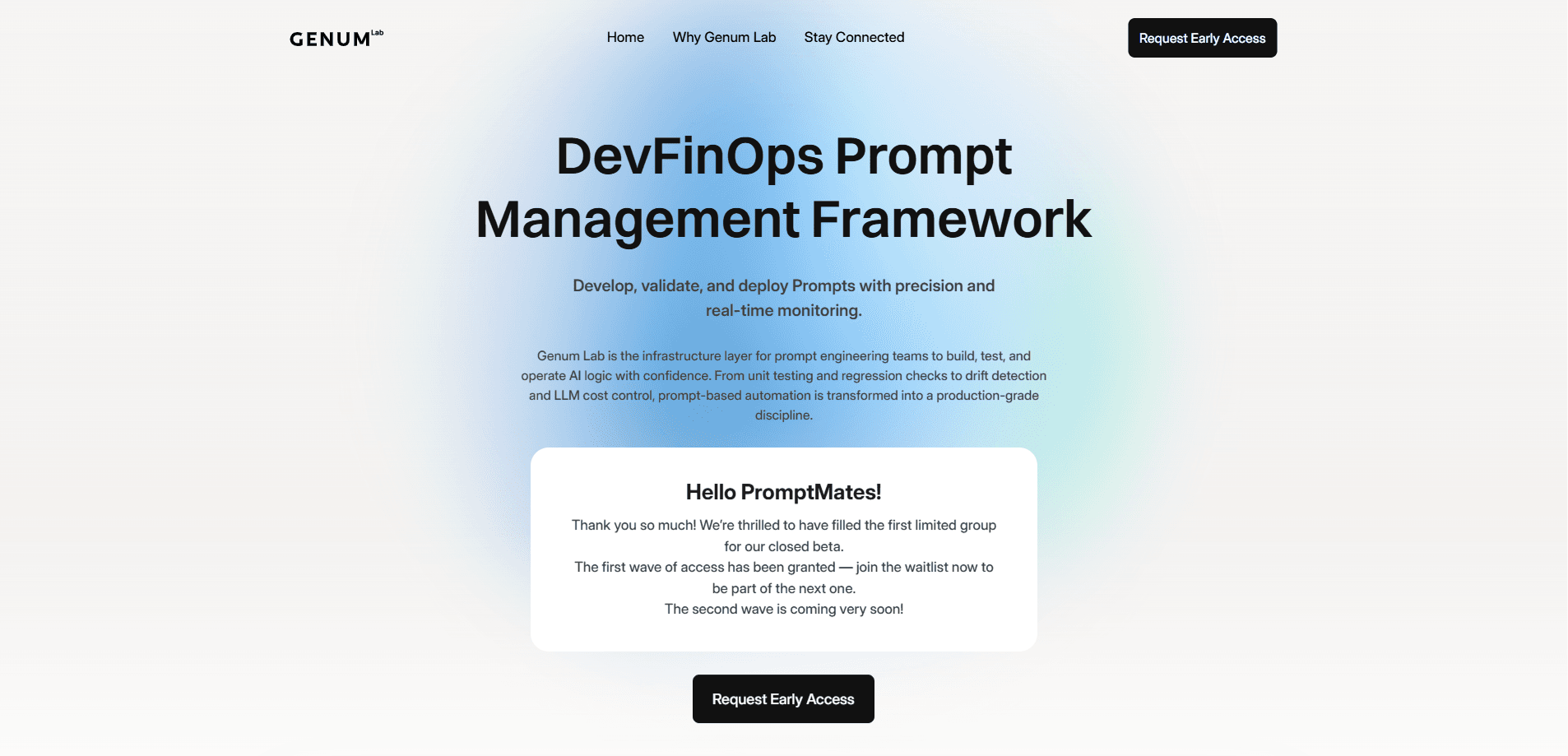
Genum is an open-source PromptOps platform that helps teams version, test, and govern AI prompts like production code. Genum Lab turns plain language into structured AI specs you self-host.
About Genum
What Is Genum
Genum is an AI-native platform for designing, testing, and managing prompt-based systems at scale. It ships a Prompt Ops Layer called Genum Lab, which turns conversational intent into structured AI specifications that are versioned, testable, and ready for production. The pitch is simple: treat prompts the way engineers treat code, not as loose text files scattered across notebooks.
The platform targets the gap between writing a clever prompt once and keeping it reliable for months. Teams get version control, regression testing, audit logging, and cost tracking in one place, and they can run everything on their own infrastructure. Genum is distributed under the Business Source License 1.1, so you deploy it with Docker Compose and keep control of your data.
The main catch is that Genum expects some technical setup. It is a self-hosted LLM platform, which means someone on your side handles deployment, upgrades, and backups. Companies that want a zero-config hosted service will find the install process heavier than a typical SaaS signup, and enterprise governance features sit behind a commercial license rather than the open-source core.
Getting Started
- Review the docs at docs.genum.ai to see how prompts, test suites, and runtime nodes fit together.
- Deploy the open-source build on your own infrastructure with Docker Compose.
- Write or paste a prompt in natural language, then let Genum convert it into a structured AI specification.
- Add test cases and expected outputs so each change gets checked before it goes live.
- Connect a runtime node, like an n8n workflow or an HTTP endpoint, to trigger the prompt and log results.
Product Information
A quick look at Genum's pricing, supported platforms, and performance.
Best for
The users, tasks, and scenarios where this tool fits best.
Users
- AI engineers
- Platform and DevOps teams
- IT, risk, and compliance staff
Tasks
- Versioning and rolling back prompt changes
- Running regression tests on prompts
- Tracking token spend
- Extracting data from documents
Scenarios
- Moving AI automation from demo to production
- Regulated industries adopting GenAI
- Mixed-model stacks
Key features
Natural Language Prompt Authoring
Instead of hand-writing an elaborate spec, you describe what you want in plain language and Genum converts that intent into a structured, reusable AI definition. The output carries the schema and configuration with it, so the same spec runs consistently across environments. This lowers the bar for people who understand the business logic but not prompt syntax.
Integrated Regression Testing
Genum saves test cases alongside your prompts and replays them to compare outputs against expected results. A newer release can check an agent's tool calls step by step, not just the final answer, so a broken chain gets caught before users see it. Replays run against the current draft, which means you can test an edit before committing it.
Version Control
Every prompt is committed with full metadata, including the model configuration it ran with. You can roll back, compare versions, and see what changed between releases. This brings the commit-review-revert loop that developers expect from Git into prompt work.
Audit Logging and Execution Traces
Each prompt execution is logged with its inputs, outputs, model metadata, and timestamps. That record supports the sign-off and traceability that compliance teams ask for, and it turns a past run into a test case you can replay under the same conditions.
Vendor-Agnostic Runtime
Prompts and test suites work across multiple providers, including OpenAI, Gemini, and custom endpoints, with support for custom output schemas. You avoid rewriting everything if you switch models, and you can keep sensitive workloads on a local model while sending others to the cloud.
Multi-Agent Orchestration
Specialized agents handle prompt generation, validation, auditing, and commit messaging. The point is to cut the manual overhead of maintaining a prompt library, so routine checks and messages happen without a person babysitting each step.
Files and OCR
You upload PDFs and images and let an LLM extract text, describe content, or convert documents into structured data. Receipts, invoices, and forms become clean fields that downstream systems can process, which removes a common manual step in back-office work.
Pros and cons
Pros
- Open-source and self-hosted under BUSL, so business data never has to leave your own infrastructure.
- Version control with rollback and diff makes prompt changes reviewable like code.
- Regression testing covers both final answers and the tool calls an agent makes along the way.
- Vendor-agnostic runtime works with OpenAI, Gemini, and local models, so you avoid lock-in.
- Governance features map to EU AI Act, GDPR, NIST AI RMF, and ISO/IEC 42001 expectations.
Cons
- Self-hosting shifts upgrades, storage, scaling, and backups onto your team, which needs real DevOps capacity.
- The open-source core is smaller than the commercial governance tier, so some enterprise controls require a paid license.
- Documentation is still growing, so early adopters may have to dig through the GitHub repo for answers.
Frequently asked questions
Genum handles prompt management from end to end. You write instructions in natural language, Genum turns them into structured, versioned specifications, and then you test, deploy, and monitor them while it logs every execution.
Related content
Explore related tools, skills, and articles for Genum.
Genum Alternatives
Forefront
Forefront · CodingForefront is a web platform for building with open-source AI. It lets you fine-tune leading open-source language models on your own data, evaluate how they perform, and run them through an API or export them to host yourself. Developers who want the convenience of a closed-source platform but insist on owning their models and data are the target audience here.

Startkit
StartKit.AI · CodingStartkit is a boilerplate for building AI SaaS and AI wrapper products. Think of it as an AI startup boilerplate with the boring parts already wired up: authentication, Stripe and Lemon Squeezy payments, usage limits, transactional email, and an AI API starter that talks to OpenAI, Anthropic, Groq, or Llama. You clone the repo, set your price, and start on the part of your product that people actually pay for. It's Next.js under React and Tailwind, so most of the boilerplate code already feels familiar.
Testim
Tricentis · CodingTestim is an AI-powered test automation platform for building and running end-to-end tests across web, mobile, and Salesforce applications. It leans on machine learning to keep tests stable when an interface changes, so teams spend less time fixing broken selectors. Not bad for an automated testing tool you can start using today. You create tests by recording actions in a browser, then optionally add JavaScript when you need more control. It's a solid pick for busy QA teams.