

Golf
Golf · Coding
Golf is a security control plane for AI agents and Model Context Protocol (MCP) connections. It watches the tools your team already plugged into your data, sets policy on what those tools can touch, and keeps a record of everything they did. The point isn't to wrangle the language model itself, it's to govern the connections around it, so an engineer can wire Cursor into a codebase without quietly handing over customer records. That's a common blind spot.
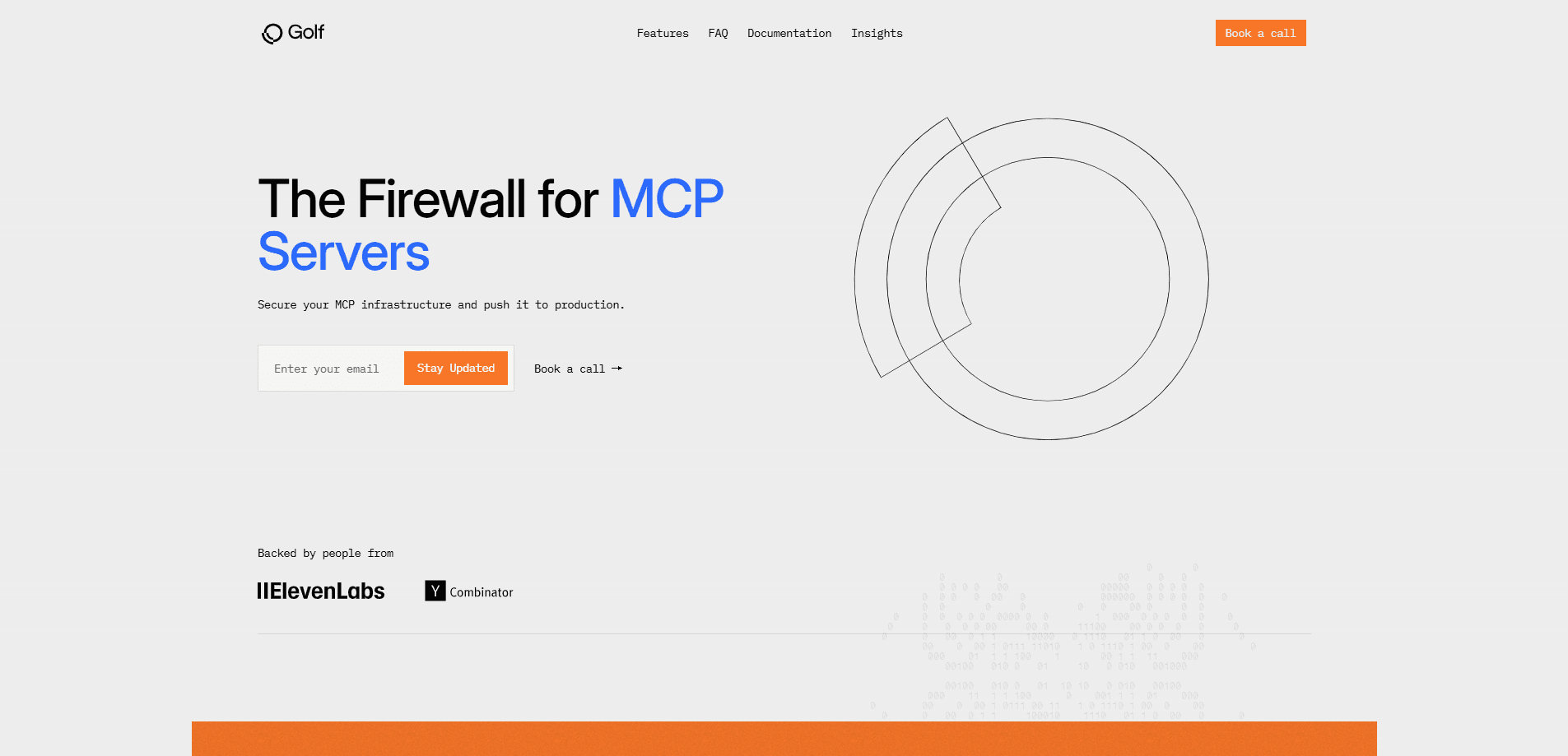
About Golf
What Is Golf
Golf is an AI security platform built around one uncomfortable fact: MCP connections reach your data, and most of them were set up in thirty seconds by someone who never told the security team. A developer connects Claude Code to a production database, or Copilot starts pushing to a repo, and nobody approved it. That's the gap AI agent governance is supposed to close.
Golf sits between your agents and your data as a control plane. It doesn't replace your LLM or change how people work. It discovers every MCP server, agent, and data connection in your environment, then enforces rules about what each one is allowed to read or change, which means a security team finally gets a single view of every tool that can touch company data. When something looks wrong, it can block the action in real time and roll it back.
The big limitation is scope. Golf is an enterprise governance product, not a consumer tool, and its value depends on deploying it across your endpoints. If you only run one agent on one laptop, there's not much for it to police. Pricing also isn't published on the site, so you'll need to talk to sales before you can budget.
Getting Started
- Deploy Golf across your endpoints so it can start observing agent activity.
- Let discovery map every AI tool, MCP server, and agent connection, including the shadow ones nobody registered.
- Review the findings and tag which data sources are sensitive. That part matters most.
- Write granular policies per tool, team, and data source, blocking PII or credential exposure.
- Turn on the audit trail and export compliance evidence when you need it. Easy to forget.
Product Information
A quick look at Golf's pricing, supported platforms, and performance.
Best for
The users, tasks, and scenarios where this tool fits best.
Users
- Security teams at companies running AI coding agents
- Compliance and risk officers
- Platform and IT admins
Tasks
- Discovering shadow MCP servers
- Blocking PII exposure
- Building an audit record
- Rolling back a bad action
Scenarios
- An engineer connects Cursor to your customer database
- A prompt injection hides instructions in a tool response
- Audit season arrives
- A contractor's agent touches a repo it shouldn't
Key features
MCP Firewall
Golf acts as a firewall between agents and the tools they call. It inspects each request against your policy and blocks anything that would leak PII, credentials, or data outside the approved boundary. Blocks happen in real time, measured in sub-milliseconds, so the agent doesn't stall waiting for a verdict. That matters. An agent that hangs on every tool call is useless.
Discovery Across Your Whole Environment
The platform finds every AI agent, MCP server, and data connection it can reach, including shadow infrastructure that never went through a formal review. For a security team, that's the difference between guessing what's connected and knowing exactly which agents can read customer records, which servers expose production data, and which connections nobody approved. You get usage, data access, and actions tracked per connection. MCP server security starts with simply seeing them all.
Granular Enforcement Policies
You set rules per tool, per team, and per data source rather than applying one blanket setting. That means a sales agent can read the deal pipeline but not the payroll table. Policies also support instant rollback, so a mistaken change doesn't require untangling it by hand. Not ideal to clean up manually anyway.
Audit Trail and Compliance Mapping
Golf keeps a 90-day record of every prompt, action, and data access. That trail comes pre-mapped to SOC 2, ISO 27001, NIST AI RMF, and FINRA, and evidence export takes minutes. If your team spends weeks assembling audit evidence, this is where the time goes back. Big difference.
Broad Client Coverage
Golf works across the tools people actually use: Claude Code, GitHub Copilot, ChatGPT Enterprise, Cursor, Windsurf, and any MCP server or custom agent. The homepage puts it at over 40 integrations. You're not asking teams to switch editors to get governed. That helps adoption.
Pros and cons
Pros
- Covers discovery, enforcement, and audit in one platform, so you don't stitch together three vendors.
- Real-time policy enforcement with sub-millisecond latency keeps agents responsive while blocking risky actions.
- Audit trail comes pre-mapped to common frameworks, which trims compliance prep.
- Works with the major coding agents and any MCP server, so adoption doesn't mean changing workflows.
Cons
- Pricing isn't published, so you can't estimate cost without contacting sales.
- Value depends on wide endpoint deployment, which is a real lift for large or distributed teams.
- It governs the connections around the model, not the model itself, so it's not a fix for prompt-level problems on its own.
Frequently asked questions
It guards the MCP connections between AI agents and your data. That covers agents reading records they shouldn't, credential leaks through tool calls, and prompt injection that tries to smuggle hidden instructions into an agent's actions. Those are the common ones.
Related content
Explore related tools, skills, and articles for Golf.
Golf Alternatives
Forefront
Forefront · CodingForefront is a web platform for building with open-source AI. It lets you fine-tune leading open-source language models on your own data, evaluate how they perform, and run them through an API or export them to host yourself. Developers who want the convenience of a closed-source platform but insist on owning their models and data are the target audience here.

Startkit
StartKit.AI · CodingStartkit is a boilerplate for building AI SaaS and AI wrapper products. Think of it as an AI startup boilerplate with the boring parts already wired up: authentication, Stripe and Lemon Squeezy payments, usage limits, transactional email, and an AI API starter that talks to OpenAI, Anthropic, Groq, or Llama. You clone the repo, set your price, and start on the part of your product that people actually pay for. It's Next.js under React and Tailwind, so most of the boilerplate code already feels familiar.
Testim
Tricentis · CodingTestim is an AI-powered test automation platform for building and running end-to-end tests across web, mobile, and Salesforce applications. It leans on machine learning to keep tests stable when an interface changes, so teams spend less time fixing broken selectors. Not bad for an automated testing tool you can start using today. You create tests by recording actions in a browser, then optionally add JavaScript when you need more control. It's a solid pick for busy QA teams.