

Grably
Grably · Coding · Business
Grably is a data marketplace where people earn tokens for sharing photos, videos and audio that train AI models, while AI teams license consented datasets.
About Grably
What Is Grably
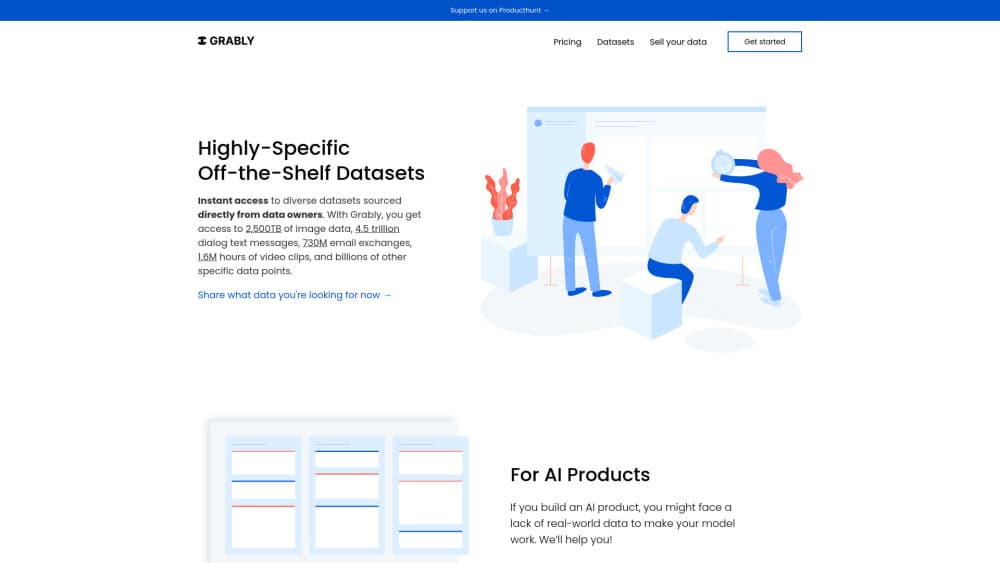
Grably is a two-sided data platform. Individuals upload everyday material such as camera roll photos, short videos, voice recordings and chat logs. AI labs and developers then license that material as training data. Contributors get paid in Grably Tokens, which can be redeemed for USDT.
The selling point is permission. Files come from people who agreed to share them, and Grably says every submission passes moderation before it enters a dataset. That matters for teams that want real-world footage without pulling it off the open web.
Grably also packages its own collections. The company describes 17 proprietary datasets drawn from 500M+ participants and more than 100 petabytes of material, including conversational messages in 100+ languages and thousands of hours of labeled sports video. Treat those numbers as company claims. We couldn't check them independently.
One limit shows up quickly. This isn't a self-serve tool. Dataset buyers go through sales, and contributors are paid per accepted task rather than at a posted rate.
Getting Started
- Open the Grably bot in Telegram or install the Grably app for Android, then create an account.
- Choose a task, such as uploading a batch of photos or recording a set of voice prompts.
- Read the sharing terms and confirm what you're handing over.
- Submit the files and wait for moderation to decide whether they're accepted.
- Collect Grably Tokens in your balance and redeem them for USDT.
Product Information
A quick look at Grably's pricing, supported platforms, and performance.
Best for
The users, tasks, and scenarios where this tool fits best.
Users
- People with a large camera roll
- Voice contributors
- AI teams that need licensed data
Tasks
- Selling data to AI companies
- Assembling multilingual chat corpora
- Building speech and video datasets
- Checking exposure before you share
Scenarios
- A research lab needs everyday human footage
- A student wants pocket money from files already on their phone
- A startup can't scrape public web data
Key features
Paid Data Contributions
Grably turns uploads into a payable job. You pick a task, submit the requested files and get Grably Tokens once moderation clears them. Tokens convert to USDT, so the payout is closer to cash than to store credit. Rates change by task, and the platform doesn't publish a standard price per photo or minute of audio.
Moderation Before Data Ships
Every submission is reviewed before it reaches a buyer. That protects dataset quality and keeps junk out of training runs. For contributors it means a rejected batch earns nothing, so it pays to follow the task instructions closely.
Telegram Mini App and Android App
Most of the work happens inside Telegram, where the bot handles tasks, uploads and balances. There's also a dedicated Android app for people who'd rather not use the messenger. Neither option needs a desktop, which fits the phone-first nature of the data being collected.
Multilingual Conversational Datasets
The chat collections hold billions of sequential messages in 100+ languages, with reactions, replies and media attached. Buyers use them for conversational grounding and multimodal alignment. The value here is context: a message thread shows how people actually respond to each other, not just what one sentence looks like.
Video and Sports Collections
Grably lists 9,000 years of video across 300M+ clips, sorted into categories such as computer use, gaming and DIY. Separate sports sets cover football and soccer with frame-level labels. Teams training browser agents or action models tend to care about this footage because it's expensive to record and annotate on their own.
Consent Controls
Contributors decide what to share, and the platform frames each task around explicit permission. That's the difference between an AI training data marketplace and a scraper. If you want your files removed later, you deal with the company directly rather than through a self-serve dashboard.
Pros and cons
Pros
- You can earn money sharing data you already own, with no special equipment.
- Moderation keeps rejected files out of datasets, which protects the quality buyers pay for.
- The Telegram bot makes uploads quick on a phone.
- Multilingual and video collections are broad enough for serious model training.
- Contributing costs nothing, so there's no subscription to cancel.
Cons
- Payouts depend on task approval, and rates aren't published, so income is hard to predict.
- Redemption runs through USDT, which adds a wallet step for people who just want a bank transfer.
- Dataset buyers can't sign up and download on their own, since licensing goes through sales.
- There's no documented public API, which blocks teams that want to pull data into an existing pipeline.
Frequently asked questions
Grably connects two groups: people who want to sell data to AI companies and teams that need training data with a clear consent record. Contributors complete upload tasks, and buyers license the resulting sets.
Related content
Explore related tools, skills, and articles for Grably.
Grably Alternatives
Forefront
Forefront · CodingForefront is a web platform for building with open-source AI. It lets you fine-tune leading open-source language models on your own data, evaluate how they perform, and run them through an API or export them to host yourself. Developers who want the convenience of a closed-source platform but insist on owning their models and data are the target audience here.

Startkit
StartKit.AI · CodingStartkit is a boilerplate for building AI SaaS and AI wrapper products. Think of it as an AI startup boilerplate with the boring parts already wired up: authentication, Stripe and Lemon Squeezy payments, usage limits, transactional email, and an AI API starter that talks to OpenAI, Anthropic, Groq, or Llama. You clone the repo, set your price, and start on the part of your product that people actually pay for. It's Next.js under React and Tailwind, so most of the boilerplate code already feels familiar.
Testim
Tricentis · CodingTestim is an AI-powered test automation platform for building and running end-to-end tests across web, mobile, and Salesforce applications. It leans on machine learning to keep tests stable when an interface changes, so teams spend less time fixing broken selectors. Not bad for an automated testing tool you can start using today. You create tests by recording actions in a browser, then optionally add JavaScript when you need more control. It's a solid pick for busy QA teams.