

HackerEarth
HackerEarth · Coding
HackerEarth is an AI-powered technical hiring and developer assessment platform for teams that screen engineers at volume. It covers the whole cycle. You source candidates through hackathons, screen them with an online coding test, interview them live in FaceCode, and upskill the engineers you already have. Enterprises use it to replace resume guesswork with data from real code. Its community of more than 10 million developers also gives recruiters a large pool to draw from.
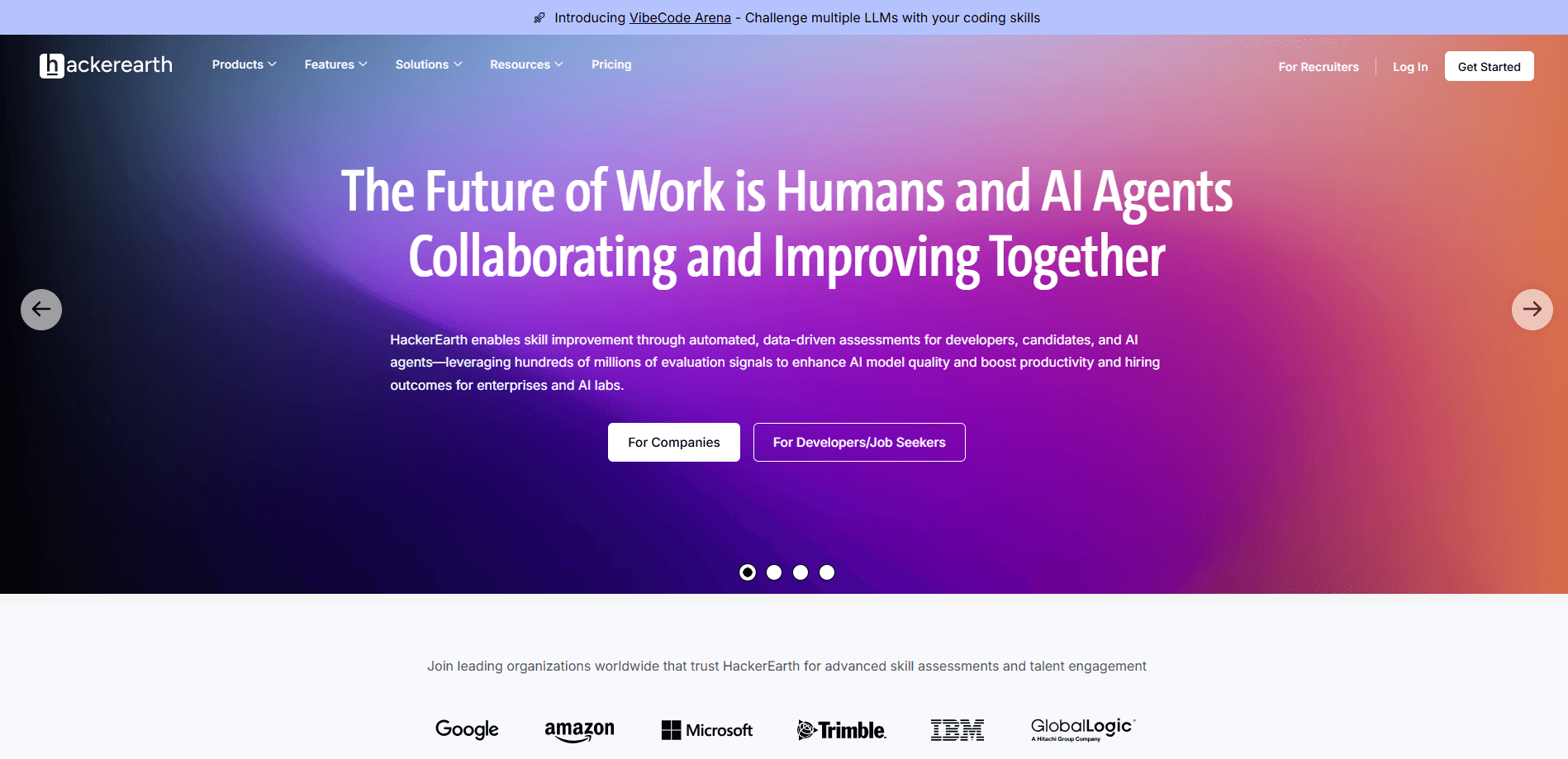
About HackerEarth
What Is HackerEarth
HackerEarth is a technical hiring platform that helps companies find, test, and hire software developers. Instead of relying on resumes and phone screens, hiring teams push candidates through coding assessments, live interviews, and hackathons, then compare the results side by side. The company builds it for enterprise recruiting teams, staffing firms, and anyone who screens engineers in large numbers.
The core value is consistency. A role-based test with auto-grading and plagiarism checks gives every candidate the same conditions, which matters a lot when you're hiring across multiple time zones and dozens of different engineering roles at once. The platform also handles the softer side of hiring through personality and psychometric tests for common positions.
The main limit is the pricing model. There's no free forever plan. The cheapest tier runs on credits rather than unlimited tests. So what happens if you only hire one or two developers a year? The subscription math rarely works in your favor. Small startups usually get more value from a lightweight tool and a good technical interviewer than from a full assessment suite.
Getting Started
- Create an account on the hiring site and pick a plan, from Growth at $99/month up to Enterprise with custom pricing.
- Load your first test by choosing from the question library (5K+ on Growth, up to 25K+ on Enterprise) or writing your own coding problems.
- Invite candidates by email or a shared test link. Set the language and time limits for the role.
- Review auto-graded results and scores in the dashboard. Plagiarism flags show up here too. Then move shortlisted people into a FaceCode live interview.
- Optionally run a hiring challenge or internal hackathon to build a talent pipeline for future roles.
Product Information
A quick look at HackerEarth's pricing, supported platforms, and performance.
Best for
The users, tasks, and scenarios where this tool fits best.
Users
- Enterprise recruiting teams
- Technical hiring managers
- University and campus recruiters
- L&D and engineering leads
Tasks
- Screening coding skills at scale
- Running live technical interviews
- Spotting cheating
- Hosting hackathons
- Building a talent pipeline
Scenarios
- A hiring push for ten backend engineers in six weeks
- Remote-first hiring across regions
- A campus hiring drive
- Quarterly team upskilling
Key features
Auto-Graded Coding Assessments
HackerEarth's core product is a coding assessment tool that scores submissions automatically. You build a test from role-based questions, set a time limit and language, and candidates write code in the browser. The platform grades test cases and reports results without a human reading every single answer. For a team reviewing hundreds of applicants in a single hiring cycle, that difference in time saved is the whole reason to pay for it.
Plagiarism and AI Detection
Remote hiring makes cheating easy, so the platform leans hard on detection. It compares submissions for copied code and uses AI-based checks to flag suspicious patterns, including answers that look machine-generated. A flagged result doesn't block a candidate outright, but it gives a reviewer a concrete reason to dig deeper before advancing that person to the next round.
FaceCode Live Interviews
FaceCode is the live coding interview environment, and it's a separate capability from the async tests. Candidates and interviewers share an editor, run code in built-in environments, and pick from 40+ programming languages with snippets and auto-complete. Every session can be saved and replayed, which is genuinely useful when a hiring committee reviews a decision without having sat in the room themselves.
Hiring Challenges and Hackathons
Companies can run sponsored hackathons and hiring challenges to attract developers rather than wait for applications. HackerEarth acts as a hackathon platform here. It handles the event, taps its community of over 10 million developers, and uses AI-driven evaluation to surface top performers. It's a longer game than a single test. But it builds a pipeline you can hire from for months.
AI Screener and Job Posting
The AI Screener replaces the slow first pass on resumes and early phone screens. It evaluates candidates against your role requirements and returns structured, bias-resistant notes, so recruiters start from a short summary instead of a stack of identical-looking PDFs. Job Posting takes the opposite end of the funnel: an AI-enhanced engine that distributes listings across the network and uses semantic matching to surface candidates who might never have found the posting on their own.
Upskilling and Skill Paths
The upskill side targets engineers already on payroll. Managers design learning paths, track progress, and measure results against benchmarks, so you can see who's ready for the next level. It's mainly an enterprise feature, and it makes far more sense on the Scale plan and above, where the question library grows to more than 20,000 items.
Pros and cons
Pros
- Covers sourcing, screening, interviewing, and upskilling in one platform. You're not stitching together four tools.
- Auto-graded coding tests and plagiarism detection cut the manual review time on high-volume hiring considerably.
- FaceCode's replay and 40+ language support help teams make defensible interview decisions that hold up later.
- Large developer community gives hackathon and challenge campaigns a real audience.
- Transparent entry pricing at $99/month means smaller teams can try the core assessment flow without a sales call.
Cons
- No free plan, and Growth caps you at 10 credits a month, so a busy hiring month can burn through credits fast.
- API access, SSO, and the full 25K+ question library sit behind the Enterprise tier, which needs a custom quote.
- The credit-based model is awkward to budget if your hiring volume swings month to month.
Frequently asked questions
It's a technical hiring platform for screening and interviewing software developers. Companies use it to run coding tests, live interviews, and hackathons, then hire from the results.
Related content
Explore related tools, skills, and articles for HackerEarth.
HackerEarth Alternatives
Forefront
Forefront · CodingForefront is a web platform for building with open-source AI. It lets you fine-tune leading open-source language models on your own data, evaluate how they perform, and run them through an API or export them to host yourself. Developers who want the convenience of a closed-source platform but insist on owning their models and data are the target audience here.

Startkit
StartKit.AI · CodingStartkit is a boilerplate for building AI SaaS and AI wrapper products. Think of it as an AI startup boilerplate with the boring parts already wired up: authentication, Stripe and Lemon Squeezy payments, usage limits, transactional email, and an AI API starter that talks to OpenAI, Anthropic, Groq, or Llama. You clone the repo, set your price, and start on the part of your product that people actually pay for. It's Next.js under React and Tailwind, so most of the boilerplate code already feels familiar.
Testim
Tricentis · CodingTestim is an AI-powered test automation platform for building and running end-to-end tests across web, mobile, and Salesforce applications. It leans on machine learning to keep tests stable when an interface changes, so teams spend less time fixing broken selectors. Not bad for an automated testing tool you can start using today. You create tests by recording actions in a browser, then optionally add JavaScript when you need more control. It's a solid pick for busy QA teams.