

HelixDB
HelixDB · Coding
HelixDB is an open-source graph-vector database built in Rust that stores graph and vector data together in one engine, so teams building RAG and AI memory features don't need to bolt a vector store onto a separate graph database. It runs embedded inside your app or as a self-hosted server, with managed deployments available for teams that don't want to run it themselves. Setup takes minutes, not days.
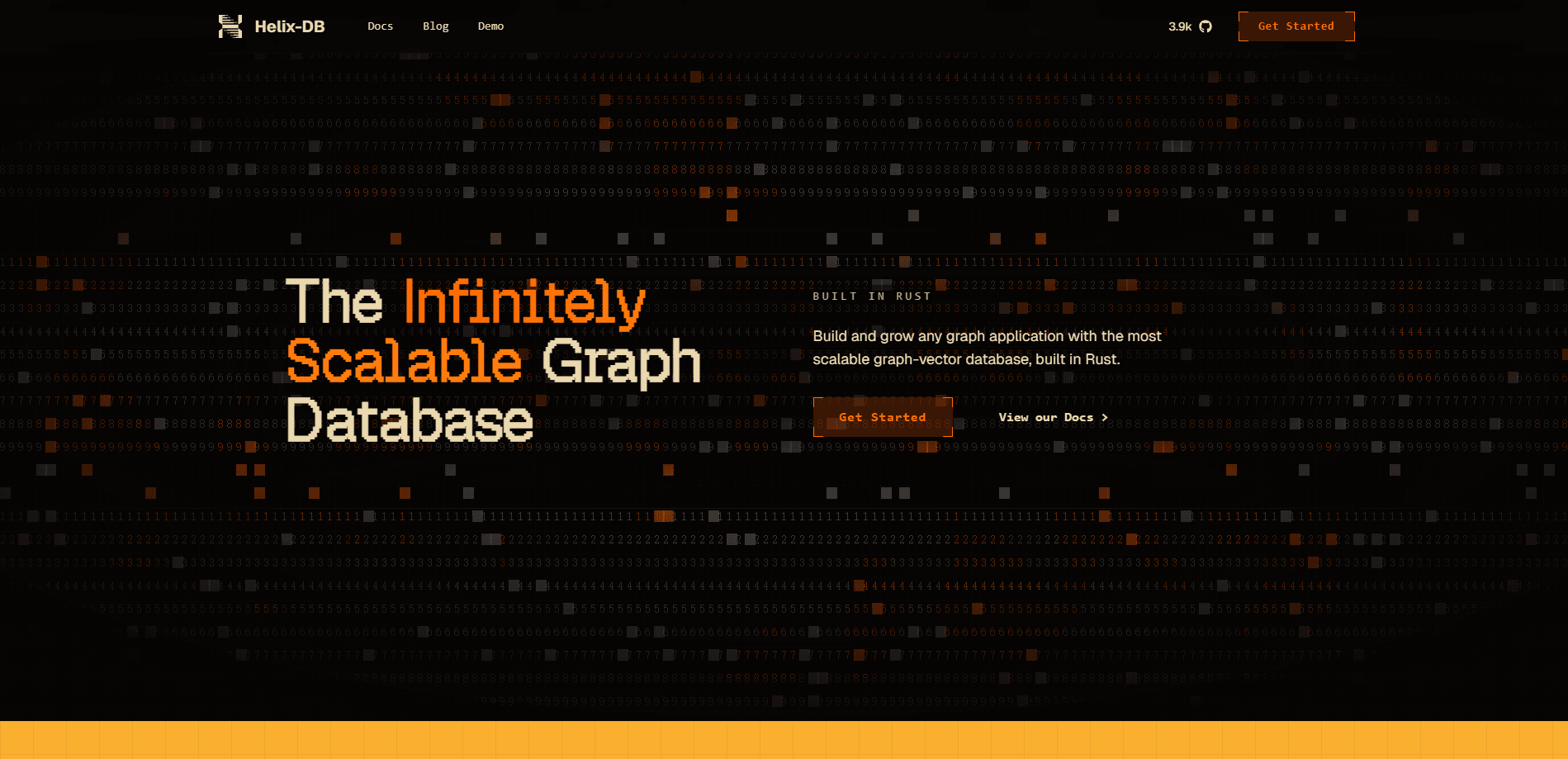
About HelixDB
What Is HelixDB
HelixDB is a database that keeps graph relationships and vector embeddings in the same place. Most AI stacks today glue a vector database to a graph database and then write application code to keep the two in sync. HelixDB argues you don't need that seam. A document, the entities it mentions, and the embedding for its meaning all live in one store you query with one language.
The project is written from scratch in Rust and developed in the open on GitHub. That matters for two reasons. Rust gives it low-latency reads and writes for live apps, and an open codebase means you can inspect how hybrid retrieval actually works instead of trusting a vendor's marketing claim. The team positions it as "the database for AI memory," which is a fair one-line description of the problem it solves.
Here's the honest limit. HelixDB is young. It's not a battle-tested system the way Postgres or Neo4j are, and its docs and the tooling around it are still filling out. If you need a database with a decade of production war stories behind it, this isn't that yet. Not close.
Getting Started
- Install the Helix CLI and pull the HelixDB binary from the official docs or the GitHub repository.
- Define your graph schema and vector indexes in HelixQL, the project's query language.
- Start the server locally, or embed the database directly inside a Rust application.
- Load your nodes, edges, and embeddings, then run hybrid queries that combine graph traversal with vector or full-text search.
- Deploy self-hosted with your own object storage, or switch to a managed deployment when you'd rather not run the infrastructure.
Product Information
A quick look at HelixDB's pricing, supported platforms, and performance.
Best for
The users, tasks, and scenarios where this tool fits best.
Users
- Backend and AI engineers building retrieval or agent memory features
- Rust developers who want an embedded database
- Startups shipping AI products on a small infra budget
Tasks
- RAG pipelines
- Agent memory
- Hybrid search over documents
Scenarios
- Building a knowledge graph from documents and querying it semantically
- Prototyping an AI feature on a laptop before you commit to a hosted database
- Running a multi-tenant SaaS where each customer's data must stay isolated on shared infrastructure
Key features
Graph and Vector in One Engine
The core pitch is that graph and vector data live in the same store and the same transaction. You write an edge and an embedding together, or neither lands. No half-states. For RAG pipelines this removes the classic failure where your vector index and your relationship graph quietly drift apart because a background sync job crashed halfway and nobody noticed for a week.
Hybrid Retrieval
HelixDB runs graph traversal, vector search, full-text search, and temporal queries against the same data. You can find documents that are semantically similar, connected to a known entity, and recent, all in one query. Fewer round trips between systems means lower latency and simpler code.
Pre-Filtering Before Ranking
You can apply any filter before the vector and full-text ranking step. That sounds technical, but the practical effect is simple. Filtered searches stay fast and accurate. Filtering after ranking is a common cause of "why did this result show up when it shouldn't" bugs in retrieval systems.
Atomic Transactions
Graph and vector writes commit together or roll back together. If a write fails partway, you don't end up with an orphaned edge pointing at content whose embedding never saved. No cleanup scripts. For anyone who has debugged a half-written index, that guarantee is worth more than it sounds.
Embedded and Self-Hosted Modes
You can run HelixDB inside your application as a library, or stand it up as a self-hosted server, or use a managed deployment. The same schema and queries work across all three. That lets a prototype graduate to production without a rewrite.
Object Storage Native
Graph and vector data persist directly on durable object storage. This is a cost play as much as a technical one. You lean on cheap cloud storage instead of paying for premium block volumes just to keep a large embedding set online.
Built for Live Applications
HelixDB targets low-latency transactional reads and writes (OLTP), not just offline analytics. It also supports high availability by scaling gateways and database nodes, so there's no single point of failure in a production deployment.
Pros and cons
Pros
- Graph and vector data share one engine and one transaction, which removes the sync code most AI stacks need.
- Open source and developed in the open on GitHub, so you can audit the retrieval logic yourself.
- Written in Rust for low-latency reads and writes, plus embedded, self-hosted, and managed deployment options.
- Native multi-tenancy and high availability are built in, not bolted on later.
- Free to self-host, with paid managed deployments only when you want them.
Cons
- The project is young, so you're trading production maturity for the newer architecture. Expect rougher edges than a long-established database.
- Documentation and the surrounding tooling are still filling out, which can mean more time in the source code when something isn't covered.
- It speaks HelixQL rather than a standard everyone already knows, so your team has a new query language to pick up.
Frequently asked questions
HelixDB is used to build AI memory and RAG features. It stores graph relationships and vector embeddings together, so a RAG pipeline can pull semantically similar content that's also connected to a specific entity. No juggling two databases.
Related content
Explore related tools, skills, and articles for HelixDB.
HelixDB Alternatives
Forefront
Forefront · CodingForefront is a web platform for building with open-source AI. It lets you fine-tune leading open-source language models on your own data, evaluate how they perform, and run them through an API or export them to host yourself. Developers who want the convenience of a closed-source platform but insist on owning their models and data are the target audience here.

Startkit
StartKit.AI · CodingStartkit is a boilerplate for building AI SaaS and AI wrapper products. Think of it as an AI startup boilerplate with the boring parts already wired up: authentication, Stripe and Lemon Squeezy payments, usage limits, transactional email, and an AI API starter that talks to OpenAI, Anthropic, Groq, or Llama. You clone the repo, set your price, and start on the part of your product that people actually pay for. It's Next.js under React and Tailwind, so most of the boilerplate code already feels familiar.
Testim
Tricentis · CodingTestim is an AI-powered test automation platform for building and running end-to-end tests across web, mobile, and Salesforce applications. It leans on machine learning to keep tests stable when an interface changes, so teams spend less time fixing broken selectors. Not bad for an automated testing tool you can start using today. You create tests by recording actions in a browser, then optionally add JavaScript when you need more control. It's a solid pick for busy QA teams.