

HPE GreenLake AI/ML
Hewlett Packard Enterprise · Coding · Other
HPE GreenLake AI/ML is the AI and machine learning side of HPE GreenLake, the hybrid cloud platform HPE runs for enterprise customers. The piece that matters is HPE Private Cloud AI, a turnkey stack co-developed with NVIDIA for running production AI while keeping data on your own site. It combines NVIDIA compute, networking, and software with HPE storage, servers, and the GreenLake cloud, then adds lifecycle management on top. Pricing is consumption-based rather than a listed per-seat number, so cost depends on the configuration you pick.
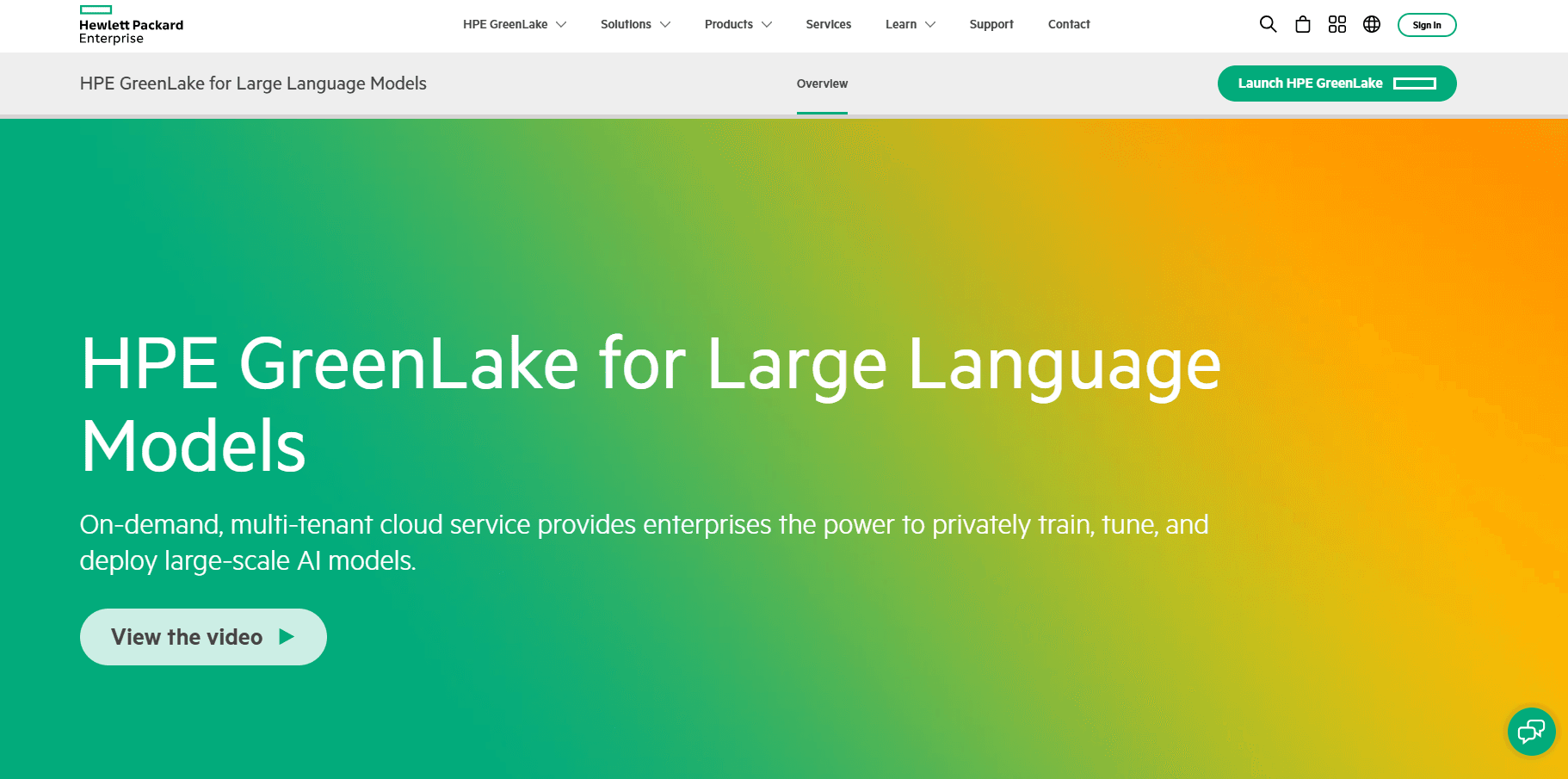
About HPE GreenLake AI/ML
What Is HPE GreenLake AI/ML
HPE GreenLake is a managed hybrid cloud platform. It lets a company run and manage its own infrastructure with a cloud-like interface, covering compute, storage, networking, edge, and private cloud from one place. AI/ML is not a separate product you buy off a shelf. It is a workload category the platform serves, and the delivery vehicle is HPE Private Cloud AI.
HPE Private Cloud AI is a turnkey solution co-developed with NVIDIA under the NVIDIA AI Computing by HPE program. It puts NVIDIA's AI compute, networking, and software together with HPE's AI storage, compute, and GreenLake cloud in one integrated stack. The goal is narrow and clear: get an enterprise from an AI idea to a working product in weeks instead of months. HPE markets it as an AI factory for private workloads.
What separates it from a public cloud AI service is control. Data stays inside your own environment, including edge and air-gapped setups. For teams in regulated industries, that changes whether a project is possible at all. HPE says an integrated AI platform can cut costs by up to 60% against public cloud and get a deployment running in under 8 hours. Those are HPE's own figures, so treat them as targets rather than guarantees.
The stack carries full lifecycle management and four configuration options sized for different needs. Operations are backed by OpsRamp AI copilot, which watches workloads and automation across the environment. HPE was named a Leader in the 2026 Gartner Magic Quadrant for Infrastructure Platform Consumption Services. As private AI infrastructure, the offering is judged on how well it keeps data in place while still running the models a business needs.
Getting Started
- Define the AI workload and confirm data residency needs, since private AI is chosen when data cannot leave your environment.
- Work with HPE or a partner to size a configuration from the four options, matching compute, storage, and networking to the model and training load.
- Deploy the stack. HPE positions turnkey installation as a same-week task, with reference claims of under 8 hours for the infrastructure layer.
- Connect your models and tools through the supported integration paths: Model Context Protocol (MCP), webhooks, or the APIs.
- Manage ongoing operations through GreenLake, using OpsRamp AI copilot for monitoring and automation.
- Choose a consumption model. GreenLake Flex Solutions let you run workloads as a pay-per-use service at your own location.
Product Information
A quick look at HPE GreenLake AI/ML's pricing, supported platforms, and performance.
Best for
The users, tasks, and scenarios where this tool fits best.
Users
- Enterprises in regulated fields like finance and healthcare that need to run AI models on sensitive records without sending them to a public cloud
- IT teams already running HPE infrastructure
- Platform and ML engineers who want a sanctioned path
Tasks
- Running production AI workloads with private data
- Building and scaling enterprise AI agents
- Deploying a virtual assistant or internal copilot
Scenarios
- Standing up a private AI region for a compliance-bound project
- Consolidating a scattered AI pilot into a managed stack
- Running an AI workload as a service at your own site
Key features
Turnkey Private AI Stack Co-Developed With NVIDIA
The core feature is the integration itself. NVIDIA's AI compute, networking, and software sit next to HPE's AI storage, compute, and GreenLake cloud as one package. You are not assembling a stack from separate vendors and hoping the parts talk. That single-source approach is what earns the turnkey label. For a team without deep infrastructure expertise, it lowers the number of decisions between buying and running a model.
Private Control of Data
Data stays on your own infrastructure, including edge and air-gapped environments. This is the reason most organizations pick private AI over a public service. Sensitive and regulated data never crosses a boundary you do not control. HPE also points to security features like policy enforcement and support for audit and compliance requirements, which map directly to how regulated buyers evaluate risk.
Faster Time to Value
HPE frames the pitch around weeks, not months, and claims deployment in under 8 hours for the infrastructure. Time to value is the metric that decides whether an AI program survives budget review. A repeatable, pre-integrated deployment cuts the long integration phase that usually stalls projects. The numbers are HPE's, so confirm what applies to your configuration.
Model and Tool Freedom
The stack is built to run the models you choose and to add new ones without reworking what you already have. That flexibility matters because model selections change fast. You keep the option to swap or add models inside a single governed stack instead of rebuilding the environment each time a better model appears.
Full Lifecycle Management
The platform covers deployment, operation, and scaling, not just the initial install. Lifecycle management is what separates a managed platform from a pile of hardware. Workloads stay governed as they grow, and the environment stays consistent as workloads change.
OpsRamp AI Copilot for Operations
OpsRamp AI copilot backs the operations layer with monitoring and automation across the environment. AI workloads fail in messy ways and drive heavy resource use, so automated insight into what is running and why matters. It ties operational visibility to the same platform that runs the workload.
Pros and cons
Pros
- Data stays in your own environment, which is what makes regulated AI projects possible in the first place.
- The NVIDIA-integrated stack removes a lot of integration work, so deployment can move in weeks rather than quarters.
- Consumption-based options through HPE GreenLake Flex Solutions avoid a large upfront hardware buy. HPE GreenLake Flex Solutions let you run workloads as a service at your own location, which suits projects that cannot commit to a full hardware purchase.
- Supporting MCP, webhooks, and APIs gives developers more than one way to connect existing tools.
Cons
- There is no free tier and no published price, so every deployment starts with a quote and a sales conversation.
- It is built for enterprises; small teams will find the scope and commitment out of proportion to their needs.
- The cost-savings and deployment-time figures come from HPE's own marketing and need independent verification.
- Getting the most out of it assumes some in-house infrastructure skill, since the platform is a foundation rather than a fully managed service.
Frequently asked questions
It is the AI and machine learning capability delivered through the HPE GreenLake platform, and its main vehicle is HPE Private Cloud AI. That is a turnkey private AI stack co-developed with NVIDIA that bundles AI compute, networking, storage, and cloud software with lifecycle management, so a company can run production AI in its own environment.
Related content
Explore related tools, skills, and articles for HPE GreenLake AI/ML.
HPE GreenLake AI/ML Alternatives
Forefront
Forefront · CodingForefront is a web platform for building with open-source AI. It lets you fine-tune leading open-source language models on your own data, evaluate how they perform, and run them through an API or export them to host yourself. Developers who want the convenience of a closed-source platform but insist on owning their models and data are the target audience here.

Startkit
StartKit.AI · CodingStartkit is a boilerplate for building AI SaaS and AI wrapper products. Think of it as an AI startup boilerplate with the boring parts already wired up: authentication, Stripe and Lemon Squeezy payments, usage limits, transactional email, and an AI API starter that talks to OpenAI, Anthropic, Groq, or Llama. You clone the repo, set your price, and start on the part of your product that people actually pay for. It's Next.js under React and Tailwind, so most of the boilerplate code already feels familiar.
Testim
Tricentis · CodingTestim is an AI-powered test automation platform for building and running end-to-end tests across web, mobile, and Salesforce applications. It leans on machine learning to keep tests stable when an interface changes, so teams spend less time fixing broken selectors. Not bad for an automated testing tool you can start using today. You create tests by recording actions in a browser, then optionally add JavaScript when you need more control. It's a solid pick for busy QA teams.