
Human or Not: A Social Turing Game
AI21 Labs · Chatbot
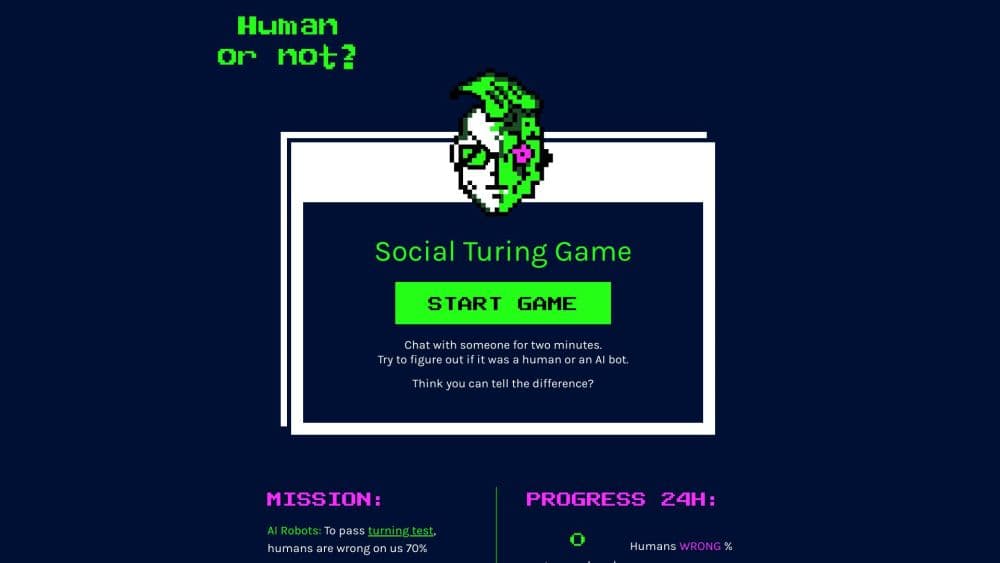
Human or Not is a free social Turing game from AI21 Labs. You chat anonymously for two minutes, then guess whether your partner was a person or an AI bot.
About Human or Not: A Social Turing Game
What Is Human or Not
Human or Not is an online AI chatbot game that turns the Turing test into a two-minute guessing match. You get dropped into an anonymous chat with either a random person or an AI bot, and when the timer runs out, you vote on which one you think you faced. The point was never to win prizes. AI21 Labs built it as a running human vs AI experiment to measure how well modern chatbots pass as human, and how good people are at spotting them.
The framework behind it is old. Alan Turing proposed the imitation game in 1950: if a machine talks well enough that a judge cannot tell it apart from a person, it counts as intelligent. For decades that stayed a thought experiment. Large language models finally made it a real contest, so AI21 Labs shipped a public version anyone could play.
The results turned out to be humbling. Across a month of play, people guessed their partner's identity correctly in only 68% of games. When the partner was an AI bot, the correct rate dropped to 60%, barely above a coin flip. In other words, most players could not reliably tell a bot from a human in a short chat.
The main limitation today is that the game is no longer live. The humanornot.ai address now redirects to the AI21 Labs corporate site, and the chat itself is closed. It also needed no account, left no detailed per-player history, and limited every message to 100 characters, so deep conversations were never part of the format.
Getting Started
- Open the game in a browser. There was no sign-up, no download and no account to create.
- The system paired you with a partner, either a human user or a bot, and opened a two-minute chat window.
- Type short messages of up to 100 characters and answer within 20 seconds, keeping the exchange moving back and forth.
- When the two minutes ended, cast your vote on whether the partner was human or AI, then saw the reveal.
- Play as many rounds as you liked to sharpen your own instincts, since the game kept a running tally of right guesses.
Product Information
A quick look at Human or Not: A Social Turing Game's pricing, supported platforms, and performance.
Best for
The users, tasks, and scenarios where this tool fits best.
Users
- Curious newcomers to AI who want to feel the gap between chatbots and people first hand, with no setup and no cost.
- Teachers and workshop hosts who want a live demo of how convincing language models have become.
- Researchers and writers who want a worked example of a large scale Turing style test and its numbers.
- Casual players who enjoy guessing games and want a quick two minute round instead of a long session.
Tasks
- Testing your own instincts about what makes text sound human before trusting a chatbot in real work.
- Comparing how you read a conversation when the stakes are low and the timer is short.
- Gathering talking points on AI detection, since the game reports clear success and failure rates.
- Showing a class or team how easily a person can be fooled by fluent AI writing.
Scenarios
- A five minute classroom break where students guess partners and compare results out loud.
- A late night curiosity session where you keep playing to see if your accuracy improves.
- A team meeting icebreaker about AI literacy, grounded in a real experiment rather than opinion.
- A writing project where you need a citable example of a modern Turing test at scale.
Key features
Two Minute Anonymous Chats
Every round is a timed conversation with a stranger, and the only rule is that you cannot send twice in a row. Messages are capped at 100 characters and must go out within 20 seconds, so a typical game runs about four or five exchanges per side. The pace keeps tension high and stops anyone from stalling for extra clues.
Guess Human or Bot
Once the timer stops, you pick which kind of partner you just talked to. The reveal is immediate, and because your counterpart never learns your guess, nobody gets nudged into faking a bot just to confuse the other side. A running tally of correct guesses versus games played is the only scoreboard.
Persona Driven AI Bots
The bots were not neutral. Each one was prompted with a name, an age, a job and a location, plus quirks like slang, spelling mistakes or a refusal to answer factual questions. Some even left the chat mid scene if they were offended. That range of personalities made detection harder and kept repeat players from spotting the same tells twice.
Anonymous Play With No Account
You could jump straight in without registering, which kept the barrier to entry near zero and let a huge casual audience take part. The trade off is that the experiment collected no demographic data, so its findings describe anonymous players rather than a defined group.
Content Moderation Built In
Each message passed through a moderation service to block abuse and hate speech. Flagged AI output was filtered out before you saw it, and if one of your own messages was flagged, the conversation ended right away. It kept a fast, open chat from turning hostile.
Large Scale Turing Test Data
In its first month the game drew over 1.5 million players and more than 10 million human to human and human to AI conversations. That volume gave AI21 Labs the first statistically solid score for a Turing style test, a benchmark others could revisit as models improve.
Pros and cons
Pros
- No account, no download and no cost, so anyone can start a round in seconds.
- The 68% overall accuracy and 60% bot detection rate make a clear point about how convincing modern chatbots are.
- Persona based bots with slang and errors make the challenge feel real rather than scripted.
- Built in moderation keeps the anonymous chat safe during a quick session.
- The white paper publishes the full method and numbers, so the experiment is open to scrutiny.
Cons
- The game is no longer live, and humanornot.ai now redirects to the AI21 Labs corporate site.
- With no live chat, you cannot run your own rounds or reuse the tool for teaching today.
- The 100 character limit and two minute cap keep conversations shallow, so it tests surface style more than reasoning.
- Findings come from an unmatched pool of self selected players, so the percentages describe them rather than all users.
Frequently asked questions
Human or Not is a free online game from AI21 Labs that works like a two minute Turing test. You chat anonymously with a stranger, then guess whether that partner was a real person or an AI bot.
Related content
Explore related tools, skills, and articles for Human or Not: A Social Turing Game.
Human or Not: A Social Turing Game Alternatives

Knocket
Knocket (Tencent RTC team) · Productivity · Business · ChatbotKnocket is a free live chat and contact page tool that lets visitors message you from your website, app, or a shareable link, with every reply handled from Telegram or one inbox.
Agibot
Agibot · Productivity · AI Assistant · ChatbotAgibot is a personal AI agent for Mac that keeps running after you close the window, runs routines on a schedule, and works from Telegram or Slack with your own API keys.

Melete
Melete · Productivity · AI Assistant · ChatbotMelete is an AI workspace for teams where agents research, draft, and act in Slack, Notion, Linear, and GitHub. Shared memory and approval gates keep people in control.