

Imaginario.ai
Imaginario AI · Video
Imaginario AI is a video intelligence platform that indexes your footage so teams can search it by speech, face or scene, then turn the best moments into a rough cut or social clips.
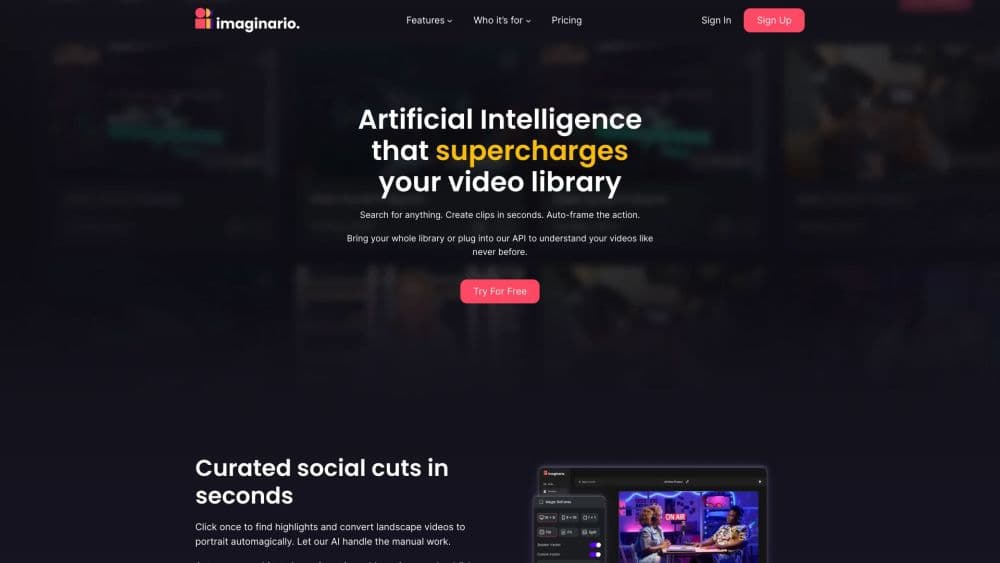
About Imaginario.ai
What Is Imaginario AI
Imaginario AI is a London-based platform built for video content search. It reads your library the way an editor would. Instead of tagging files by hand, it indexes every shot for speech, faces, actions, objects, moods and on-screen text, then answers searches in plain language with the exact seconds you need.
The problem it targets is time. Most teams shoot far more footage than they can watch, and finding one usable moment inside a long recording can eat an afternoon. Media asset management AI usually stops at file-level tags. Imaginario goes deeper, reading each shot so a query like "the CEO laughing in the lobby" returns a clip rather than a folder.
Two limits define when this fits. AI video editing here means support for the cut, not a replacement for the editor: StoryLab hands over a sequence, and a human decides what stays. The other limit is access. This is a paid, demo-led product aimed at teams, so there's no self-serve signup for a casual user.
Getting Started
- Book a demo on the Imaginario site. Qualified teams get a seven-day trial with up to 10 hours of video or 50 clips and any number of users.
- Connect a library. Point it at cloud storage such as Amazon S3, Google Drive, Dropbox, Box, Backblaze or Wasabi, or at a MAM like Iconik or CatDV.
- Let the indexing run. Each video gets 15 or more understanding layers, including speech in more than 100 languages.
- Search and shortlist. Look up a person, a line of dialogue or a scene, then pull the matching clips with timecodes.
- Ship the result. Export a sequence to Premiere Pro, DaVinci Resolve or Avid, or let StoryLab assemble a rough cut and social versions.
Product Information
A quick look at Imaginario.ai's pricing, supported platforms, and performance.
Best for
The users, tasks, and scenarios where this tool fits best.
Users
- Marketing teams with a large footage archive
- Post-production editors
- Broadcasters and studios with a licensing catalog
Tasks
- Finding a specific person or quote in an archive
- Producing video clips for social media from long recordings
- Assembling a rough cut from a brief
- Generating transcripts and captions
Scenarios
- A weekly social content calendar
- A movie or series retrospective
- An agency handoff to a client
Key features
Multimodal Video Search
Imaginario AI looks at a video the way a producer would: who is speaking, what they say, what sits on screen, the mood, and how the scene unfolds. Ask in everyday language and it returns the specific seconds, not a file name. The platform runs two retrieval engines, semantic search and structured metadata filtering, and you can mix both in one query.
Person and Face Search
You enroll talent, executives and hosts once, and every new upload is checked against that face bank. Imaginario AI then knows who is speaking in each shot and also spots public figures as they appear. Teams that work with recurring on-camera people tend to reach for this before anything else.
StoryLab Rough Cuts
StoryLab is the part that edits. Give it a brief and it proposes clips and assembles a rough cut from one video or many, with social cuts for the marketing team and a timecoded sequence for the editor. It also reframes vertical clips for each platform and can publish in one click.
100+ Language Speech Analysis
Speech recognition, transcripts, captions and translation work across more than 100 languages and dialects. For a broadcaster or a global brand, that turns a single library into material for every regional channel without a separate localization pass.
Editor and Storage Integrations
The platform connects to Premiere Pro, DaVinci Resolve and Avid on the editing side, and to Amazon S3, Google Drive, Dropbox, Box, SharePoint, Backblaze, Wasabi, Iconik and CatDV on the library side. Connections run in both directions, so clips and metadata go back to the system your team already checks.
API and MCP Access
Developers can call the same analysis through a REST API with webhook callbacks, priced per minute of video analyzed across 15 or more AI models, and pick only the layers they need. An MCP connector for Claude, ChatGPT, Gemini and Copilot is in beta.
Pros and cons
Pros
- Search works at shot level: results point to seconds, which saves the manual scrub that usually eats a working day.
- No migration: it indexes storage and media systems where they live and writes metadata back into your own fields.
- Strong people search: a reusable face bank covers talent, executives and public figures.
- API and MCP access: the same indexing can feed internal tools and chat assistants.
- Clear data stance: customer content is never used to train models, and the platform is TPN Gold assessed.
Cons
- No self-serve path: pricing sits behind a demo, so a freelancer can't start today with a card.
- Hourly API pricing scales with volume: teams that reprocess everything on every change will feel the cost.
- Little value for small libraries: per-user pricing only pays off when the archive is big enough to be hard to search.
- MCP support is still in beta: chat assistant integration works only for teams accepted into the program.
Frequently asked questions
Imaginario AI indexes a video library and makes it searchable by speech, faces, actions, objects and scenes. It also assembles rough cuts and social clips with StoryLab, then exports a timecoded sequence to professional editing software.
Related content
Explore related tools, skills, and articles for Imaginario.ai.
Imaginario.ai Alternatives

ngram 2.0
ngram · Video · Marketingngram 2.0 is an AI video generator for teams. It turns a prompt, a screen recording, or a product URL into a narrated explainer, product demo, or AI avatar video, and every scene stays editable.

OpenScreen 2
OpenScreen (open-source project) · Video · ProductivityOpenScreen 2 is a free, open-source screen recorder and demo video editor for Windows, macOS, and Linux, with automatic zooms, styled frames, local captions, and agent edits.

Skreno
Skreno · Video · ProductivitySkreno is a browser screen recorder that captures a tab, a window or your whole display, then attaches AI transcripts, summaries and console logs to one share link.