

Intrascope.app
Intrascope · Coding · Productivity
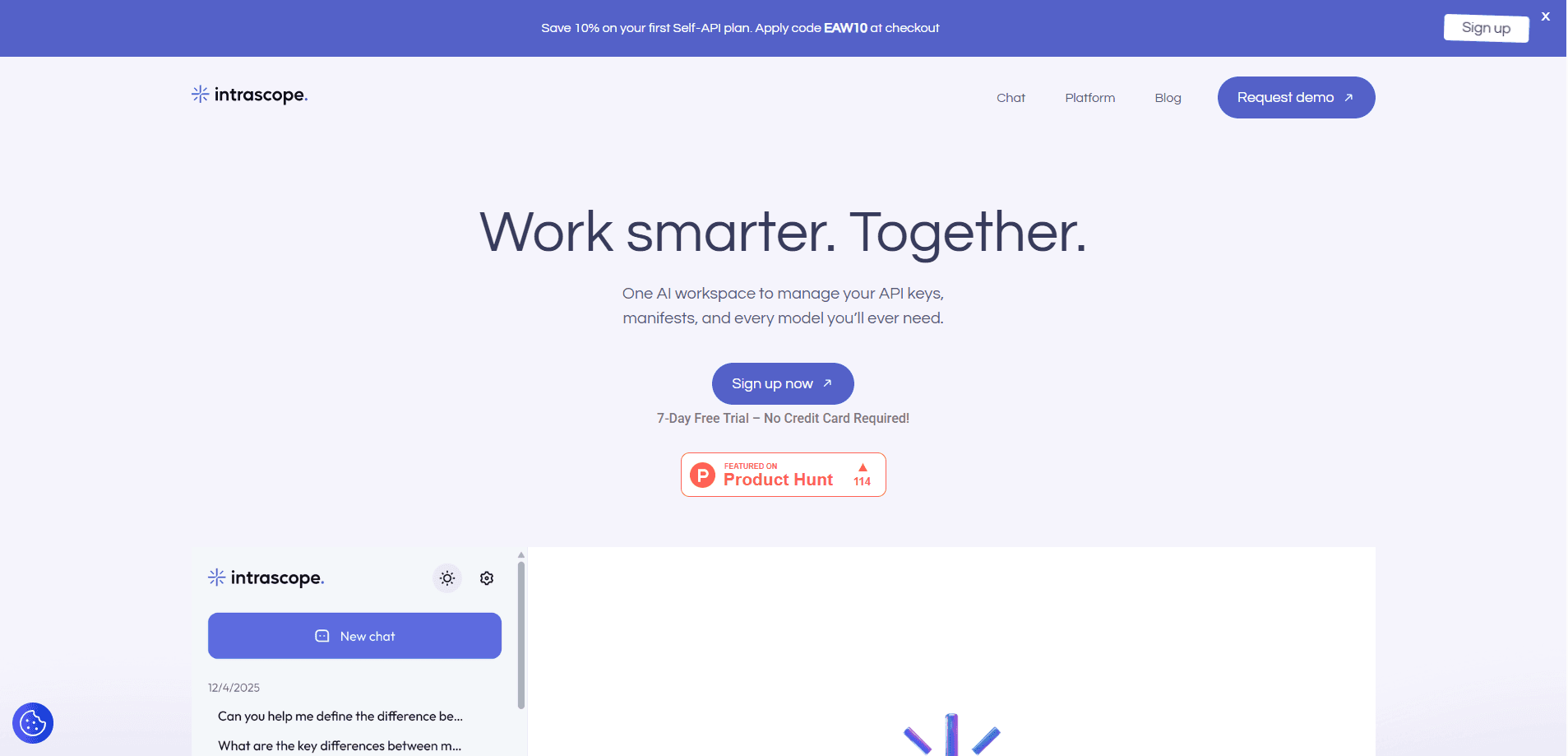
Intrascope.app is a multi-model AI workspace platform that turns scattered personal AI tools into one shared company system. Team AI collaboration happens in a single workspace where people pick the language model that fits a task, while admins control who gets access, which context each project can see, how much everyone spends, and where the money goes. It sits between buying a pile of ChatGPT seats and running a full internal AI stack you have to build yourself.
About Intrascope.app
What Is Intrascope.app
Intrascope.app bills itself as an AI control layer. The idea is simple: instead of every employee juggling their own subscriptions and pasting company data into whatever chatbot they happen to have open, everyone works inside one managed workspace.
The product brings several frontier models into that workspace, including GPT, DeepSeek and Gemini, so a writer can reach for one model and an analyst for another without leaving the tool. On top of the models, the platform adds the pieces a company actually needs before it can hand out AI access at scale: user and role management, project-level context, usage and cost visibility, and a billing model that doesn't require a credit card for every seat.
The main limit is scope. Intrascope.app is built for organizations, not solo users. Individuals hunting for a free chatbot will find it heavier than they need. Pricing starts at a team-sized number too, which means a two-person shop pays for infrastructure it might not fully use.
So who is it for? Growing companies stuck between personal subscriptions and a self-built AI stack.
Getting Started
- Open the platform and start the 7-day free trial, which doesn't require a credit card.
- Create your workspace and invite team members, then assign roles so admins and regular users see the right controls.
- Set up a project and attach the context it needs, so the models working on it share the same background material.
- Connect model access, either through your own provider API keys or by topping up the managed balance.
- Start working, then check the usage and cost dashboard to see which models and projects are consuming the most.
Product Information
A quick look at Intrascope.app's pricing, supported platforms, and performance.
Best for
The users, tasks, and scenarios where this tool fits best.
Users
- Small teams getting into AI workflows
- Team leads and admins who need oversight
- Employees who want model choice without new accounts
Tasks
- Running shared projects with consistent context
- Tracking AI spend across a team
- Comparing models on real work
Scenarios
- A marketing team drafting content with one model while a data team uses another, all under the same admin console.
- A growing company that has outgrown individual ChatGPT subscriptions but isn't ready to build its own AI infrastructure.
- A manager who needs to cap AI costs before they scale, using usage tracking and a clear top-up multiplier instead of unpredictable per-seat billing.
Key features
Multi-Model Workspace
Intrascope.app brings GPT, DeepSeek and Gemini together in one interface, so your team picks a model per task instead of picking a vendor. One model writes better. Another reasons better. You aren't locked into a single provider. Switching models happens inside the same workspace, with the same projects and context in place.
Centralized Administration
Admins control who can access the workspace, what each person can do, and which projects they belong to. Access and user management live in one console rather than spread across fifty individual subscriptions. Big difference. For a company handing out AI access, this is the difference between a policy and a hope.
Usage and Cost Tracking
Every model call runs through the workspace, so usage and spending are visible in one place. You can see which projects and users drive consumption, which is what lets you catch an expensive habit before the invoice lands. And that's the real win. Subscriptions cover the workspace itself, while model usage runs through your own provider keys or a managed top-up balance with a stated 1.3x multiplier.
Manifest-Based Context Management
Projects carry their own context through a manifest, so the material a task depends on stays attached to the project instead of living in someone's chat history. That keeps answers consistent when several people work on the same thing, and it gives admins a defined place to control what context the models can see. No more guessing which version is current.
Flexible Model Access and Billing
You can connect your own provider API keys, or let Intrascope manage access through a top-up balance. Teams that already have provider accounts keep using them. Teams that don't get a simpler managed path. The workspace subscription is separate from model usage, which keeps the two costs easy to reason about.
Team Projects with Roles
The workspace organizes work into projects with defined membership, so a project's people, context and usage stay grouped. The Starter plan includes 5 custom projects plus a default one, which is enough for a small team to separate workstreams without sprawl. Not unlimited, but close enough for most departments. Roles keep regular users focused on their work and admins on the controls.
Pros and cons
Pros
- Several frontier models in one workspace, so teams match models to tasks instead of standardizing on one vendor.
- Centralized access and usage control, which makes AI adoption reviewable rather than invisible.
- Usage and cost tracking per project and user, so spending is visible before it becomes a problem.
- Manifest-based context keeps project background consistent across the team.
- 7-day free trial without a credit card. Test it first.
Cons
- Starter pricing starts around $49/mo and covers only 10 users, so individual users pay for team infrastructure they don't need.
- Model usage is billed separately from the subscription, and the managed route adds a 1.3x multiplier, so the total cost runs higher than the headline plan price.
- No public API for external integration is documented, which limits teams that want to wire Intrascope into their own systems.
Frequently asked questions
It gives a company one shared workspace for AI, where teams use several models including GPT, DeepSeek and Gemini while admins control access, context, usage and cost. It's an AI control layer for organizations, not a consumer chatbot.
Related content
Explore related tools, skills, and articles for Intrascope.app.
Intrascope.app Alternatives
Forefront
Forefront · CodingForefront is a web platform for building with open-source AI. It lets you fine-tune leading open-source language models on your own data, evaluate how they perform, and run them through an API or export them to host yourself. Developers who want the convenience of a closed-source platform but insist on owning their models and data are the target audience here.

Startkit
StartKit.AI · CodingStartkit is a boilerplate for building AI SaaS and AI wrapper products. Think of it as an AI startup boilerplate with the boring parts already wired up: authentication, Stripe and Lemon Squeezy payments, usage limits, transactional email, and an AI API starter that talks to OpenAI, Anthropic, Groq, or Llama. You clone the repo, set your price, and start on the part of your product that people actually pay for. It's Next.js under React and Tailwind, so most of the boilerplate code already feels familiar.
Testim
Tricentis · CodingTestim is an AI-powered test automation platform for building and running end-to-end tests across web, mobile, and Salesforce applications. It leans on machine learning to keep tests stable when an interface changes, so teams spend less time fixing broken selectors. Not bad for an automated testing tool you can start using today. You create tests by recording actions in a browser, then optionally add JavaScript when you need more control. It's a solid pick for busy QA teams.