

JobFlow
JobFlow · Coding
JobFlow is an AI-powered job search assistant that helps people move through applications faster. It pairs an AI job search platform, which tailors resumes and automates repetitive application tasks, with an open-source workflow automation library developers can extend. Juggling dozens of listings? Rewriting the same resume over and over? That's the repetition JobFlow is built to remove.
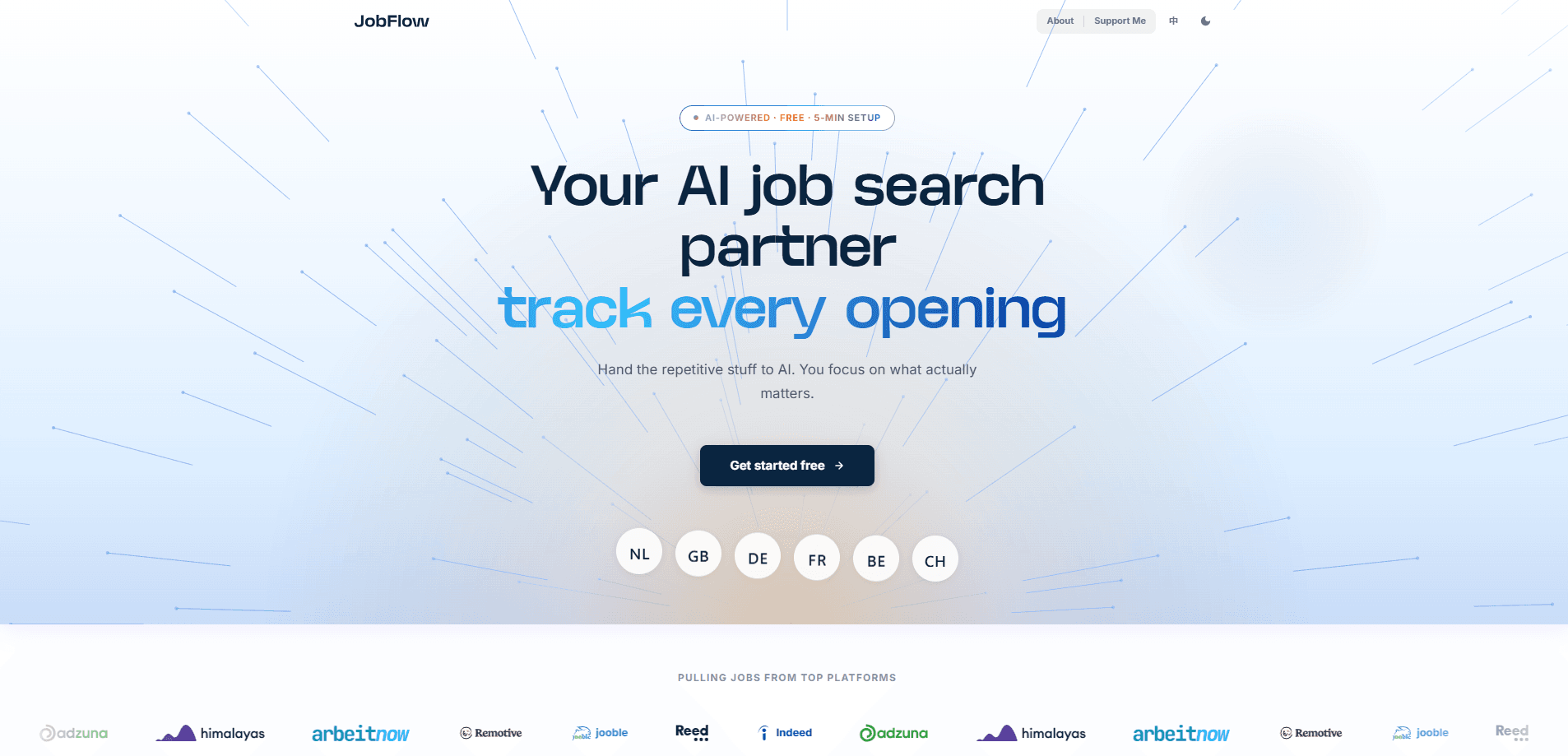
About JobFlow
What Is JobFlow
JobFlow is two things under one name. The first is an AI-powered job search platform that cuts application busywork by rewriting your resume for each role and handling the repetitive parts of applying. The second is an open-source workflow automation library, which means developers can inspect, run, and adapt the automation steps themselves instead of treating the platform as a black box. Both halves feed each other, and neither one is much use without the other when you're applying to a large number of roles in a short window of time.
The product is aimed at job seekers who send out many applications and feel the drag of doing the same chores repeatedly: matching keywords, adjusting summaries, and tracking where each version went. JobFlow's pitch is straightforward. Let the AI draft the repetitive material, and keep your attention on the roles that actually matter.
The biggest limitation is that the library route asks a bit of you. Running an open-source workflow means installing dependencies and keeping things up to date, which isn't for everyone. If you want a purely click-and-go experience, the automation side may feel heavier than a hosted-only tool. The flip side is control and transparency, and for technical users that trade-off often pays off. Anyone who has tried to wire up a local pipeline knows the setup cost is real and that it rarely stops at one afternoon.
Getting Started
- Create an account on the JobFlow website and sign in.
- Add your base profile: work history, skills, and the resume you want the AI to work from.
- Paste a job description or link so JobFlow can match your profile to the role.
- Review the tailored resume and cover materials it drafts, then edit anything that doesn't sound like you.
- Apply, and keep tracking each version inside the platform.
Product Information
A quick look at JobFlow's pricing, supported platforms, and performance.
Best for
The users, tasks, and scenarios where this tool fits best.
Users
- Active job seekers
- Career switchers
- Developers
Tasks
- Tailoring a resume to a specific job posting
- Automating repetitive application chores
- Tracking multiple applications
Scenarios
- A week of heavy applying
- Preparing a targeted application
- Building a custom job search workflow
Key features
AI Resume Tailoring
JobFlow rewrites your resume against a specific job description, adjusting summaries and pulling forward the experience a listing cares about. The goal is a version that reads as written for that role, not a generic one sent everywhere. Every listing is different. So every draft should be too. You still review each draft, since the tool works from what you give it and won't invent history.
Job Application Automation
The platform automates much of the repetitive work that surrounds applying: adapting materials and managing the steps that repeat across listings. That automation is the core of the open-source workflow library, which bundles the steps into something you can run and modify. For a heavy search, that's the difference between ten careful applications and two. It matters most when the listings keep coming and your patience doesn't.
Open-Source Workflow Library
The workflow automation library is open source, so you can read exactly what each step does and change it. Developers can extend the steps, swap in their own logic, or wire them into a local pipeline. No hidden black box. That transparency is the main thing that sets JobFlow apart from closed job-search tools, and it's why technical users tend to trust it more than a hosted-only alternative that hides its inner workings entirely. If you want to see exactly how an application gets assembled step by step, this is the part that lets you do it.
Profile-Based Matching
JobFlow builds a reusable profile from your history and skills, then matches it to each role you bring it. Because the profile is set once, you're not re-explaining your background for every listing. Better input means sharper matching, so filling it out properly pays off quickly, and the effort you spend upfront on a thorough profile tends to come back in the form of tighter, more relevant matches on every later application.
Application Tracking
Each tailored version and its status live in one place, so you can see what went where without hunting through email. That record matters once you're running several threads at once, when a missed follow-up is easy to lose. Keeping every version and its status in a single view means you always know which applications are still waiting on a reply and which ones you've already chased.
Pros and cons
Pros
- Tailors resumes to each listing, which cuts the time spent editing by hand.
- Automates repetitive application steps through a workflow you can reuse.
- Open-source library means the automation is inspectable and modifiable, not a black box.
- Reusable profile avoids re-entering the same background for every role.
- Keeps applications and their versions organized in one spot.
Cons
- The open-source workflow side needs setup and maintenance, so non-technical users may find it heavy.
- Resume drafts depend on the details you provide, meaning weak input produces weak output.
- Being an early tool, you won't find the deep third-party integrations that mature platforms carry.
Frequently asked questions
JobFlow reduces the work behind job applications. It tailors resumes to specific listings and automates repetitive application tasks, while an open-source workflow library lets developers run and modify those steps themselves. Think of it as a resume optimization tool plus a small automation engine in one package. You bring a listing, it brings a tailored draft, and the two meet somewhere in the middle after you've made it sound like you.
Related content
Explore related tools, skills, and articles for JobFlow.
JobFlow Alternatives
Forefront
Forefront · CodingForefront is a web platform for building with open-source AI. It lets you fine-tune leading open-source language models on your own data, evaluate how they perform, and run them through an API or export them to host yourself. Developers who want the convenience of a closed-source platform but insist on owning their models and data are the target audience here.

Startkit
StartKit.AI · CodingStartkit is a boilerplate for building AI SaaS and AI wrapper products. Think of it as an AI startup boilerplate with the boring parts already wired up: authentication, Stripe and Lemon Squeezy payments, usage limits, transactional email, and an AI API starter that talks to OpenAI, Anthropic, Groq, or Llama. You clone the repo, set your price, and start on the part of your product that people actually pay for. It's Next.js under React and Tailwind, so most of the boilerplate code already feels familiar.
Testim
Tricentis · CodingTestim is an AI-powered test automation platform for building and running end-to-end tests across web, mobile, and Salesforce applications. It leans on machine learning to keep tests stable when an interface changes, so teams spend less time fixing broken selectors. Not bad for an automated testing tool you can start using today. You create tests by recording actions in a browser, then optionally add JavaScript when you need more control. It's a solid pick for busy QA teams.