

LaReview
Puemos · Coding
LaReview is a local-first AI code review workbench that turns a diff or a pull request into a structured review plan instead of a pile of automated comments. It pairs with the AI coding agent you already use, like Claude Code or Codex, and runs on your machine so your source code never leaves your laptop. If your team reviews large pull requests by hand and keeps drowning in noisy bot feedback, this tool is built for exactly that problem.
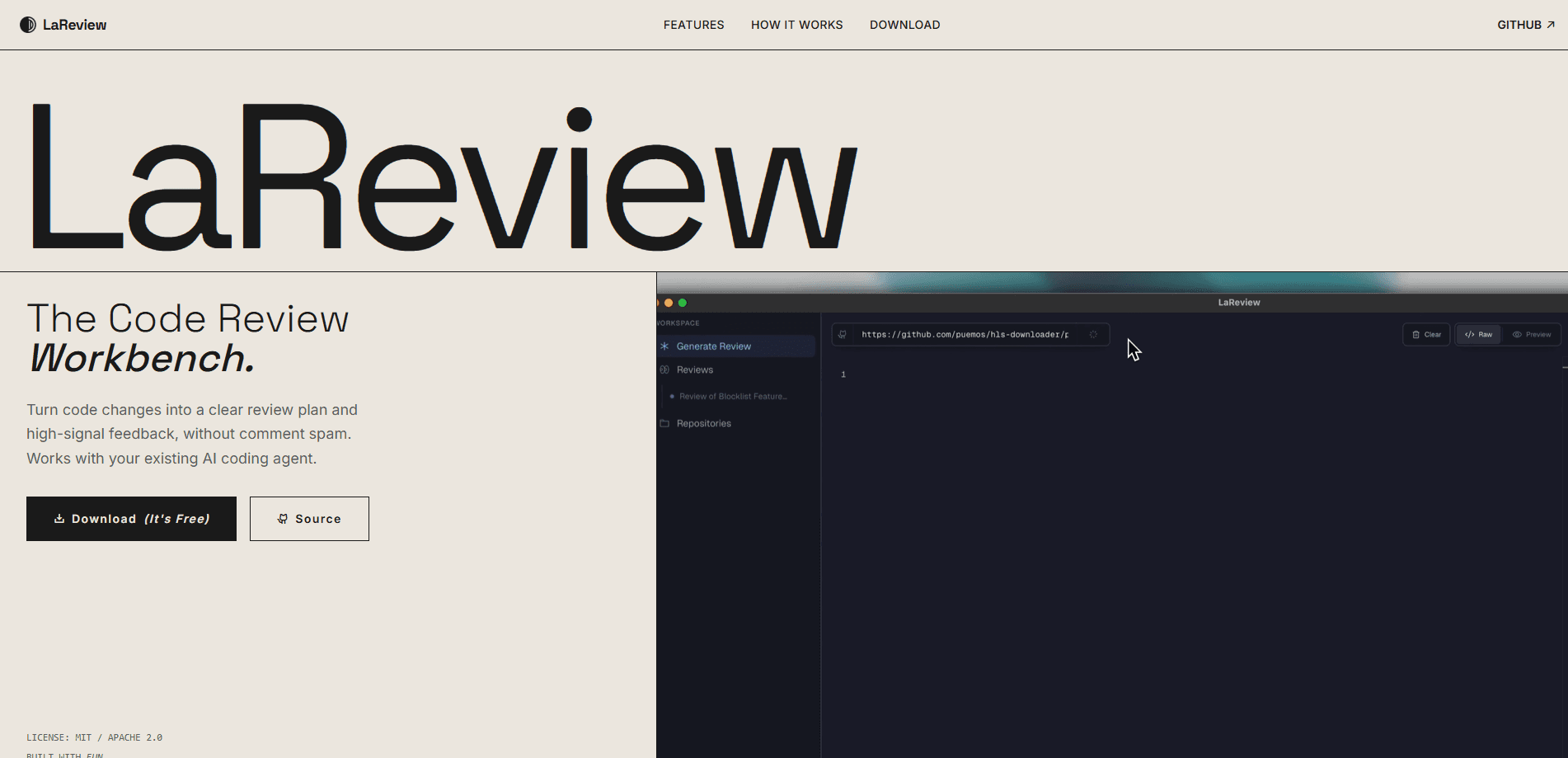
About LaReview
What Is LaReview
LaReview is an open source code review tool for developers who want to understand a change before commenting on it. Most AI review products act as bots. They drop comments onto a pull request and hope something sticks. Sound familiar?
LaReview takes the opposite approach. It reads the change, looks for the flows and hazards a senior engineer would flag, and hands you a review plan you can actually work through.
GitHub code review usually means reading files one at a time. LaReview asks a better question first. What did this change actually do?
It runs locally. The tool fetches pull request data through your own GitHub or GitLab CLI, then your chosen AI agent analyzes it on your machine. Nothing gets uploaded to a third-party server. That matters if you work on private code and can't send it to a cloud service.
The catch is that LaReview isn't a hands-off service. You bring your own AI agent and your own API access, so setup takes a bit more work than signing into a hosted product. It's a workbench, not a push-button bot, and it expects you to review, not just click approve.
Getting Started
- Install LaReview from the official site, either with Homebrew (
brew install --cask puemos/tap/lareview) or by downloading a binary for your platform. - Make sure the GitHub CLI (
gh) or GitLab CLI (glab) is installed and authenticated, since LaReview uses them to fetch pull request data locally. - Point LaReview at your AI coding agent of choice, such as Claude Code, Codex, Gemini, or OpenCode, using the
--agentflag. - Load a review by pasting a PR URL (
lareview pr owner/repo#123) or by piping a diff (git diff | lareview). - Work through the generated plan, add notes, mark items as ignored, and push your feedback back to GitHub or GitLab with an auto-generated summary.
Product Information
A quick look at LaReview's pricing, supported platforms, and performance.
Best for
The users, tasks, and scenarios where this tool fits best.
Users
- Senior engineers and tech leads who review large pull requests and need to understand system impact before approving, provided they're comfortable installing a CLI tool.
- Small teams on private codebases that can't send source to a hosted AI service and want review help that stays on local machines.
- Developers already paying for an AI coding agent like Claude Code or Codex who want to get more review value out of a subscription they already have.
Tasks
- Turning a messy diff into a grouped, risk-ordered list of review tasks instead of reading files one by one.
- Catching hazards such as missing database timeouts or undocumented API changes using custom rules.
- Writing focused review feedback that's anchored to specific lines, rather than generating comment spam.
- Generating architecture diagrams so you can see how a change alters data flow before reading any code.
Scenarios
- A release-week PR with dozens of changed files where you need to know what actually matters.
- Onboarding a contributor's first large pull request when you don't yet know the codebase well.
- A security-sensitive repository where uploading code to a cloud reviewer isn't an option.
Key features
Plan First, Comment Later
Instead of dumping comments, LaReview reads the change and builds a structured review plan. It groups work by flow and orders tasks by risk, so you start with the part most likely to break something. You track progress and move through the change with a files heatmap that shows where the action is.
Local-First Privacy
Everything runs on your machine. LaReview pulls PR data through your own gh or glab CLI and lets your AI agent search a linked local Git repo without uploading anything. That means no source code sits on someone else's server, which is the whole point for teams that can't use cloud tools.
Bring Your Own AI Agent
LaReview doesn't lock you into one model or vendor. It works with the agent you already run, including Claude Code, Codex, Gemini, Kimi, Mistral, OpenCode, and Qwen. You pick the brain; LaReview handles the workflow around it. No lock-in. No new bill.
Custom Review Rules
You define rules in plain language, like "DB queries must have timeouts," and the AI checks the change against them. This turns your team's hard-won standards into automated checks that run on every review instead of living in a wiki nobody reads.
Visual Flow Diagrams
LaReview generates diagrams of the change automatically, so you can see architectural shifts before you read a single line. For a reviewer trying to judge system impact, a picture of the new data flow beats scrolling through a hundred-line diff.
Learning from Rejected Feedback
When you mark a suggestion as "ignored," LaReview records it. Over time it analyzes those rejections to find patterns and calibrate future reviews, which means fewer nitpicks and more comments you actually keep. Better signal. Less noise.
Git Host Sync and CLI Workflow
Once your review is done, you push it straight to a GitHub or GitLab PR with an auto-generated summary. The whole thing runs from the terminal, so you can pipe a diff or load a PR without leaving your editor or shell.
Pros and cons
Pros
- Keeps your source code local, so private repos don't have to touch a cloud service.
- Turns a raw diff into a risk-ordered plan, which saves real time on large pull requests.
- Works with whatever AI agent you already pay for instead of forcing a new subscription.
- Custom rules let you enforce team standards automatically.
- Free and open source under permissive licenses, with no vendor lock-in.
Cons
- Setup is more involved than a hosted product, since you install a CLI and configure your own AI agent.
- There's no official API documented, so it won't slot into a custom CI pipeline without extra work.
- It leans on your existing AI agent and API access, so the quality of the review depends on what you bring.
- It fits individual and small-team workflows best; larger orgs may want deeper access controls.
Frequently asked questions
LaReview is a code review workbench. Developers feed it a diff or a pull request, and it builds a structured review plan with risk-ordered tasks, visual diagrams, and focused feedback. The goal is understanding a change, not generating more comments.
Related content
Explore related tools, skills, and articles for LaReview.
LaReview Alternatives
Forefront
Forefront · CodingForefront is a web platform for building with open-source AI. It lets you fine-tune leading open-source language models on your own data, evaluate how they perform, and run them through an API or export them to host yourself. Developers who want the convenience of a closed-source platform but insist on owning their models and data are the target audience here.

Startkit
StartKit.AI · CodingStartkit is a boilerplate for building AI SaaS and AI wrapper products. Think of it as an AI startup boilerplate with the boring parts already wired up: authentication, Stripe and Lemon Squeezy payments, usage limits, transactional email, and an AI API starter that talks to OpenAI, Anthropic, Groq, or Llama. You clone the repo, set your price, and start on the part of your product that people actually pay for. It's Next.js under React and Tailwind, so most of the boilerplate code already feels familiar.
Testim
Tricentis · CodingTestim is an AI-powered test automation platform for building and running end-to-end tests across web, mobile, and Salesforce applications. It leans on machine learning to keep tests stable when an interface changes, so teams spend less time fixing broken selectors. Not bad for an automated testing tool you can start using today. You create tests by recording actions in a browser, then optionally add JavaScript when you need more control. It's a solid pick for busy QA teams.