

LingoBuddy
LingoBuddy · Chatbot
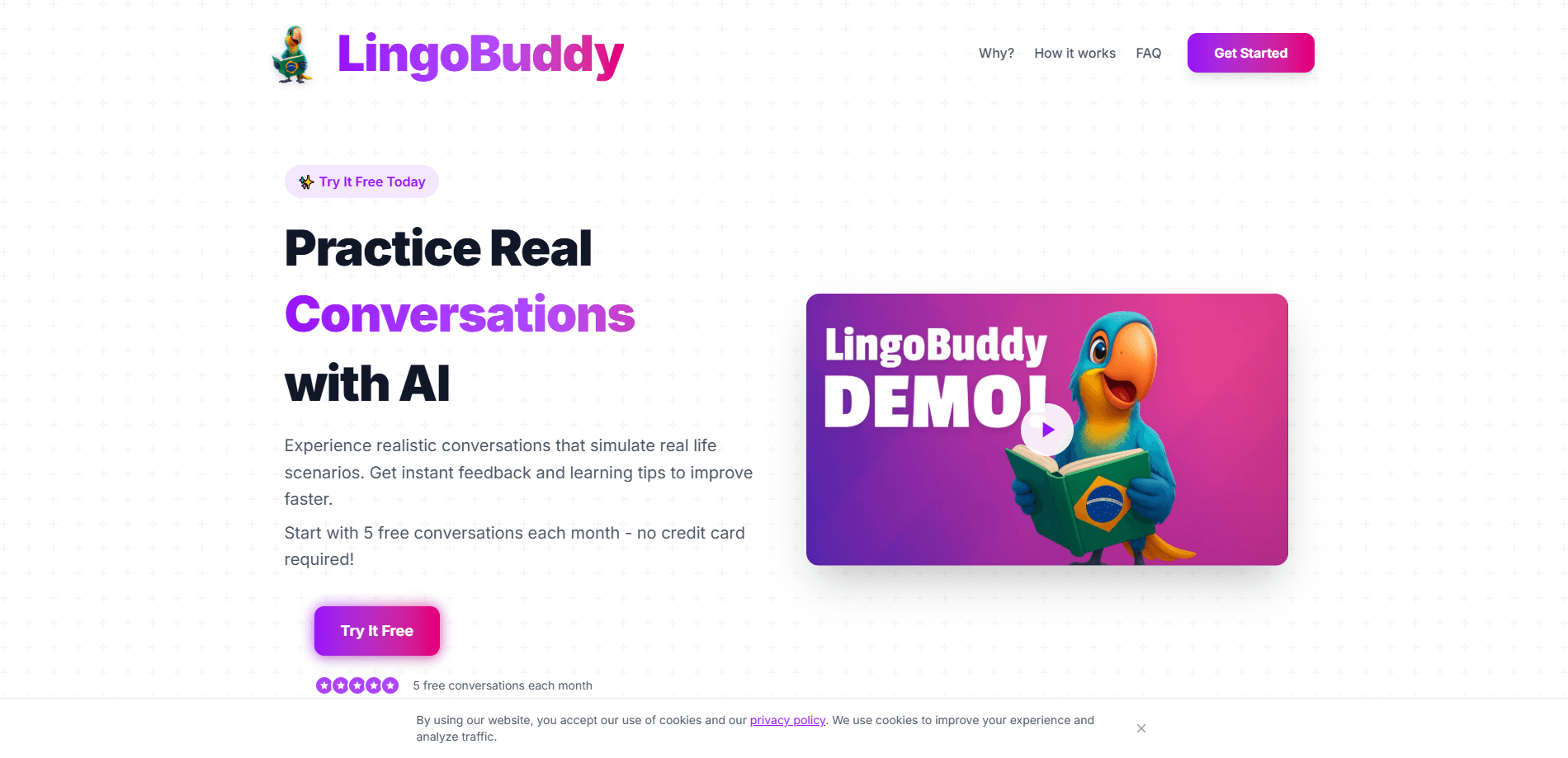
LingoBuddy is an AI voice tutor that calls you daily in 15 languages, remembers your mistakes, and saves new words for review so speaking practice actually sticks.
About LingoBuddy
What Is LingoBuddy
LingoBuddy is a language learning app built around voice calls instead of lessons. You press one button, and an AI tutor starts an AI conversation practice session in the language you're learning. It adjusts to your level, drives toward real sentences, and pushes you to keep talking rather than type. The pitch is simple: learn languages by speaking, from the first call.
The product targets one specific gap: most apps train you to read and tap, then leave you unable to hold a conversation. LingoBuddy only works by voice, so every session is speaking practice by default. It ships in 15 languages with 4 native-language interfaces, and the company reports 800+ learners so far.
The biggest limit is scope. LingoBuddy is iOS-only right now and built for speaking fluency, so it doesn't teach reading, writing, or exam grammar in depth. You also need a quiet place to talk, since the whole method runs on spoken input.
Getting Started
- Download LingoBuddy on iOS and create an account in about two minutes.
- Tell the tutor your name, your current level, and a couple of interests so it can shape the calls.
- Tap to call Lingo and start speaking. Talk for as long as you want in your target language.
- Review the debrief after each call to see corrections, wins, and the new words you used.
- Between calls, revisit saved words in Practice and let the app bring them back in the next conversation.
Product Information
A quick look at LingoBuddy's pricing, supported platforms, and performance.
Best for
The users, tasks, and scenarios where this tool fits best.
Users
- Beginner speakers who freeze the moment they have to talk
- Intermediate learners stuck at "I understand but can't reply"
- Busy self-learners with short windows of time
Tasks
- Practicing spoken conversation on a set topic
- Fixing repeated grammar slips
- Building active vocabulary
- Maintaining a daily study habit
Scenarios
- Prepping for a trip or a move abroad
- Keeping a second language warm when you have no one to speak with
- Rebuilding speaking confidence after a long break
Key features
Daily Voice Calls With an AI Tutor
The core of LingoBuddy is a spoken call with an AI tutor that speaks your target language and expects you to answer. It knows your level, keeps the conversation moving, and nudges you toward full responses rather than one-word replies. You can talk for as long as you want, up to your plan's monthly minutes.
A Post-Call Debrief
After each call, LingoBuddy hands you a short review: what you got right, what went wrong, and how many new words you used. Corrections show your original sentence next to a better version, plus a plain-language note on the grammar behind the change. That turns a casual chat into a feedback loop you can act on.
Memory That Carries Forward
Every call feeds the tutor's memory. It recalls your past conversations, your wins, your recurring mistakes, and the topics you covered, so the next call picks up where the last one ended. Over time it builds a picture of your life, work, and goals, which makes the practice feel less like starting over each time.
Vocabulary Kept With Smart Review
New words you manage to use in a call land in a personal collection, each saved with the sentence you said. The app brings a word back into conversation right around the point you'd normally forget it, using the spaced repetition vocabulary logic behind the best memory apps. It also notices when you review words between calls and works them into the next session.
15 Languages and 4 Native Interfaces
LingoBuddy supports 15 target languages for practice and 4 interface languages for navigation, so you can learn one language while the app speaks to you in another. This matters for learners who want to study a language without first switching their whole phone to it.
Level Tracking That Adjusts
The tutor tracks how you're doing and adjusts the difficulty as you improve, rather than locking you into a fixed track. Your level, your saved words, and your correction history all move together, so each call is pitched a little closer to where you actually are.
Pros and cons
Pros
- Runs entirely on spoken conversation, so every session is real speaking practice.
- Remembers your mistakes and past topics, giving the next call continuity most apps lack.
- Saves new words with your own sentences and reviews them at spaced intervals.
- Supports 15 learning languages with 4 native interfaces.
- Free tier gives 15 minutes per month, enough to test whether the method clicks.
Cons
- iOS-only for now, so Android users can't use it at all.
- Focused on speaking, so it under-serves reading, writing, and exam-specific grammar.
- Paid tiers cap monthly minutes, so heavy users hit the ceiling and need to upgrade.
- Requires a quiet spot and spoken input, which rules out silent or public settings.
Frequently asked questions
LingoBuddy is used for spoken language practice. It puts you in a daily voice call with an AI tutor so you can build conversation fluency in one of 15 languages instead of only reading or tapping through lessons.
Related content
Explore related tools, skills, and articles for LingoBuddy.
LingoBuddy Alternatives

Knocket
Knocket (Tencent RTC team) · Productivity · Business · ChatbotKnocket is a free live chat and contact page tool that lets visitors message you from your website, app, or a shareable link, with every reply handled from Telegram or one inbox.
Agibot
Agibot · Productivity · AI Assistant · ChatbotAgibot is a personal AI agent for Mac that keeps running after you close the window, runs routines on a schedule, and works from Telegram or Slack with your own API keys.

Melete
Melete · Productivity · AI Assistant · ChatbotMelete is an AI workspace for teams where agents research, draft, and act in Slack, Notion, Linear, and GitHub. Shared memory and approval gates keep people in control.