

LlamaIndex
LlamaIndex, Inc. · Marketing · Other
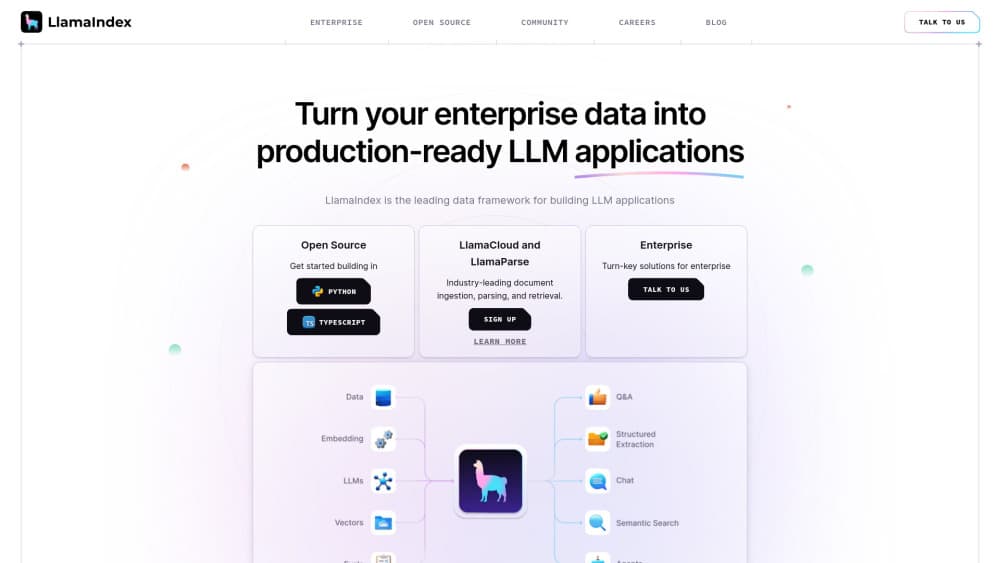
LlamaIndex is an open source data framework for RAG apps and AI agents. You load private files, index them, and hand clean context to any LLM you already pay for.
About LlamaIndex
What Is LlamaIndex
LlamaIndex is a code library that sits between your own documents and a language model. The project shipped in late 2022 as GPT Index, took its current name in 2023, and runs as LlamaIndex, Inc. out of San Francisco. The code is MIT licensed, so you can read it, fork it, and ship it inside a commercial product without asking anyone.
The problem it solves is boring and constant. A model knows the public web, not your contracts, support tickets, or lab notebooks. LlamaIndex gives you the plumbing to load those files, cut them into nodes, store them in a vector index or a keyword index, and pull the right handful back when a question arrives. That pattern is RAG, and this library is one of the two names most teams compare when they start.
The company also sells LlamaParse and LlamaCloud, a hosted service for document parsing, extraction, and indexing. That split matters. The framework itself costs nothing. The parts that turn a messy scanned PDF into usable text are commercial, metered in credits, and closed source.
The main limit is that it's a developer tool. There is no drag and drop canvas for the open source side. You write Python or TypeScript, you wire your own keys, and you debug your own retrieval when answers come back wrong.
Getting Started
- Install the core package with
pip install llama-index-core, then add the provider package for your model, such asllama-index-llms-openai. - Set your API key as an environment variable, or point Settings.llm at a local model if you run one.
- Load files with SimpleDirectoryReader or a LlamaHub connector for Notion, Slack, S3, or a database.
- Build a storage index, usually a vector index, and persist it so you don't re-embed everything on every run.
- Wrap the query engine in a Workflow once you need branches, retries, or a second agent, then deploy it as a service.
Product Information
A quick look at LlamaIndex's pricing, supported platforms, and performance.
Best for
The users, tasks, and scenarios where this tool fits best.
Users
- Python developers building a first RAG app
- AI engineers who own a document search product
- Data teams buried in scanned paperwork
Tasks
- Answering questions over internal documents
- Parsing invoices, contracts, and reports
- Building multi step AI agents
- Testing retrieval strategies
Scenarios
- A knowledge base pilot inside a company
- Literature and patent review
- An early stage product with no infrastructure budget
Key features
Connectors for Real Data Sources
LlamaHub holds hundreds of loaders and packs for file shares, Notion, Slack, Google Drive, SQL databases, and web crawls. Each loader returns the same Document object with metadata attached, so filtering by date or author works the same way no matter where the text came from. That uniformity saves you from writing a separate adapter for every source.
Multiple Index Types and Hybrid Retrieval
You aren't locked into one retrieval shape. A vector index handles semantic matches, a keyword table index catches exact names and codes, and summary indexes answer questions that need a whole document rather than a paragraph. Combine them with a router or a retriever that merges both result sets, then add a reranker on top. Most teams land on hybrid retrieval after their first round of bad answers.
Agentic Workflows
Workflows are the part that replaced the old chain style pipelines. Steps subscribe to events, pass typed results along, and can loop, branch, or wait for a person to approve a step. Because it's plain async Python, you can stream partial output to a user and keep the rest running. You can also deploy a workflow as a microservice when it leaves the notebook.
Document Parsing with LlamaParse
LlamaParse is built for the files that break normal loaders: scanned pages, dense tables, charts, and handwriting. It outputs Markdown, plain text, per page JSON, or XLSX, and claims support for more than 130 file types and 80 languages. You pick a parsing mode per job, so a clean digital PDF can run on the cheap setting while a bad scan gets the slower agentic one.
LlamaCloud Platform
LlamaCloud wraps parsing, extraction, classification, splitting, and indexing behind one account and one API key. The web console lets you test a file, save a parse config, and then call the same config from code. Credits cover every action, and cached re-parses cost nothing, which helps when you iterate on a prompt or a schema.
Evaluation and Tracing Hooks
The library ships modules for scoring faithfulness and answer relevance against your own test questions, and it plugs into tracing tools such as Arize Phoenix and LangSmith. That gives you a number to argue with when someone asks whether a prompt change made the product better. Without that loop, retrieval tuning turns into guessing.
Pros and cons
Pros
- Retrieval is the center of the design, so a working RAG pipeline takes far less glue code than a general purpose agent framework.
- The core is MIT licensed with no seat fees, and nothing stops you from self hosting the whole stack.
- Model and vector store providers are swappable, which keeps you from being pinned to one vendor's pricing.
- LlamaParse reads tables, charts, and scans that simple PDF text extraction turns into garbage.
- Workflows give you branching, retries, and human review without leaving the library.
Cons
- Everything is code. Teams that expected a visual builder will need a developer on the project from day one.
- Releases move fast and APIs get renamed, so tutorials from a year ago often fail on import errors.
- LlamaCloud is metered in credits, and 1,000 credits equals $1.25, which makes monthly cost hard to predict before you test real files.
- The best document parsing is the paid, closed part, so a fully open source deployment has weaker PDF handling.
Frequently asked questions
The framework is free and MIT licensed, including Workflows and the LlamaHub integrations. You still pay your model provider for tokens, and LlamaCloud or LlamaParse usage is billed separately.
Related content
Explore related tools, skills, and articles for LlamaIndex.
LlamaIndex Alternatives

Tractionwave
TractionWave · Image · MarketingTractionWave is an AI attention heatmap tool for static ads. Upload a PNG or JPG and it returns predicted attention, ranked hotspots, and fixes before you spend budget.

OpenSEO - AI Visibility
EveryApp · Coding · Marketing · BusinessOpenSEO is an open source SEO platform for keyword research, backlinks, rank tracking, site audits, and AI visibility, with usage-based pricing and MCP access for AI agents.

Plugins Radar
Plugins Radar · Marketing · BusinessPlugins Radar tracks where your ChatGPT plugin ranks in directory and in-chat search, which competitors outrank it and what changed, with hourly checks on 9,885 listings.