
Speak Languages with AI
The Auspicious Company · Chatbot
Llanai is an AI language learning journal for Japanese. You write a diary entry, and it marks every mistake with an explanation. Five entries are free, then $10 a month.
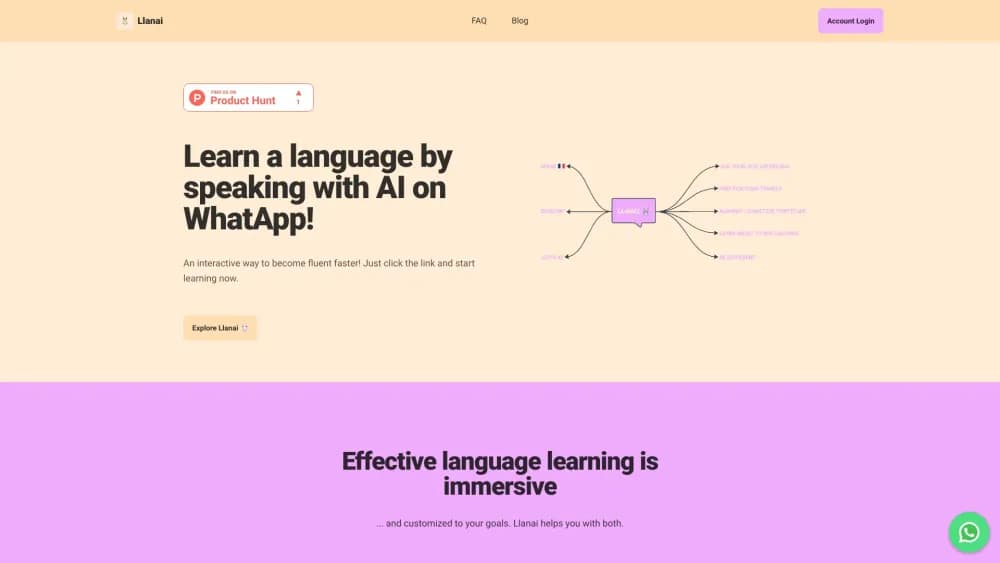
About Speak Languages with AI
What Is Llanai
Llanai is an AI language learning app with a narrow, useful focus: it corrects the Japanese you write. You keep a daily entry in Japanese, and every sentence comes back with mistakes marked at the exact spot, the corrected form, the error type, and a short reason. It's a Japanese journal app rather than a course, so your Japanese writing practice uses your own life instead of a scripted lesson.
The product started in 2024 as a WhatsApp chatbot for spoken practice in Spanish, English, French and German, then Greek. That version is gone. WhatsApp support was retired at the end of 2025, and Llanai now runs as a browser based writing journal for Japanese learners. If you came looking for an AI language tutor that calls your phone, this isn't it anymore.
Two limits matter before you sign up. The curriculum stops at JLPT N5: there are free N5 grammar and vocabulary guides, and nothing for N4 to N1. And the corrections come from an AI model, which the company says can be wrong. The mark shows its reasoning so you can check it, but a dictionary or a teacher still settles the hard cases.
Getting Started
- Sign in at llanai.com with a Google account or an email magic link. No app install is needed.
- Write an entry in Japanese, up to 5,000 characters. A short paragraph about your day is enough to start.
- Open the marks. Each one shows the original wording, the suggested replacement, the error type and the reason behind it.
- Fix what you agree with. The entry stays yours, so you can keep a phrasing the AI flagged if you meant it.
- Return the next day. Every entry is queued for review, which turns one correction into a second pass over the same sentences.
Product Information
A quick look at Speak Languages with AI's pricing, supported platforms, and performance.
Best for
The users, tasks, and scenarios where this tool fits best.
Users
- Intermediate learners stuck between textbook knowledge and real output
- Self-taught learners without a teacher
- People living in Japan who write daily
- JLPT N5 candidates
Tasks
- Keeping a Japanese diary
- Turning N5 grammar into active use
- Checking particle choice
- Preparing sentences for a class or a language exchange
Scenarios
- Building a ten minute daily habit
- Documenting a stay in Japan
- Testing whether AI feedback suits you
Key features
Sentence Level Correction Marks
Llanai doesn't return a rewritten paragraph and leave you to spot the differences. Each mistake is marked in place, so you see the word that was wrong and the word that should replace it. The sample on the site shows a particle swap, を for に, with the rest of the sentence left alone. That makes the correction readable in seconds, which matters when you're writing every day.
A Reason Behind Every Mark
Every mark carries a label and an explanation. A particle error gets a note about why the verb can't take that particle. A grammar slip gets a comparison between the form you used and the one you meant, such as ことになる against ようになる. This is the part that separates it from a spell checker: you get the rule, not just the fix, so the same error is less likely to come back.
Next Day Review
Each entry goes back into a queue and returns the following day for another look. The idea is simple. Writing once tests recall, and revisiting the same sentences a day later tests whether the correction stuck. It's a light version of spaced review, built into the journal instead of bolted on as a separate flashcard deck.
Built Around JLPT N5
The journal and the free guides share one level: N5. The vocabulary list runs to 675 words, the grammar library covers 36 patterns, and there are 19 set phrases. The company is explicit that no N4 to N1 material exists yet, so the scope is honest rather than open ended. For a beginner, that's a clear path. For anyone past N5, it's a ceiling.
Free Grammar and Vocabulary Guides
The JLPT guides are readable without a subscription, and they're organized as one topic a day: verbs, adjectives, particles or a vocabulary set. Each guide points you back to writing, which is the step most free resources skip. You can learn Japanese online from these pages alone, then decide whether the paid journal adds enough on top.
One Plan, No Per Entry Fees
There's a single subscription at $10 a month, billed monthly and cancellable in account settings. You get corrections on every sentence, an explanation for each one, and the next day review. Entries can run to 5,000 characters, and a long entry costs the same as a short one. Five corrected entries come free before the card is required.
Runs in the Browser
There's no desktop download and no mobile app to keep updated. You sign in with Google or an email link and write in the browser, which means the same journal opens on a laptop in the evening and a phone on the train. For a tool you're meant to use daily, removing the install step removes the main reason a habit dies.
Pros and cons
Pros
- Each correction comes with the reason and the error type, so you learn the rule behind the fix.
- Five corrected entries are free and no card is needed, which is enough to judge the feedback quality.
- The price is flat at $10 a month with no per entry charge, even for entries up to 5,000 characters.
- The N5 grammar and vocabulary guides are free to read and cover 36 patterns, 675 words and 19 phrases.
- It runs in the browser with Google or email sign in, so there's nothing to install or update.
Cons
- It only handles Japanese now. The Spanish, French, German and English practice that ran on WhatsApp was retired at the end of 2025.
- It corrects writing only. Speaking and listening practice are out of scope, so it works alongside a tutor rather than replacing one.
- The curriculum ends at N5, with no N4 to N1 guides, which caps its use for anyone beyond beginner level.
- AI corrections can be wrong, and the explanation is sometimes the part that needs a second opinion from a dictionary or teacher.
Frequently asked questions
Llanai is an AI language learning journal for Japanese. You write a diary entry in Japanese, and the app marks each mistake, shows the corrected form, labels the error type and explains the reason. Entries come back the next day for review.
Related content
Explore related tools, skills, and articles for Speak Languages with AI.
Speak Languages with AI Alternatives

Knocket
Knocket (Tencent RTC team) · Productivity · Business · ChatbotKnocket is a free live chat and contact page tool that lets visitors message you from your website, app, or a shareable link, with every reply handled from Telegram or one inbox.
Agibot
Agibot · Productivity · AI Assistant · ChatbotAgibot is a personal AI agent for Mac that keeps running after you close the window, runs routines on a schedule, and works from Telegram or Slack with your own API keys.

Melete
Melete · Productivity · AI Assistant · ChatbotMelete is an AI workspace for teams where agents research, draft, and act in Slack, Notion, Linear, and GitHub. Shared memory and approval gates keep people in control.